
What Thai law says about a noisy neighbour
Noise that causes disturbance qualifies as a nuisance under Sections 25 and 26 of the Public Health Act B.E. 2535, which empower the local officer to order it stopped or remedied. Two provisions of the Criminal Code sit on top of that.
| Law | Conduct | Penalty |
|---|---|---|
| Criminal Code Section 370 | Making noise or a din without reasonable cause, alarming or disturbing the public | Fine up to THB 1,000 |
| Criminal Code Section 397 | Causing disturbance or annoyance to another | Fine up to THB 5,000; if committed in public, imprisonment up to 1 month, a fine up to THB 10,000, or both |
| Public Health Act B.E. 2535, Sections 25 and 26 | Noise amounting to a nuisance | The local officer may order it stopped or remedied, with penalties for ignoring the order |
What that table quietly says is that the law exists and has teeth, but the process takes time, and a four-figure fine does not stop somebody who is being deliberately difficult.
So the most valuable part of this article is at the end: how to test for noise before you sign. Once you have moved in, every route available is slow and only partly effective.
Is there actually a curfew on noise
People expect a clean answer such as "no noise after 10pm". The reality is more granular.
There is a clear time limit for construction: no construction producing noise or light between 22:00 and 06:00.
For ordinary residential noise, the law does not decide primarily by the clock. It decides whether the noise amounts to a disturbance, judged on loudness, frequency, duration and the time it occurs, taken together.
In practice, the same noise that is tolerable at two in the afternoon can be a nuisance at two in the morning, and three minutes of it is a different thing from three hours.
The numbers the law actually uses
| Standard | Limit |
|---|---|
| 24-hour average sound level | Not exceeding 70 dB(A) |
| Peak sound level | Not exceeding 115 dB(A) |
| Disturbing noise between 22:00 and 06:00 | Not more than 10 dB(A) above the background level |
| Construction, measured at 30 metres | Not exceeding 75 dB(A) |
The third row is the most useful one in a condominium, because it does not measure how loud the noise is. It measures how much louder it is than that place's normal quiet. A unit on a main road and a unit deep in a soi therefore have different thresholds.
Note that a measurement relied on legally must be taken by an official with calibrated equipment. A phone sound-meter app is usable as a record of what happened when you complain, but it is not the figure that decides anything.
The complaint sequence that works
The order matters more than people expect. Skipping straight to the police usually ends in a warning and then silence, while following the sequence builds a layer of evidence for the next step.
- Speak to the other party first. Many genuinely do not know how far the sound carries, particularly bass and impact noise through the floor.
- Notify the juristic person or building management in writing, and ask for a receipt number.
- Notify the district or municipal office, which is the local officer empowered to order a nuisance stopped under the Public Health Act.
- Pollution Control Department hotline 1650 for noise pollution matters.
- The Traffy Fondue app, which records the report with location and timestamp automatically.
- Police on 191 for an incident happening right now, at night.
Step 5 is more useful than most people realise, because the system supplies the time and the location itself, which are the two things noise evidence usually lacks.
What the juristic person can and cannot do
It can issue warnings under the building regulations, log the complaint formally, send staff up to inspect while the noise is happening, and put the matter to a general meeting if it recurs.
It cannot enter a unit without permission, cut off water or electricity as pressure, or force an owner to leave, because a unit is private property and the juristic person's authority runs to the common property and enforcement of the regulations.
Read the building's regulations before complaining. Many already set quiet hours and rules on use of units, and citing a rule that exists works faster than citing how you feel.
Where the noise comes from a tenant rather than the owner, ask the juristic person to contact the owner, since it is the owner who is bound by the regulations and who can terminate the lease.
How to gather evidence that holds up
Almost every noise dispute turns on evidence, not on who is suffering more.
- Record video with sound, with a clock or a screen showing the date and time in the same frame.
- Keep a log as a table: date, start time, end time, type of noise, effect.
- Document the pattern. One incident carries little weight; twenty in a month is a pattern.
- Keep a copy of every complaint, with the receipt numbers from the juristic person and the district office.
- Keep evidence of health effects, such as a medical certificate for chronic sleeplessness, which connects to the "harmful to health" limb of the nuisance definition.
- Do not retaliate with noise, which turns you into the second party causing a nuisance immediately.
Testing for noise before you sign
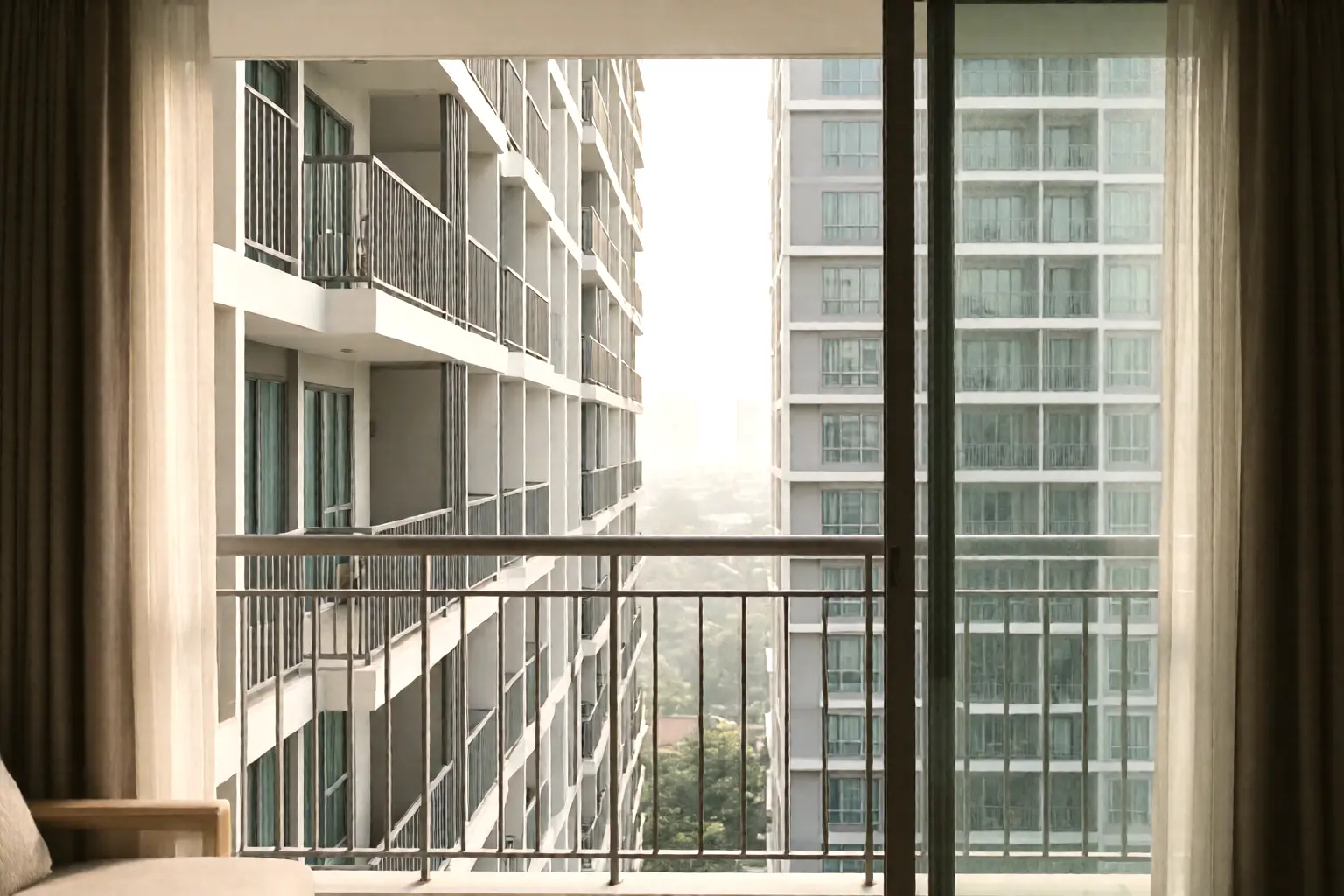
This is the part that saves the most time and money, because moving out of a noisy unit costs far more than spending another evening viewing it.
- View twice, at different times. Once on a weekday afternoon, once on a Friday evening or Saturday night, when neighbour noise peaks.
- Stand silently in the unit for two minutes. Air conditioning off, fans off, just listen. Those two minutes tell you more than ten questions.
- Knock on the wall shared with the next unit. A hollow note means a lightweight partition, which stops far less sound than blockwork.
- Check what the unit adjoins: the refuse room, plant rooms, lifts, fire stairs, and units directly above common facilities such as a gym or a pool all carry regular noise.
- Look up. Impact noise from the floor above is the hardest to fix and the least attenuated. If you can, ask whether the unit above is occupied and by what sort of household.
- Look out of the window for vacant land or a rising structure within sight, because that is construction noise two years from now.
- Ask the juristic person directly how many noise complaints there were in the past year. An evasive answer is also an answer.
Tenants should also write into the lease that where a nuisance is not resolved by the lessor within a set period, the tenant may terminate and recover the deposit. For what else a lease should contain, see what documents you need to rent in Thailand.
Noise from construction next door
This is different from neighbour noise, because the time and loudness thresholds are clearer.
Construction producing noise or light is prohibited between 22:00 and 06:00, and construction noise measured at 30 metres must not exceed 75 dB(A).
The most direct channel is the district office, which issues the construction permit and has the power to order work stopped. Report it with the project location and the times the noise occurs stated clearly.
Worth knowing: large projects requiring an environmental impact report usually have noise mitigation measures written into that report. Citing a measure the project itself committed to carries more weight than a general complaint.
If you are the noisy one
Worth reading too, because a great many people have no idea how far sound from their own unit travels.
- Bass from speakers travels through the structure much further than speech. Turning the overall volume down may not be enough; the bass has to come down too.
- Speakers against a wall or directly on the floor push vibration into the structure. Lifting them onto a rubber pad helps considerably.
- Dragging chairs and walking on your heels is impact noise, which the unit below hears most clearly. A rug and chair-leg pads fix it for a few hundred baht.
- Drilling and hammering should be done within the hours the building regulations set, and neighbours told in advance.
- Pets that vocalise while the owner is out are a common complaint the owner never knows about. For the related rules, see Bangkok's pet rules.
Frequently asked questions
Is a noisy neighbour breaking the law in Thailand
They can be. Noise causing disturbance is a nuisance under Sections 25 and 26 of the Public Health Act B.E. 2535, and may also breach Criminal Code Section 370, fine up to THB 1,000, and Section 397, fine up to THB 5,000.
After what time is noise prohibited
For construction, no work producing noise or light between 22:00 and 06:00. For ordinary residential noise there is no fixed hour; it is judged on whether the noise causes disturbance, from loudness, frequency, duration and the time it occurs.
How many decibels is too loud
The 24-hour average must not exceed 70 dB(A) and the peak must not exceed 115 dB(A). Between 22:00 and 06:00, disturbing noise must not be more than 10 dB(A) above the background level. Construction measured at 30 metres must not exceed 75 dB(A).
Where do I complain about noise
Start with the other party, then the juristic person or building management, then the district or municipal office as the local officer, the Pollution Control Department hotline 1650, the Traffy Fondue app, and 191 for an incident happening now at night.
Can the juristic person enter a noisy unit
Not without permission, because a unit is private property. It can issue warnings under the regulations, log complaints and send staff to inspect, but it cannot cut utilities as pressure or force an owner out.
Can a phone sound-meter app be used as evidence
It can support a complaint as a record of events, but it is not legally decisive, because a measurement relied on must be taken by an official with calibrated equipment.
How do I check for noise before buying or renting
View twice at different times, with one visit on a Friday evening or Saturday night. Stand silently in the unit for two minutes with the air conditioning and fans off, knock the shared wall to test whether it is a lightweight partition, check whether the unit adjoins lifts, refuse rooms or common facilities, and ask the juristic person how many noise complaints there were last year.
In short
The law on noise exists and has teeth, through nuisance under the Public Health Act and offences under Criminal Code Sections 370 and 397.
But what decides the outcome is evidence showing a repeated pattern rather than a single incident, and a complaint sequence that runs from the neighbour to the juristic person to the district office, each step producing the paperwork for the next.
The blunt conclusion: viewing a unit a second time on a Saturday night costs two hours. Moving out of a unit you cannot bear costs the rest of the lease plus the removal van. Pay the first one.
Looking for somewhere new? Browse houses and condominiums for rent or properties for sale. Owners who want an intermediary screening tenants can see our rental management service.