
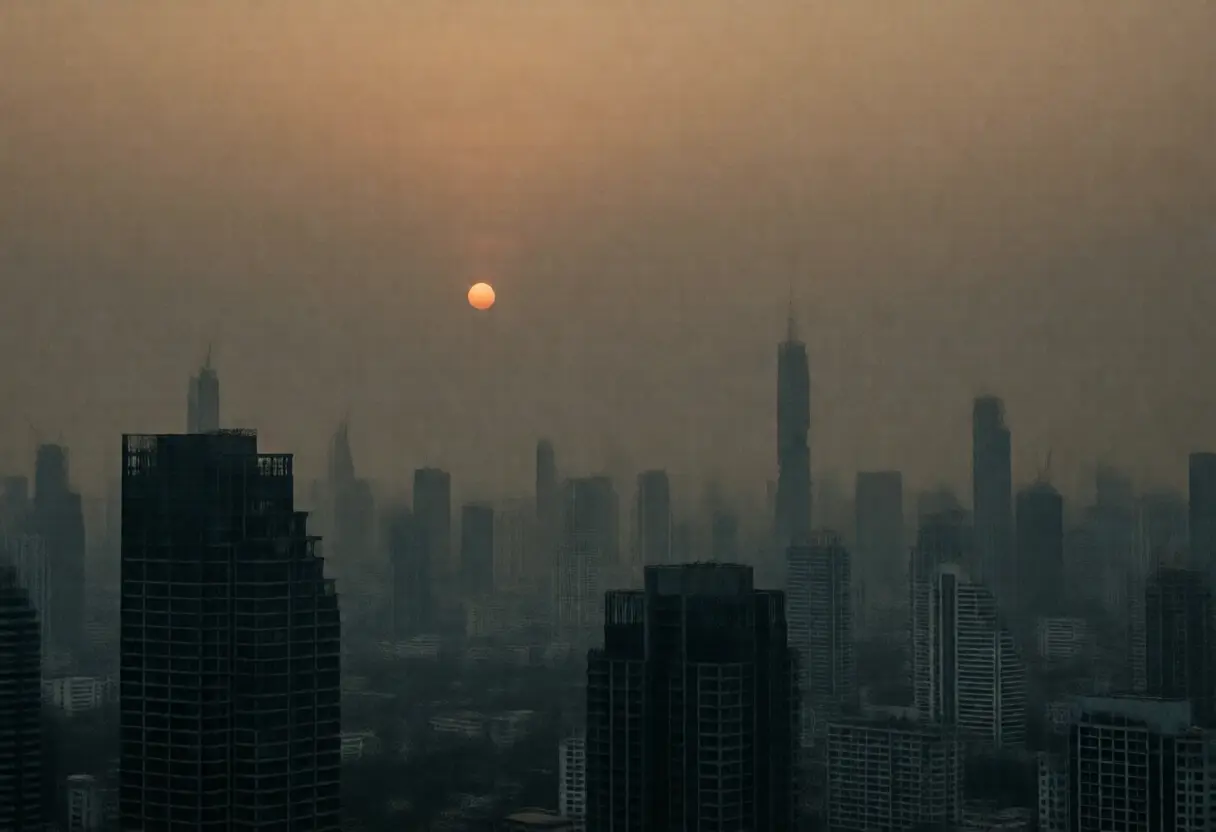
How high is dangerous?
Thailand's ambient standard for PM2.5 is 37.5 micrograms per cubic metre averaged over 24 hours, and 15 micrograms per cubic metre as an annual average. Both have been in force since 1 June 2023. Above those figures, the air is outside the standard.
The Pollution Control Department issued Thailand's Air Quality Index notification B.E. 2566, published in the Government Gazette on 3 July 2023. This is the table your app's colours are quoting.
| AQI | Colour | PM2.5 (µg/m³) | Meaning |
|---|---|---|---|
| 0 to 25 | Blue | 0 to 15 | Very good |
| 26 to 50 | Green | 15 to 25 | Good |
| 51 to 100 | Yellow | 25.1 to 37.5 | Moderate |
| 101 to 200 | Orange | 37.6 to 75 | Beginning to affect health |
| 201 and above | Red | 75.1 and above | Affecting health |
Notice how wide the orange band is. It runs from 37.6 all the way to 75, which means the actual concentration can nearly double while the colour on your screen does not change at all. A day at 40 and a day at 74 look identical on the app and are not remotely the same to breathe.
Why two apps show different numbers in the same spot
Because AQI is not a measurement. It is a number converted from the measurement, and every country converts it using its own set of breakpoints.
The table above is Thailand's. Many international apps use the United States breakpoints instead, which divide the scale quite differently. The result is that identical air, measuring exactly the same micrograms per cubic metre, produces one number on one app and a different number on another, sometimes in a different colour band.
The fix is simple. Stop comparing AQI numbers and compare micrograms per cubic metre instead. That figure is the actual measurement and it travels between apps unchanged. Any decent app shows it. If an app gives you only an AQI number and never the microgram figure, you are reading something you cannot compare to anything.
How far Thailand's standard sits from the WHO guideline
The World Health Organization revised its air quality guidelines in 2021, recommending no more than 15 micrograms per cubic metre over 24 hours and no more than 5 as an annual average.
| Averaging period | Thai standard | WHO guideline |
|---|---|---|
| 24 hours | 37.5 | 15 |
| Annual | 15 | 5 |
Read across and the practical consequence appears. On a day at 30 micrograms your app shows yellow and calls the air moderate, because it is inside the Thai standard. That same reading is double what the WHO recommends.
This does not make the Thai standard wrong. National standards are set against what is achievable in that country's circumstances as well as against health evidence. What it does mean is that within the standard and safe are two different statements, and if your household includes small children, older people or anyone asthmatic, treating 37.5 as the line where you start caring is leaving it late.
Is a higher floor really cleaner?
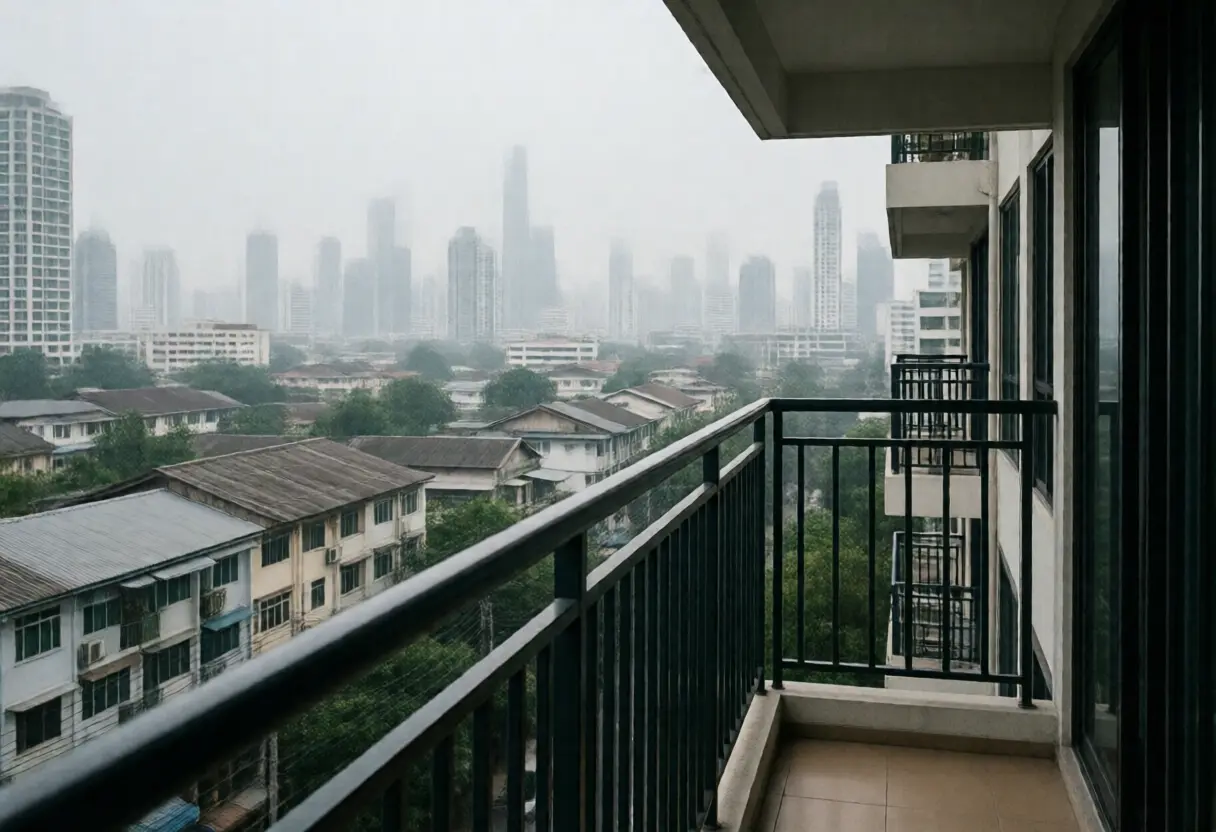
The short answer is not reliably, and the research does not support the belief as firmly as people assume.
The idea that higher means cleaner comes from dilution, which does hold up to a point in open areas. Studies measuring concentration against height find the decrease clearer in open surroundings, but the trend weakens considerably in dense urban settings.
More interestingly, some findings run the other way. Vertical measurements taken near a highway found PM2.5 at 15 metres above ground was around 30 per cent higher than at ground level under certain traffic conditions. Work measuring inside urban residential high rises has found the highest concentrations at the two lowest floors.
The usable conclusion is that floor height is not a variable worth paying a premium for on air quality grounds. Bangkok's seasonal pollution is regional haze sitting over the whole city, not smoke hanging at street level. On those days the 30th floor and the 8th floor are breathing much the same air.
Height genuinely does help with other things: road noise, coarse street dust, smells and privacy. Those are good reasons to choose a floor. PM2.5 is not the one to lead with.
What matters more than which floor you are on
- Distance from a main road. Traffic pollution is most concentrated close to the carriageway and falls off quickly with distance. A unit facing a side street or an internal courtyard is in a different position from one facing an arterial road, more so than most buyers expect.
- Which side of the building. Same building, same floor, and the road side and the far side are not equivalent. When viewing, ask what the windows actually open onto rather than only whether the view is good.
- Car park exits and building exhaust vents. A unit sitting above a car park ramp or beside the parking levels' extract takes a daily dose of exhaust that has nothing to do with the haze season.
- Construction next door. A building site is a dust source that arrives and then stays for a year or more. When viewing, look around for vacant plots that a project is about to rise on.
- Whether the windows actually seal. You can test this during the viewing. Close everything and look for daylight along the edges. Old sliding frames with perished seals leak continuously.
Size an air purifier by arithmetic, not by the box
The number that matters is CADR, clean air delivery rate, in cubic metres per hour. Serious manufacturers publish it. A box that says suitable for rooms up to 40 square metres without giving a CADR is marketing you cannot check.
Three steps:
- Work out the room volume. Floor area times ceiling height. A 30 square metre room with a 2.5 metre ceiling is 75 cubic metres.
- Choose how many air changes per hour you want. For particle filtration in living spaces, five per hour is the figure commonly used.
- Multiply. 75 times 5 is 375, so that room wants a unit rated at 375 cubic metres per hour or better.
Two warnings. First, published CADR is usually measured at the highest fan speed, which on most machines is loud enough that nobody actually runs it overnight. If you intend to use a low setting, buy more capacity than the arithmetic suggests. Second, one machine filters the room it stands in. A closed door makes a separate volume, so a large unit in the living room is not looking after a bedroom with the door shut.
Sealing the place up creates a second problem
Close the windows and run a purifier all day and the particles do come down. What goes up is carbon dioxide from the people breathing in the room. A standard purifier filters particles. It does not bring in fresh air.
What people notice is drowsiness, a dull headache and losing concentration, most often in a sealed bedroom overnight and worst in a small room with two people in it.
The answer is not leaving windows open on a bad day. It is picking the moment. The daily low usually falls in the afternoon or early evening once the air has mixed. Ventilate for ten to twenty minutes then, and close up again. You get fresh air without taking the day's peak. Check the actual reading for that day rather than airing out of habit at a fixed time.
When Bangkok's haze season runs
Sustained high readings in Bangkok belong to the dry season, roughly December through April. The wind drops, cooler air caps the layer above the city so pollution does not disperse upward, and it coincides with open burning both in Thailand and across the region. Readings are generally much lower in the rainy season because rain washes particles out and the wind moves them along.
Which means that reading this in the middle of the year puts you in the right month to prepare rather than the wrong one. Replacing window seals, finding a purifier with adequate CADR and testing whether a sealed room feels stuffy are all easier now than in December when stock is short and prices are up.
What to check before you sign
- Stand on the balcony and see whether the windows face a main road, a car park exit or a construction site.
- Close every window and look for daylight along the edges. Listen for whether traffic noise drops noticeably.
- Ask the building management whether there is any fresh air supply to the units. In most older buildings there is none.
- Check there is somewhere sensible to stand a purifier near a socket, and that the socket is not across a walkway.
- If you are renting, ask whether window seals may be replaced or extra sealing fitted, and who pays for it.
On who is responsible for repairs in a rented home, the Civil and Commercial Code already answers. And if you are still choosing a place, our condominiums and houses for sale are listed with their locations and floor areas.
Where to get the real numbers
Official data comes from the Pollution Control Department, which publishes readings from monitoring stations nationwide through the Air4Thai website and app. The strength is that these are calibrated reference stations. The weakness is that there are a limited number of them, so a reading represents a district rather than your doorstep.
Low cost sensors in homes and on community map apps fill in the spatial detail, but accuracy varies widely by model and upkeep. Use them for trends. Do not use them to argue with an official figure.
The Clean Air Act is still not law
The draft Clean Air Act has been working through parliament for several years and had still not been enacted as of September 2026, when it remained under consideration in the House.
It is worth knowing because it changes how a householder should plan. With no statute in force, the levers you actually control are choosing where you live, closing the gaps in your own unit, and the filtration capacity you install. Waiting on a measure that has not taken effect is not a plan.
Frequently asked questions
What PM2.5 level exceeds the Thai standard?
Above 37.5 micrograms per cubic metre for the 24 hour average, and above 15 for the annual average. Both figures have applied since 1 June 2023.
Why do two air quality apps disagree in the same place?
Because AQI is converted from the measurement, and Thailand and the United States use different conversion breakpoints. The same air produces different index numbers. Compare the micrograms per cubic metre figure instead, because that is what was actually measured.
Is the air really cleaner on a high floor?
Not reliably. The decrease with height is clearer in open areas and much weaker in dense urban settings, and measurements near a highway have found readings at 15 metres around 30 per cent higher than at ground level under some traffic conditions. Seasonal haze covers the whole city rather than sitting at street level.
How powerful does an air purifier need to be?
Multiply room volume by the air changes per hour you want. A 30 square metre room with a 2.5 metre ceiling is 75 cubic metres, so five changes an hour calls for a CADR of at least 375 cubic metres per hour. Allow more if you plan to run it on a low, quiet setting.
Can one purifier cover a whole home?
Not with the doors closed. A unit only filters the air volume it circulates. A bedroom with a shut door is a separate volume and needs its own machine.
Is there a downside to sealing the place up all day?
Yes. Carbon dioxide from breathing accumulates, because a purifier filters particles without introducing fresh air. Drowsiness and a dull headache are the usual signs. Ventilate briefly when the day's reading is at its lowest, then close up again.
When is Bangkok's haze season?
Roughly December through April, the dry season, when winds drop, cooler air caps the layer over the city and open burning is under way. Rainy season readings are generally much lower.
Does the Thai standard match the WHO guideline?
No. The WHO recommends no more than 15 micrograms per cubic metre over 24 hours and 5 annually, against the Thai standard of 37.5 and 15. A reading can sit inside the Thai standard and still be well above what the WHO advises.
Key takeaways
- Thailand's PM2.5 standard is 37.5 micrograms per cubic metre over 24 hours and 15 annually, in force since 1 June 2023.
- AQI is not a measurement. Thailand and the United States convert it differently, so always compare the microgram figure.
- Thailand's orange band spans 37.6 to 75, so the concentration can almost double without the colour on screen changing.
- A higher floor does not reliably mean cleaner air, and near a highway readings at 15 metres have come in around 30 per cent above ground level.
- Distance from a main road, which side of the building, car park exits and neighbouring construction all matter more than floor height.
- Size a purifier from CADR. A 75 cubic metre room at five air changes an hour needs at least 375 cubic metres per hour.
- A sealed room accumulates carbon dioxide, so plan a short ventilation window at the quietest point of the day.