
A neighbour has crossed your land for ten years. Have they acquired a permanent right?
The answer turns on one word: did you ever give permission?
If you did, then ten years or thirty makes no difference, because use with the landowner's consent does not become a servitude.
If you never did, and they have used it peaceably and openly for ten unbroken years, your land may already be burdened with a servitude without anybody registering anything.
The difference between those two situations is one sheet of paper, and almost everybody who loses land this way lost it by simply being obliging and never writing anything down.
This is written from the side of the owner whose land is being crossed: what the code says, how a servitude arises, and how to stop one while it can still be stopped.
What a servitude is, and two words to keep straight
Section 1387 of the Civil and Commercial Code provides that immovable property may be subjected to a servitude, obliging its owner to accept certain acts affecting their property, or to refrain from exercising certain rights inherent in ownership, for the benefit of other immovable property.
Read slowly, that says three things.
First, the burden attaches to the land, not to an agreement between people.
Second, the owner may have to allow something, such as passage, a pipe, or a power pole, or to refrain from something, such as building in a way that blocks light or air.
Third, it exists for the benefit of another piece of land, not for the benefit of a person.
Thai law gives those two plots specific names, worth memorising because they appear on every document.
The servient property is the land carrying the burden, which here is yours.
The dominant property is the land taking the benefit, which here is the neighbour's.
What confuses people most is mixing a servitude up with a way of necessity, which is a different thing.
A way of necessity arises because a plot has no access at all to a public road, so the law grants passage over neighbouring land with compensation. A servitude requires no such condition. Ways of necessity are covered in landlocked land, ways of necessity and servitudes.
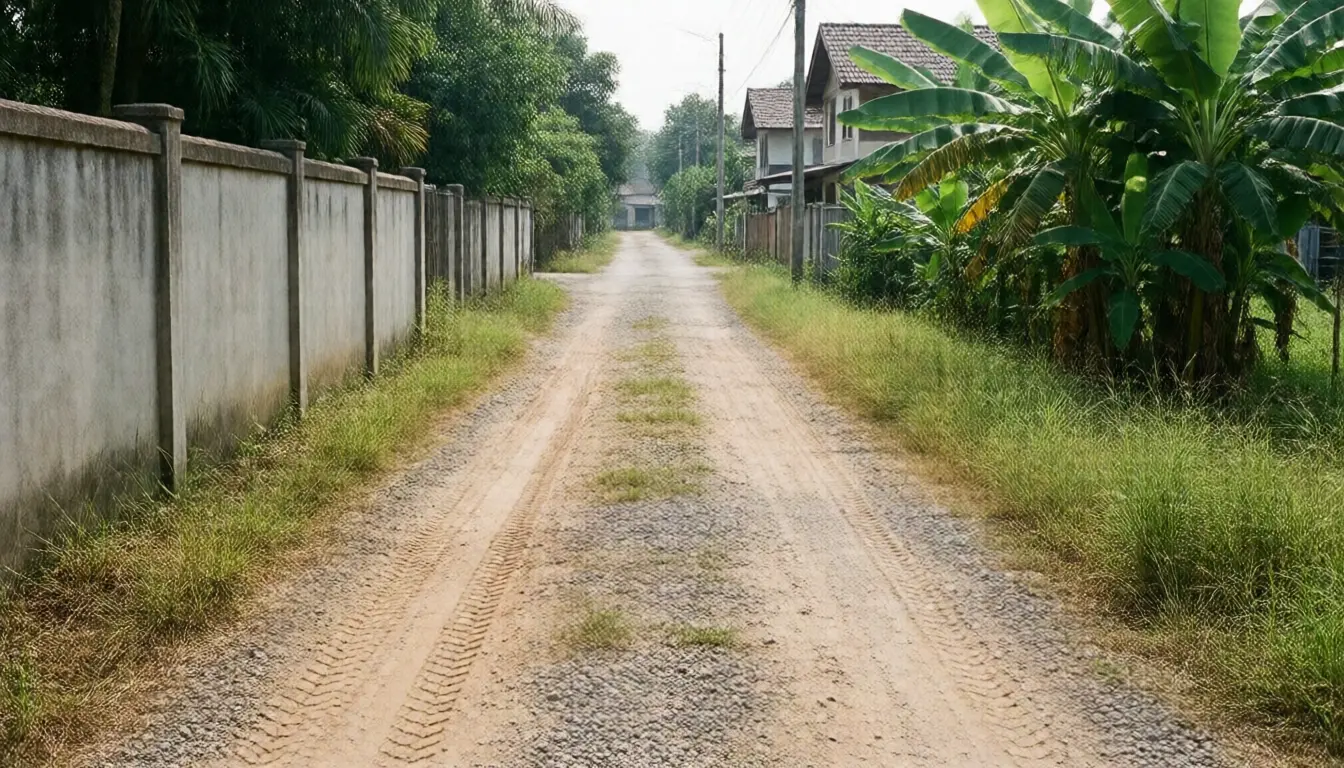
Three ways a servitude comes into being
First, by agreement. Both landowners agree and register the servitude at the Land Office.
This is the clearest route and the one that produces the fewest disputes, because everything is written down: how far it extends, how wide it is, what it may be used for, and whether anything is paid.
The advantage of registering, from the burdened owner's side, is that it closes the boundaries. Register a two-metre footpath and the neighbour cannot start bringing lorries through.
Second, by prescription. Section 1401 provides that a servitude may be acquired by prescription, applying the rules on adverse possession with the necessary modifications.
So if a neighbour crosses your land peaceably, openly, and with the intention of holding it as a servitude, continuously for ten years, they may acquire that right without asking anybody and without paying anything.
Peaceably means you did not object. Openly means they were not sneaking across at night. Continuously means it was not interrupted.
This is the dangerous route for a landowner, because it happens quietly, out of goodwill, rather than out of any trespass.
Third, by operation of law, in specific cases, such as a land allocation where the developer must provide the utilities and access approved for the project.
In practice the second route is what fills the courts, and nearly every case turns on the same single question: over those ten years, was the use permitted or simply taken?
The one sentence that stops the ten-year clock
If you remember one thing from this article, remember this.
Use with the landowner's consent does not become a servitude.
The reasoning is contained in the rule itself. Acquiring a servitude by prescription requires use with the intention of taking that right as one's own, whereas somebody using it because the owner allowed it already knows the right is not theirs.
In practice this means you can let a neighbour use the track. You just have to let them in a way that leaves evidence it was permission.
Three things to do, none of which costs anything.
Write a one-page permission. Name the person permitted, the position and width of the track, what it may be used for, and a statement that this is temporary permission which the owner may withdraw at any time. Both sign, and each keeps a copy.
Renew it every couple of years. A fresh copy with a fresh date restates that the relationship is permission rather than the exercise of a right.
Redo it whenever ownership changes on either side, because a document signed with the previous owner does not automatically bind the new one.
If you refuse to have any paperwork at all, the next best thing is making it visible that the land is yours and access runs through you: a lockable gate whose key you hand over, or closing the track for one day a year.
But those cause more trouble with a neighbour than a single sheet of paper does, and prove less.

Once a servitude exists, what the owner may and may not do
The common misconception is that land subject to a servitude is no longer yours, which is untrue.
You still own it, you still pay land tax on it, and you may still use it so long as you do not conflict with the servitude.
The limit on what you may not do is section 1390, which provides that the owner of the servient property shall not do any act tending to diminish the benefit of the servitude or to make its use less convenient.
Less convenient is broader than people assume. Stacking materials across the track, planting trees whose roots break the surface, or fitting a gate that makes vehicles harder to bring through can all fall within it.
As for maintenance costs, section 1391 gives the owner of the dominant property the right to do everything necessary to preserve and use the servitude, at their own expense.
Which means the person who benefits from the track pays to repair the track, not the landowner. Plenty of landowners do not know this and have been paying for years.
What to do in that position is agree in writing who maintains what, because the code sets the principle but does not say how thick the concrete should be or how often it is resurfaced.
A servitude runs with the land, not with the person
This is the part that affects land value directly.
Section 1393 provides that unless otherwise stipulated in the act creating it, the servitude passes with the dominant property when that property is transferred, and cannot be transferred separately from it.
In practice that cuts both ways.
If the neighbour sells, the new owner keeps crossing your land, because the right belongs to their land rather than to them personally.
And if you sell, the burden follows to your buyer just the same.
Which is why a careful buyer asks about this before paying a deposit. Land with a servitude running through the middle is worth less than an identical plot without one, because that strip cannot be built on.
One more thing worth knowing: a servitude acquired by prescription exists in law even where nothing has been registered. Looking at the back of the title deed and seeing nothing does not mean there is nothing.
What tells you more than the paperwork is standing on the land and looking for evidence of use: tyre ruts, a path where grass will not grow, pipework crossing it. Checking before buying is covered in buying land with a servitude.
How a servitude comes to an end
Section 1399 is very short: a servitude, if not used for ten years, is extinguished.
The same ten years that create one can also end it.
In practice that applies when the neighbour gains other access, such as a new public road reaching their plot, and abandons the old track. Leave it unused for ten years and the servitude is gone.
The second route is both parties agreeing to end it and registering the release at the Land Office, which is the fastest way where people are still talking.
The third is both plots coming into the same ownership, because a servitude exists for the benefit of another piece of land, and once there is only one owner its reason has gone.
What to be careful of is that blocking the track yourself and counting ten years does not work the way people assume. Blocking a track that is already a servitude makes its use less convenient, which section 1390 forbids, and it usually ends with the neighbour suing to have it reopened.
If somebody is crossing your land right now, work through this
- Confirm the boundary first, so you know the track really is inside your title, because sometimes it is public land or part of another plot. The survey process is in the boundary survey.
- Work out how long it has been used, using old aerial photographs or what long-term residents recall.
- Under ten years, write the permission today. This is the most valuable window and the one people let pass.
- At or past ten years, take legal advice before doing anything, because blocking the track yourself may put you in the wrong under section 1390.
- If you accept it exists, register it, drawn as narrowly as you can negotiate, because a registered servitude with clear limits beats one acquired by prescription whose extent nobody knows.
- Put the maintenance in writing too, with the user paying, following the principle in section 1391.
The last thing worth thinking about is that this does not end with you. Land outlives good relations between neighbours, and the people who actually end up arguing about it are usually both sides' children, twenty years later.
A sheet of paper signed today is therefore not an accusation of bad faith. It is what saves the next generation from guessing.
Frequently asked questions
My neighbour has crossed my land for ten years. Do they now have a right?
Not necessarily. Use with the landowner's consent does not become a servitude. But use that was peaceable, open and never permitted may create one after ten years under section 1401.
How do I stop a servitude arising?
Write a temporary permission stating the extent and reserving the right to withdraw it, signed by both with a copy each, renewed every couple of years and whenever ownership changes.
Is land subject to a servitude still mine?
Yes, and you may still use it, provided you do not diminish the benefit of the servitude or make its use less convenient, under section 1390.
Who pays to repair a track that is a servitude?
Section 1391 puts the work and the expense of preserving and using it on the dominant owner, meaning the party who benefits from the track.
Does a servitude disappear when the land is sold?
No. Under section 1393 it runs with the land rather than with the person, so new owners on both sides take the right and the burden.
Does a servitude expire?
Section 1399 extinguishes one not used for ten years. It can also end by agreement registered at the Land Office, or when both plots come into the same ownership.
Can I just block the track, since the land is mine?
If no servitude exists, yes. If one does, blocking it makes its use less convenient, which section 1390 forbids. Take advice before acting.
In short
- A servitude burdens the land rather than being an agreement between people, under section 1387.
- It arises three ways: registration, ten years of prescription, or operation of law.
- Use with the owner's consent never becomes a servitude, so one sheet of paper stops the clock.
- You remain the owner but must not make the servitude less convenient, under section 1390.
- Maintenance falls on the party who benefits, under section 1391.
- It passes with the land on a sale, under section 1393, and affects the price directly.
- Ten years of non-use extinguishes it, under section 1399, but blocking the track yourself is not a safe route.