
What changed in 2026
Two things landed this year, and together they move rooftop solar in Thailand from marginal to clearly worth modelling.
First, Royal Decree No. 805 (B.E. 2569 / 2026) grants a personal income tax exemption of up to THB 200,000 for anyone who pays for and installs rooftop solar between 3 March 2026 and 31 December 2028.
Second, the Solar Phak Prachachon (Citizen Solar) programme for 2026 opened for applications on 1 July 2026, buying power back at THB 2.20 per unit on a 10-year contract, with a total quota of 500 MW.
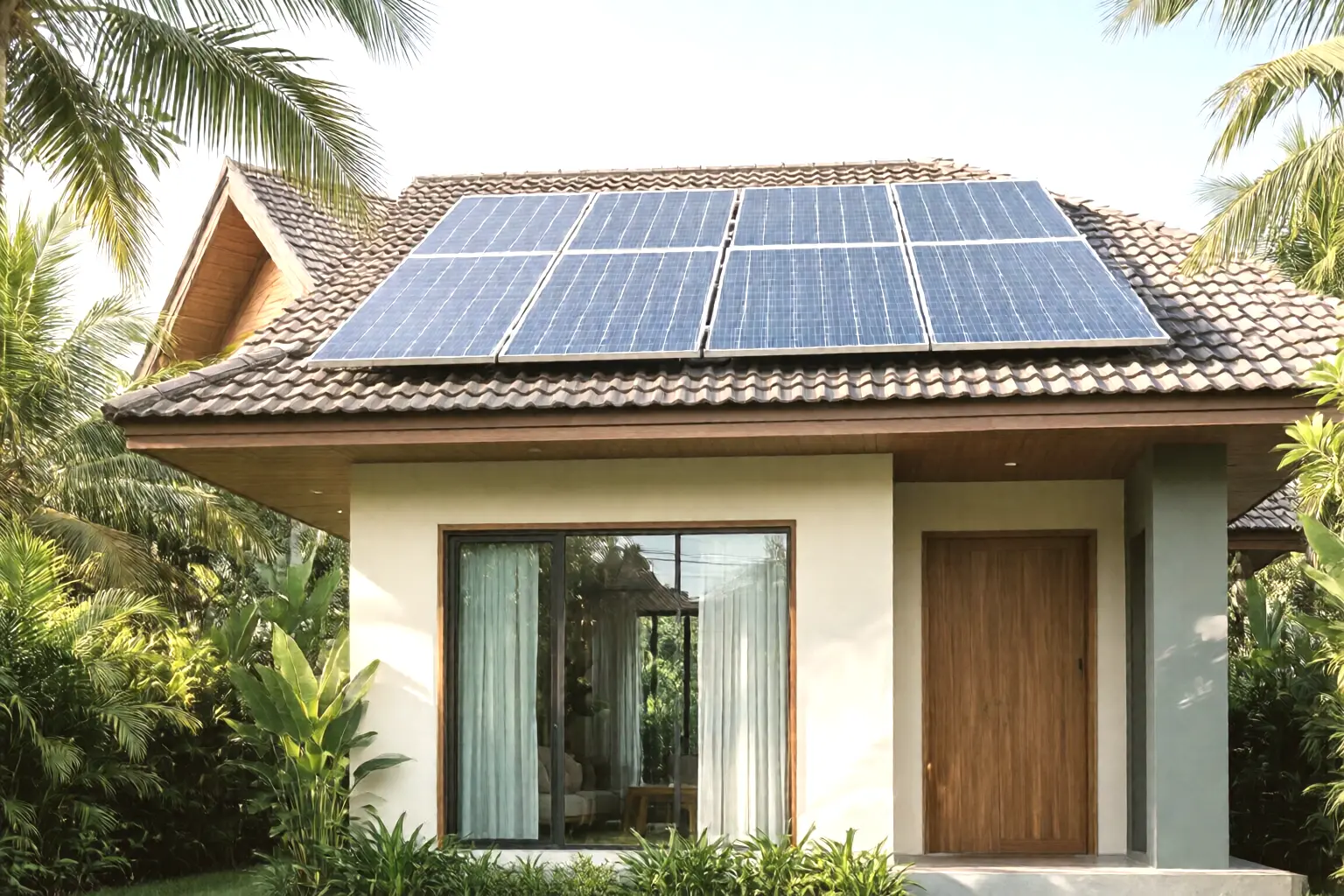
That 500 MW quota is a large step up from the previous ceiling of 90 MW per round, and the programme allocates on a first come, first served basis.
The THB 200,000 deduction: who qualifies and how
The conditions are narrower than the headline suggests, so read all of them.
| Condition | Detail |
|---|---|
| Amount | Personal income tax exemption of up to THB 200,000 |
| Period | Paid and installed between 3 March 2026 and 31 December 2028 |
| Eligible costs | Both equipment (panels, inverter, mounting) and installation labour |
| System size | Up to 10 kWp for a residential property |
| Evidence | e-Tax Invoice only; a paper tax invoice does not qualify |
| Meter type | Type 1 residential meter |
| Names | Meter holder, property owner and tax filer must be the same person |
The condition that costs people the benefit most often is the e-Tax Invoice. Many smaller installers still issue paper tax invoices, which do not qualify. Confirm this before paying a deposit, not when you come to file.
The second is the name matching. A house whose meter is still in a parent's name, where the child pays and files, cannot claim until the names are aligned.
For companies, the same measure allows the investment to be deducted as an expense at up to 1.5 times the amount actually paid.
The 2026 Citizen Solar programme in full
| Item | Condition |
|---|---|
| Buyback rate | THB 2.20 per unit |
| Contract length | 10 years from the scheduled commercial operation date |
| Export limit | Not more than 5 kW per meter |
| Total quota | Not more than 500 MW |
| Applications open | From 1 July 2026 |
| Eligibility | Type 1 residential electricity users registered with MEA or PEA |
| Allocation | First come, first served |
Note that the 5 kW export cap per meter is not the same as the 10 kWp system size limit for the tax deduction. A 10 kWp system can be installed and deducted, but no more than 5 kW may be sold back.
You sell at THB 2.20 and buy at THB 3.95, which changes how the system should be sized
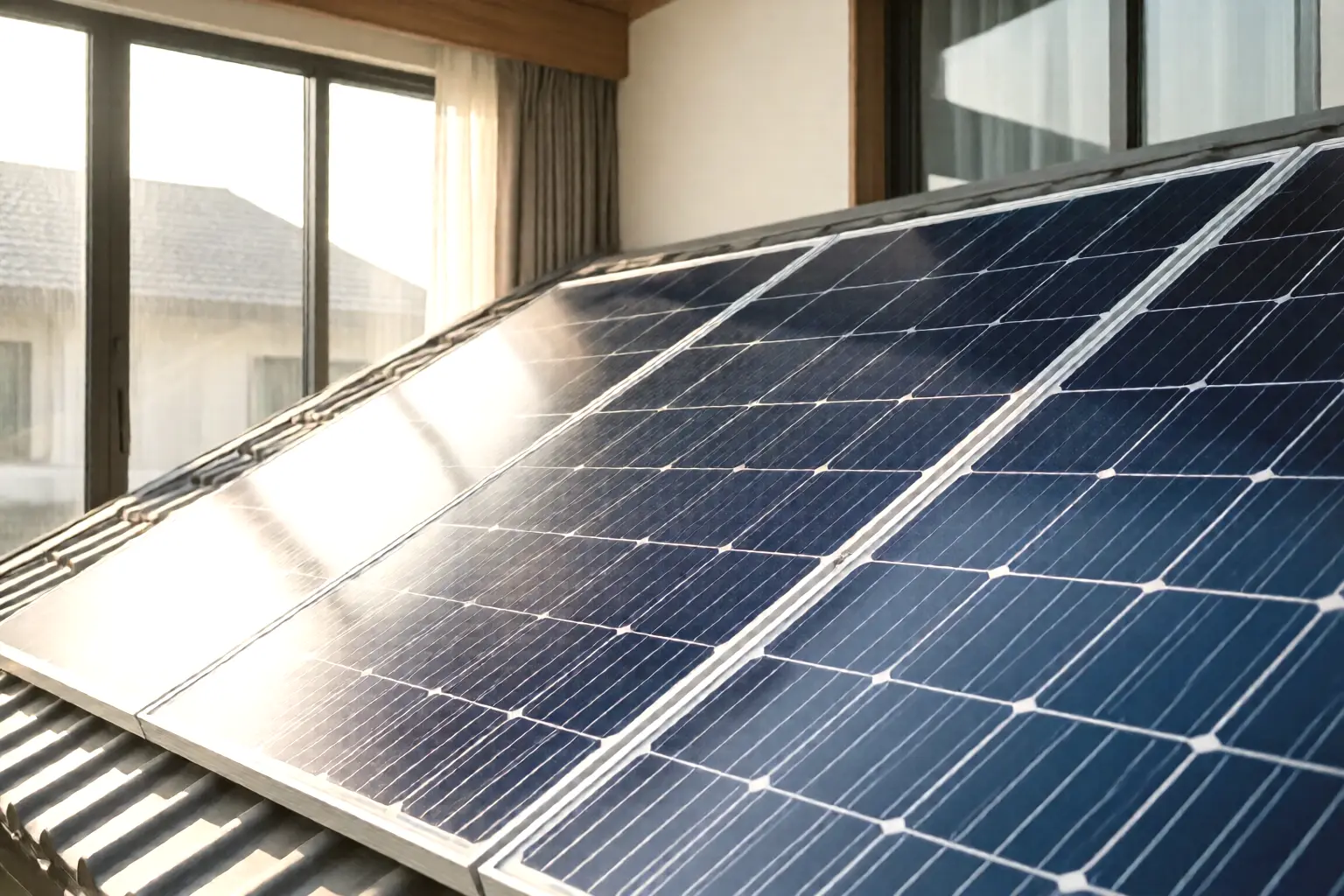
The base electricity tariff is THB 3.78 per unit. With the Ft charge for the May to August 2026 billing period at 16.23 satang per unit, the average billed rate is THB 3.95 per unit, excluding VAT.
So a unit you consume yourself is worth THB 3.95, while a unit you export is worth THB 2.20. Self-consumption is worth almost twice as much as export.
Thailand runs net billing, not net metering: the utility buys at a fixed rate rather than netting your exported units against the units you draw. The gap between the two prices therefore stays with the homeowner.
The design conclusion is a single sentence: size the system to the household's daytime consumption, not to the largest array the roof will carry, because every unit that spills to export is worth materially less than one used in the house.
A house that is empty during the day gains less than one where somebody works from home or runs air conditioning in the afternoon, even with an identical roof.
Installation cost and payback
Market prices seen in 2025 ran at roughly THB 90,000 for a 3 kW system, THB 180,000 for 5 kW, and THB 320,000 for 10 kW.
The commonly cited worked example is a 5 kW system at THB 180,000 saving around THB 3,000 a month, or THB 36,000 a year, which is a payback of about five years.
Kasikorn Research Center puts the payback range at 2 to 6 years, while most residential systems in Thailand pay back in 4 to 6 years.
What has to be added to this year's calculation is the tax exemption of up to THB 200,000. That is not THB 200,000 back in cash. It is the installation cost deducted from assessable income before tax, so its real value depends on your marginal rate: a taxpayer at 20% gains roughly 20% of the deducted amount.
Which houses it suits, and which it does not
Clearly worthwhile when:
- The electricity bill runs over THB 3,000 a month and heavy usage falls in daylight hours.
- Somebody is home during the day, working from home or an older relative living there.
- The roof faces south with no shade from buildings or trees.
- You intend to stay in the house at least five to seven more years.
- You have assessable income taxed at a rate high enough for the deduction to be worth something.
Not yet worthwhile when:
- The bill is under THB 1,500 a month, so the saving cannot catch the capital cost.
- The house is empty during the day most of the week.
- The roof is old and due for re-tiling within a few years, meaning the array comes off and goes back on.
- You expect to sell within one to two years.
The sequence from decision to first export
- Pull six months of electricity bills and work out how much you use in daylight. That number sets the system size.
- Have an installer survey the roof: structure, orientation and shading.
- Confirm the installer can issue an e-Tax Invoice, before paying a deposit.
- Check that the meter holder, the property owner and the tax filer are the same name.
- Apply for grid connection with your local utility and submit the export application through the MEA or PEA online system.
- Install, commission, and wait for the utility's inspection.
- Keep the e-Tax Invoice and the connection documents for your tax filing.
What to check about the roof first
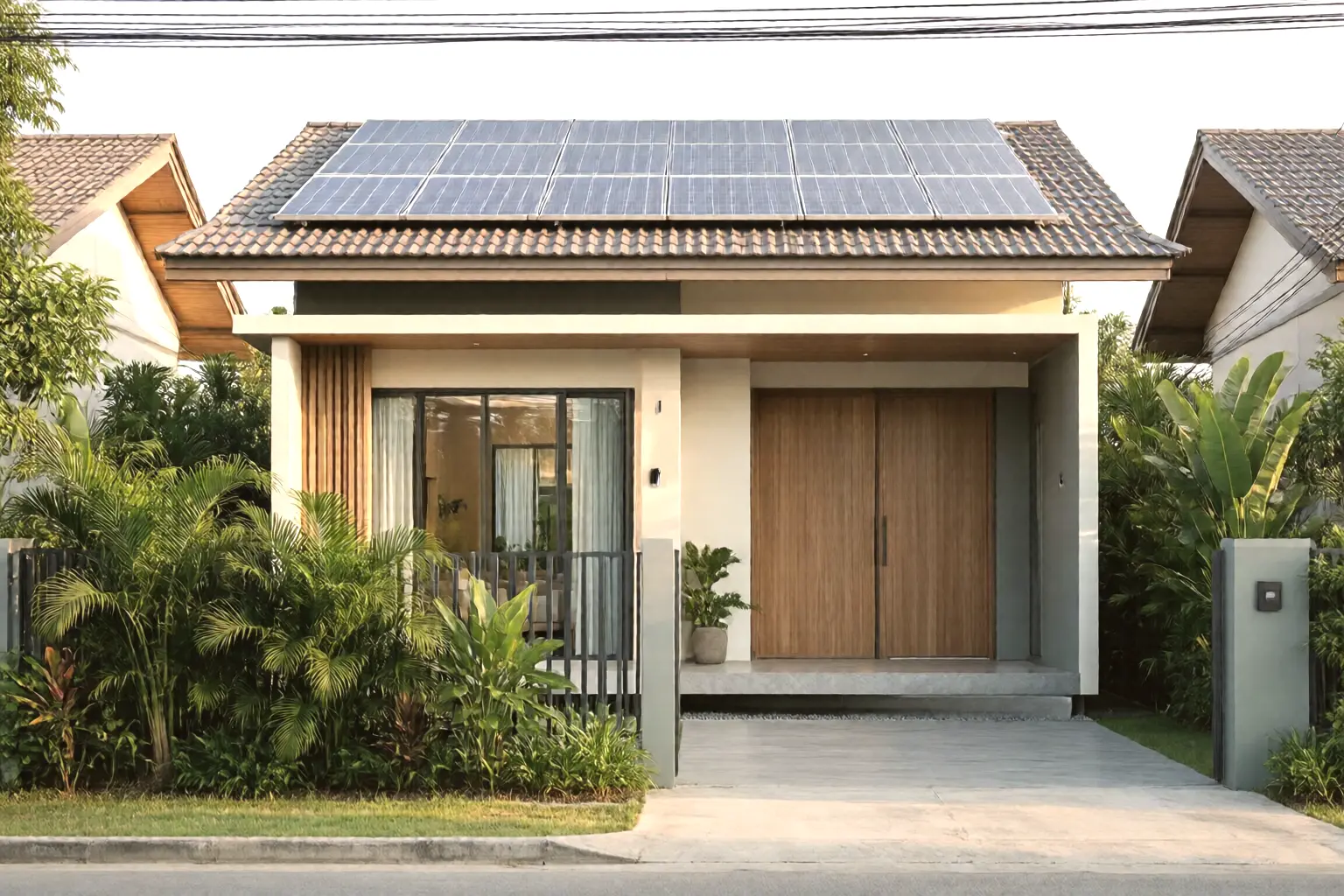
The panels stay on that roof for twenty years, and the roof carrying them may not have been designed with that in mind.
- Roof age. If its remaining life is shorter than the panels', replace the roof first.
- Load capacity. Have an engineer check it, rather than accepting the installation crew's judgement by eye.
- Fixings and leaks. Every penetration is a future leak. Ask what mounting method is used and how many years the leak warranty runs.
- Shading. Partial shade across an array cuts output by more than most people expect.
- Access for cleaning. Dust reduces output, and a roof you cannot reach is a roof that never gets washed.
For a recently handed-over house, check whether drilling the roof affects the developer's structural warranty. See the five-year structural and one-year fittings warranty.
Can a condominium unit have solar
An individual unit owner cannot install on the building roof, because the roof is common property under condominium law. Installation has to be a resolution of the juristic person, and it reduces common-area electricity, not any one unit's bill.
The Citizen Solar programme also requires a Type 1 residential meter, which is a house meter rather than a condominium building's bulk meter.
Frequently asked questions
How much tax can I deduct for installing solar
Up to THB 200,000 of personal income tax exemption under Royal Decree No. 805 (2026), for payment and installation between 3 March 2026 and 31 December 2028, covering both equipment and installation, for systems up to 10 kWp.
What is the solar buyback rate in Thailand
THB 2.20 per unit under the 2026 Citizen Solar programme, on a 10-year contract, with exports capped at 5 kW per meter and a total programme quota of 500 MW.
When can I apply to the 2026 Citizen Solar programme
From 1 July 2026, through your local distribution utility, MEA or PEA, allocated first come, first served until the quota is filled.
How long is the payback on rooftop solar
Most residential systems in Thailand pay back in 4 to 6 years, with Kasikorn Research Center putting the range at 2 to 6 years. The cited example is a 5 kW system at THB 180,000 saving about THB 3,000 a month.
What size system should I install
Size it to your daytime consumption, because a unit used in the house is worth THB 3.95 at the average billed rate for the May to August 2026 period, while a unit exported earns THB 2.20. Oversizing beyond your own use does not pay.
Why does a paper tax invoice not qualify
Because the measure requires an e-Tax Invoice. Ask the installer explicitly whether they can issue one before paying a deposit.
Can I install solar on a condominium
Not as an individual unit owner, because the roof is common property, so it takes a resolution of the juristic person and serves common-area electricity. The Citizen Solar programme also requires a Type 1 residential house meter.
In short
2026 is the best the numbers have looked in years, with a tax exemption of up to THB 200,000 running to the end of 2028 and a buyback quota raised to 500 MW.
But the figures that should actually drive the decision are THB 3.95 and THB 2.20, because they say that rooftop solar in Thailand pays through the power you stop buying, not through the power you sell.
Before calling an installer, open six months of bills. If most of your consumption happens after dark, the answer may be a new air conditioner before any panels.
Looking for a house with a roof suited to solar? Browse properties for sale. Owners who already have a correctly documented system should treat it as a selling point; see our house sales service.