
How often to clean: the answer is in your own numbers
There is no single answer that works for every house, because a house on a dusty road, one beside farmland and one in an estate full of trees accumulate dirt at completely different rates.
Getting the right answer for your own roof takes two days. Note the units generated on a clear day before cleaning, clean, then note a comparable clear day afterwards. The difference is what the wash bought you.
If the difference is negligible, the rain here is already doing the work and you need not clean often. If it is obvious, clean more frequently and it pays. Do this once and you will know your own cycle for good.
Most systems have an app or a display showing daily output; if yours does not, read the meter instead. Compare only days with similar skies, because cloud moves the figure far more than dust does.
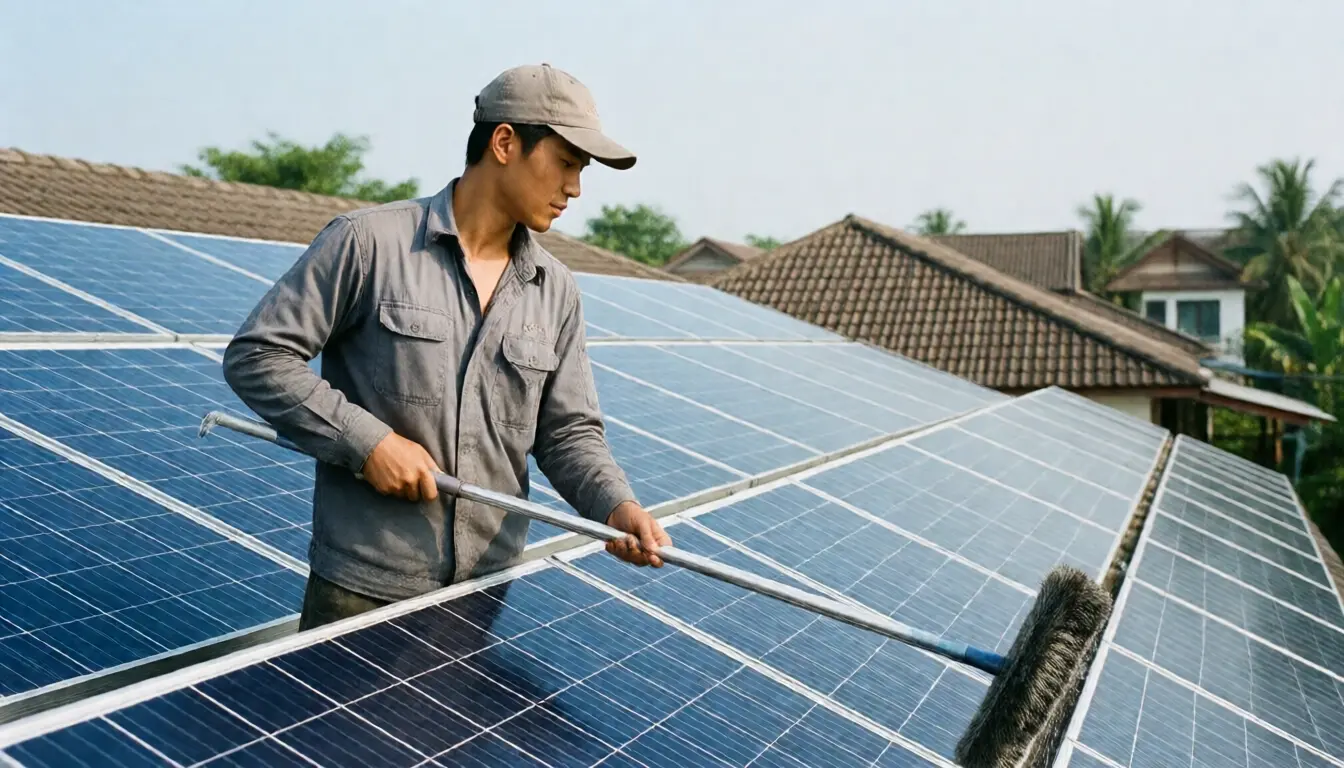
When a wash is worth most in Thailand
If you clean only once a year, do it at the end of the dry season before the hottest months, not at some arbitrary point.
The reason is that the dry season is when dust accumulates most and no rain comes to wash it off: road dust, smoke from burning, and the months when particulate levels run high in many areas. That period coincides with strong sun and long days, when the system should be producing more than at any other time of year.
So leaving the panels dirty then costs you output in the months that are worth most. A wash in the middle of the rainy season usually achieves little, because rain has just done it.
The exception, to be cleaned immediately whatever the season, is bird droppings and anything forming an opaque spot, because rain does not shift either, and they do more than block light. That is the next section.
Why a small shadow costs more output than it looks like it should
People assume that shade over ten percent of a panel costs ten percent of the power. It does not work that way, and this is worth knowing before deciding anything about the tree in front of the house.
The cells in a panel are wired in series, so the current through the whole string is limited by the worst cell, in the way that one narrow section in a pipe limits the flow along its whole length.
Manufacturers deal with this using bypass diodes across groups of cells. When a group is shaded, the diode lets current pass around it, so the damage is confined to that group rather than the whole panel. But that group is typically a third of a panel, not merely the shaded area.
In practice this means one bird dropping in the wrong place can cut a third of that panel's output, and the shadow of an aerial or a branch crossing the array in the afternoon costs more than the eye suggests.
Knowing that, walking out to look at the array in the late afternoon once a month to see what new shade has appeared is a five minute job worth more than several washes.
An opaque spot does not just block light, it makes heat
What makes a bird dropping worse than dust is that the shaded cell stops producing and starts absorbing energy from the other cells in its group, and that energy comes out as heat.
Left long enough, the hot spot degrades the encapsulant and causes permanent damage that cleaning afterwards will not undo.
So dust spread evenly across a panel is an efficiency matter, while an opaque spot is a lifespan matter. The two are not equally urgent.
If you see droppings, clean soon rather than waiting for the scheduled wash. And if birds perch often enough to be a real problem, deal with where they perch, such as the cable or the roof edge above the array, rather than washing more and more often.
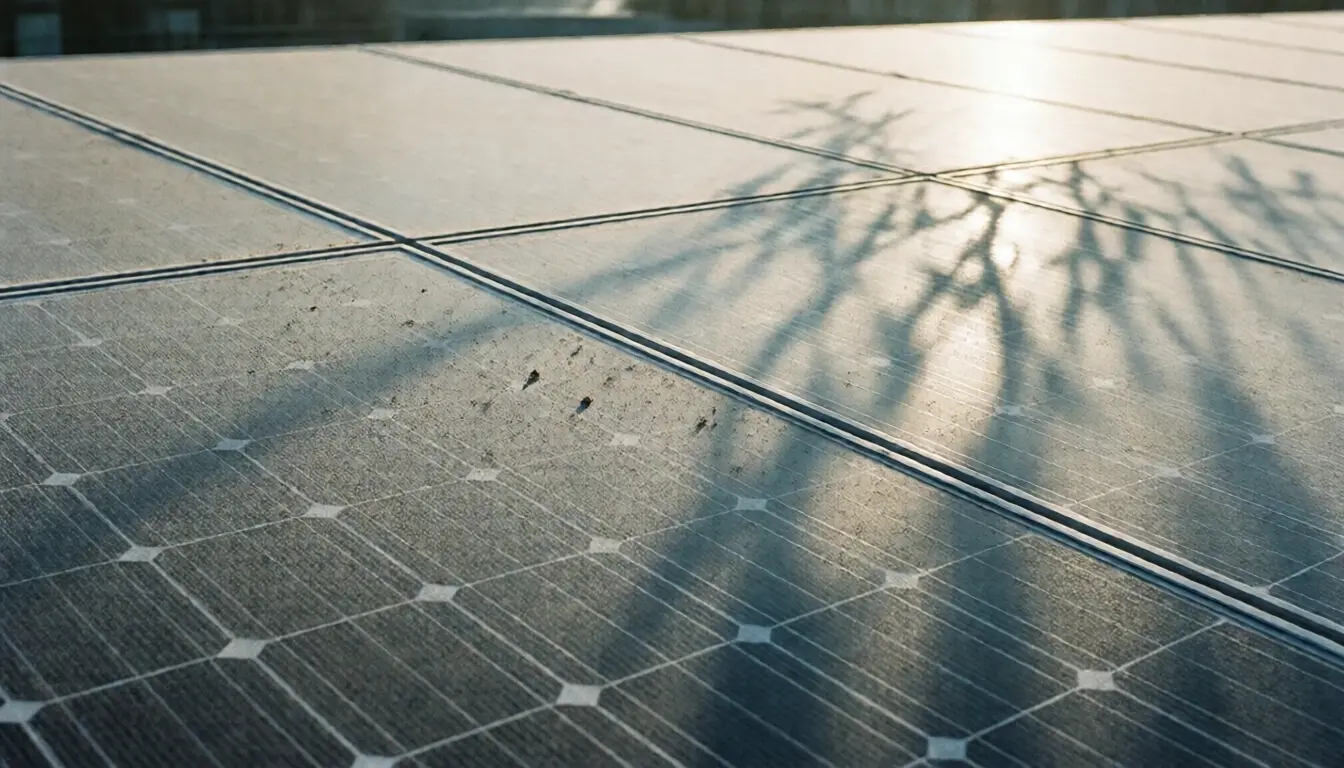
How to clean without damaging anything
- Clean early morning or after the sun is off the roof. Never spray cold water on glass that is scorching at midday, because too fast a temperature change can damage it.
- Use clean water and a soft long-handled brush. No detergent or washing-up liquid, because the soap residue left behind becomes a dust magnet and it gets dirty faster than before.
- Never use a pressure washer. The pressure drives water past the edge seals and into the junction box behind the panel, and that moisture is what fails months later.
- No abrasives or rough sponges. Scratches in the coating reflect light away permanently.
- Never stand on a panel. Even where nothing visibly breaks, a person's weight causes microcracks in the cells that cannot be seen and that lower output for good.
- If the roof is steep or high, pay someone. Falling off a roof is not a risk worth a few hundred baht of electricity.
The most important safety point: the panels carry DC voltage whenever there is light on them. Switching off the breaker on the household side does not de-energise the array. Never open a junction box or unplug a connector yourself. Washing glass is an owner's job. Touching wiring is not.
How long panels last, and what fails first
Solar panels do not fail by simply stopping. They produce slightly less each year, which is why manufacturers issue two warranties that people routinely confuse.
The first is the product warranty, covering physical and manufacturing defects, and it runs for the shorter term.
The second is the performance warranty, stating that after a given number of years the panel will still produce no less than a stated percentage of its original output. That figure varies by brand and model, and it should be read from the documents for the panels actually on your roof rather than from what a salesperson said.
Keep both documents somewhere you can find them, together with the invoice and a photograph of the label on the back of a panel taken at installation, because a claim ten years from now needs the model and serial to match, and by then you cannot climb up to photograph it.
The component that fails before the panels, almost every time, is the inverter, being electronics that work every day with parts that have a life. Treat replacing it as a mid-life cost to budget for from the start rather than a surprise.
Signs that need a technician, not a wash
- Output this month is clearly below the same month last year, with the panels clean and the weather comparable.
- The inverter shuts down by itself occasionally and comes back on its own later.
- Unusual noise or smell from the inverter or the combiner box.
- Scorch marks, melting or discoloration at a connector or at the junction box behind a panel.
- Crazing across the panel surface, or water standing inside the panel frame.
- The backsheet turning yellow or brown in patches.
The last three need a technician promptly rather than waiting for an annual check, because they concern heat and current rather than lost output. Choosing an installer who will actually come back is covered in the rooftop solar installer registry.
What to do once a year besides cleaning
Good maintenance is more than washing glass. Once a year someone should go up and check four things.
Mounts and fixings, that they are still tight and free of corrosion, because daily thermal expansion works fixings loose over years.
Wherever cables touch the frame or the roof, because insulation abraded daily by the wind is where the most expensive problems start. Cables should be clipped clear and not swinging.
Under the panels and in the gutters, for accumulated leaves or nests, which block the airflow that should be cooling the array from below and dam the water until it stands on the roof.
The inverter and its ventilation, that nothing is blocking it and dust has not clogged the vents, because an inverter that cannot shed heat derates itself on the hottest days, which are exactly the days you want the output.
If you are thinking about storing the midday surplus for the evening, whether it pays is in a home battery with solar, is it worth it.
Frequently asked questions
How often should solar panels be cleaned?
It depends on the surroundings. Find your own answer by noting output on a clear day before and after a wash. The difference tells you how often it is worth doing.
Is rain enough on its own?
For ordinary dust in many areas, yes. Not for bird droppings and opaque spots, which rain does not shift and which create hot spots that damage the panel permanently.
Can I use washing-up liquid?
Better not. The soap residue attracts dust and the panels get dirty faster than before. Clean water and a soft brush are enough.
Does a small branch shadow really matter?
More than you would think, because the cells are in series and the current is limited by the worst one. Bypass diodes confine the loss to one group, but that group is a portion of the whole panel, not just the shaded patch.
How many years do panels last?
Read the performance warranty for the model actually on your roof, which states the percentage of original output guaranteed after a given number of years. And budget for an inverter replacement, since that usually fails first.
In short
- Cleaning frequency comes from your own figures, not from general advice.
- If you clean once a year, do it at the end of the dry season before the strongest sun.
- Opaque spots are more dangerous than even dust, because they create permanently damaging hot spots.
- Clean when the panels are cool, with plain water and a soft brush, no pressure washer, and never stand on them.
- Panels carry DC voltage whenever there is light. The household breaker does not de-energise them.
- The inverter usually fails before the panels, so budget for replacing it from day one.