
Answer three questions and you will know whether your house needs whole-house filtration
One: where does your water come from, mains or a borehole?
Two: have you had it tested?
Three: what exactly are the symptoms that made you consider a system?
If the answers are mains, no, and a feeling that the water is not clean, that is the combination behind a great many expensive systems that fixed nothing.
Whole-house filtration is not right or wrong in itself. It is a tool that has to match the problem, and the problem has to be known first.
This covers what such a system genuinely does, which houses it pays for, which it does not, and how to read the quotation somebody hands you.
What it is, and what it is not
It is a set of filter vessels installed where water enters the property, before it splits off to the bathrooms, kitchen and washing machine.
What it does well is handle problems affecting all the water in the house: sediment, iron staining, chlorine, odour, and in some configurations hardness.
What it is not is a drinking water filter.
A whole-house system is designed to pass water fast enough to supply every outlet at once, and that speed is traded against fineness of filtration compared with a point-of-use unit running slowly.
So a household that fits one and abandons the drinking filter at the sink has misunderstood its job.
The two work at different levels and both belong in a house where people drink from the tap.
Which houses it pays for
Houses on a borehole benefit most clearly, because groundwater often carries iron, manganese, hardness or sediment at levels that affect daily use.
Houses getting sediment or sand through the taps, whether from a well or from old mains pipework in the area.
Houses with obvious hardness: soap that will not lather, scale on shower heads, and water heaters failing unusually often.
Houses with orange-red staining in basins and on laundry, which is iron.
Houses drawing from a tank that is open or growing algae, which should be fixed at the tank, though filtration helps with what gets through.
Which houses it does not pay for
Houses on urban mains with no symptoms at all, who are buying peace of mind. Not wrong, but worth knowing that is what is being bought.
Houses whose real problem is drinking water, solved far more cheaply at a single point of use.
Rentals and condominiums, where large vessels cannot be installed and nothing comes with you when you move.
Houses that have never tested the water, because choosing a system without figures is guessing, and guessing here is expensive.
That last point matters most, which is why testing comes up again below.
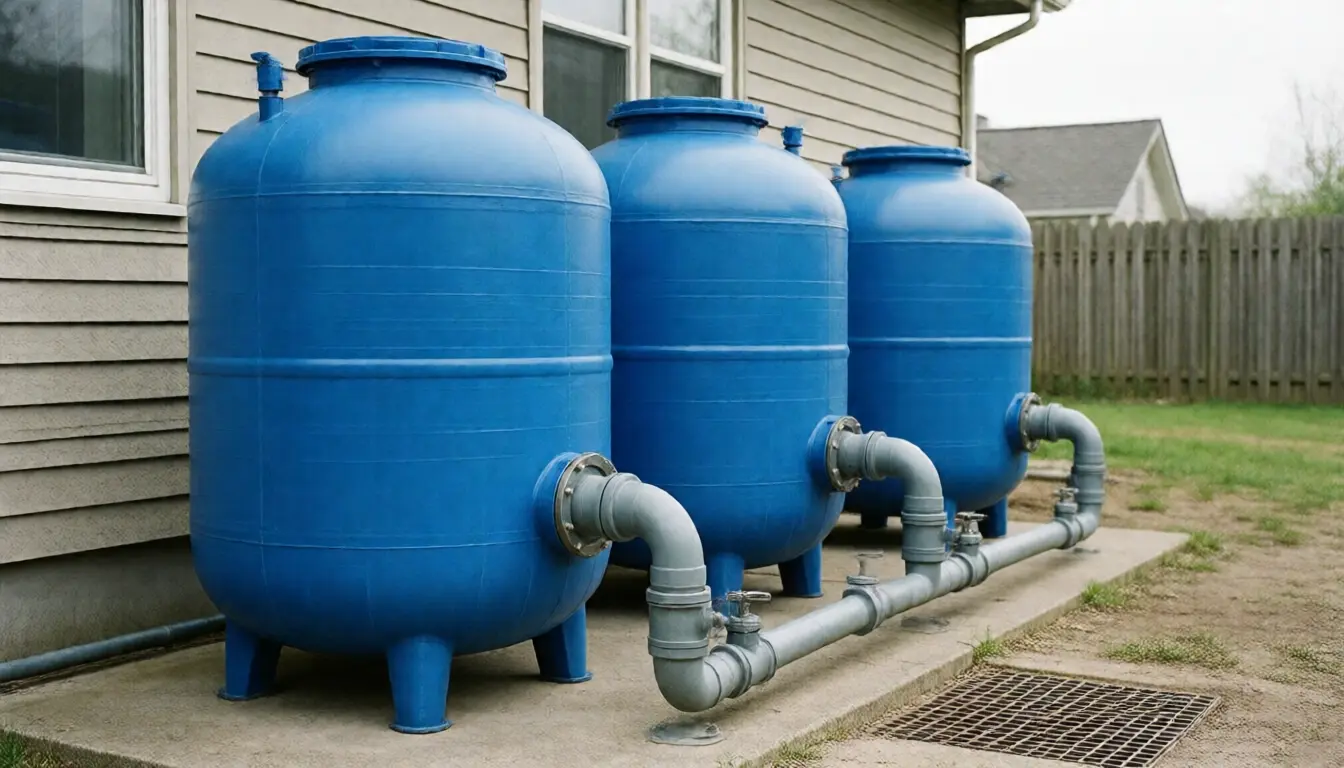
The correct order of vessels, and why order matters
This separates a competent installation from vessels simply lined up in a row.
The order runs from coarse particles towards finer things, and from what clogs easily towards what is more delicate.
Stage one, coarse sediment: sand, rust flakes, and debris from the pipework. Without it, everything downstream clogs unusually fast.
Stage two, iron and manganese, if the analysis shows them. This usually means aeration or oxidation before filtration.
Stage three, carbon, for chlorine, odour and taste.
Stage four, hardness, with an ion exchange softener, if needed.
The order people get wrong most often is putting the softener ahead of iron treatment, which coats the resin with iron and destroys it quickly.
A good supplier asks for the analysis and designs the sequence from it. One offering the same three vessels to every house is selling equipment rather than solving a problem.
Hardness specifically is covered in hard water and why a three-stage filter does nothing about it.
The costs that are invisible on the day you buy
The price discussed on day one is installation. The real cost arrives afterwards in instalments.
- Media has a life and must be changed on a cycle. It is not a lifetime purchase.
- Sediment cartridges change most often, and the dirtier the water the more often.
- Salt for the softener, for as long as it runs.
- Backwash water, which is water you already paid for and then poured away.
- Electricity for automatic valves on systems that backwash themselves.
The question to ask is what it costs per year, not per item, because the annual figure is what you will actually pay for the next decade.
Also ask what happens if the media is not changed on schedule. The answer is that an exhausted vessel does not merely stop working. It becomes a reservoir of everything it once captured and starts releasing it back into the water.
An unmaintained filtration system is therefore worse than none at all, which sellers rarely mention.
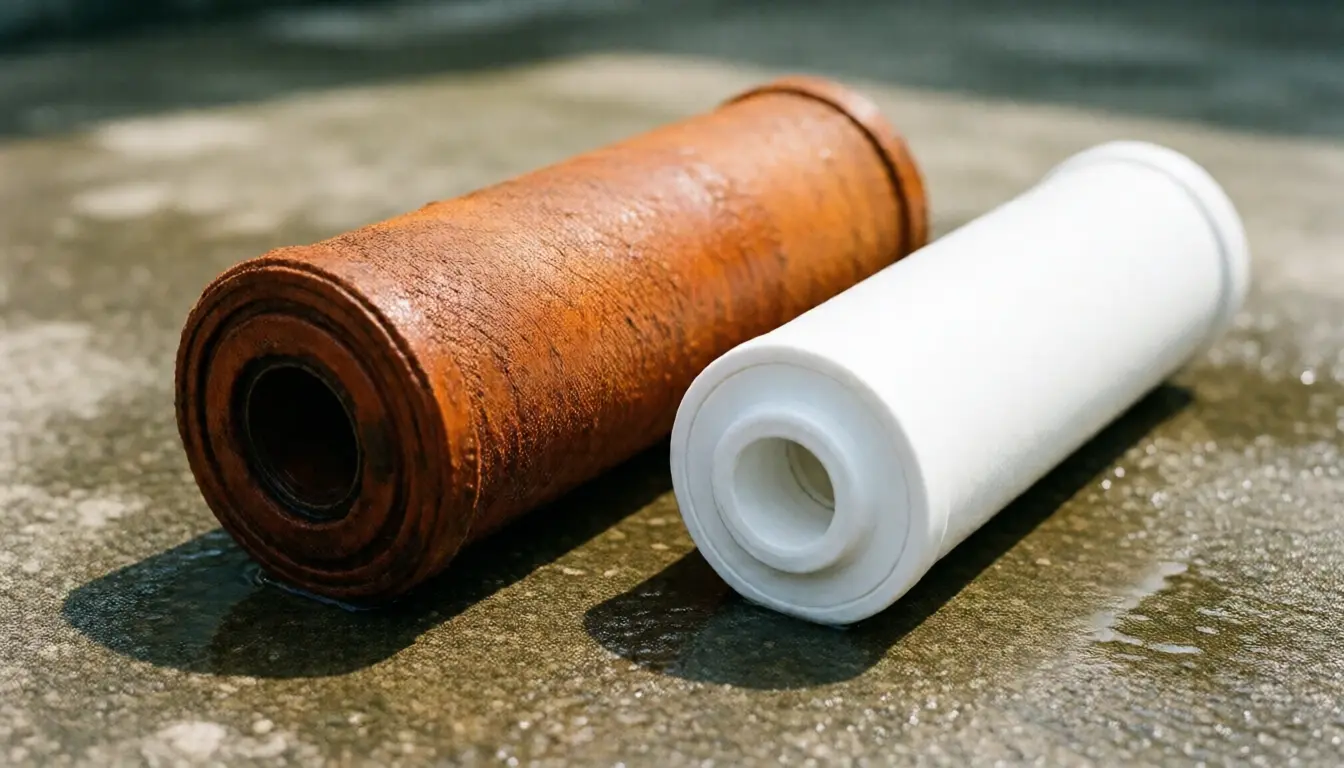
Signs the system you have is no longer working
- Pressure falls everywhere at once, which is nearly always a clogged vessel or cartridge.
- Old symptoms returning, such as staining or scale that had gone away.
- A musty or odd smell, especially in water that stood in the system overnight.
- Backwashing more and more often, or not backwashing at all despite being set to.
- Not remembering when the media was last changed, which is itself the answer.
The most direct check is measuring pressure before and after the filter train. An unusually large drop means something is blocked, and how to measure it is in measuring water pressure yourself before buying a pump.
Follow this order and you will not waste the money
One, test the water first. Ask at minimum for hardness, total dissolved solids, iron, manganese and coliform bacteria.
Two, write down the actual symptoms: where they occur, since when, and whether they are constant or seasonal.
Three, do the free fixes first. Clean the tank, clean shower heads and aerators, then see how many symptoms remain.
Four, take the analysis to at least two suppliers and compare how differently they sequence the vessels, and why.
Five, get the annual running cost as a number before signing anything.
How to take and submit a sample is in a borehole at home, the licence and whether the water is drinkable.
Frequently asked questions
Is whole-house filtration necessary?
Necessary for houses on a borehole, or with sediment, iron or clear hardness. Houses on urban mains with no symptoms usually do not get their money back.
Can I drink from the tap once it is fitted?
No. A whole-house system passes water fast enough to supply everything at once, so it filters less finely than a point-of-use unit. To drink from the tap, have both.
Why test before buying?
Because each vessel addresses a different problem. Choosing without figures is guessing, and usually ends with a system that does not treat the symptom you actually have.
How much does the order of vessels matter?
A great deal. Coarse sediment first, then iron, then carbon, then hardness. Putting a softener ahead of iron treatment ruins the resin quickly.
What are the ongoing costs?
Media with a service life, sediment cartridges changed frequently, salt for a softener, backwash water, and electricity for automatic valves.
Can I skip changing the media?
You should not. An exhausted vessel becomes a reservoir of what it captured and starts releasing it back into the water.
How do I know the system is blocked?
Pressure falling everywhere at once is the main sign. Measure pressure before and after the filter train, and an unusually large drop means something is blocked.
Can a condominium have one?
Usually not, for lack of space and because of building rules. A point-of-use unit is the appropriate answer there.
In short
- Whole-house filtration treats the water you use, and is not a drinking water filter.
- It pays best on a borehole, or with sediment, iron or hardness.
- It rarely pays on urban mains with no symptoms at all.
- Test first, always, because each vessel addresses a different problem.
- Sequence runs coarse sediment, iron, carbon, then hardness.
- Ask for running cost per year, not per item.
- An unmaintained system is worse than no system.
- Pressure dropping everywhere at once is the first sign it needs attention.