
The number on the shop sign is not the number to ask about
Almost every window film shop will tell you it blocks over ninety percent of heat. That figure usually refers to infrared or ultraviolet rejection, which is only part of the energy coming through the glass, and it does not tell you how much cooler the room will be.
The figure to ask for is total solar energy rejection, which counts both the radiation passing straight through and the heat the glass and film absorb and then re-radiate into the room. A film rejecting ninety-nine percent of infrared while absorbing a great deal itself can perform worse overall than one whose headline number looks unremarkable.
Ask for the specification sheet for the exact product being fitted, not a brand brochure, and read three values together: total solar energy rejection, visible light transmission, and ultraviolet rejection. They have to be read together, because the film that rejects the most heat is usually the one that makes the room darkest.

Heat comes through a window two ways
Understand these two and you can choose for yourself. The first is solar radiation passing straight through the glass and landing on your floor and furniture. The second is heat the glass itself absorbs until it is hot, then radiates from both faces, including the one inside your room.
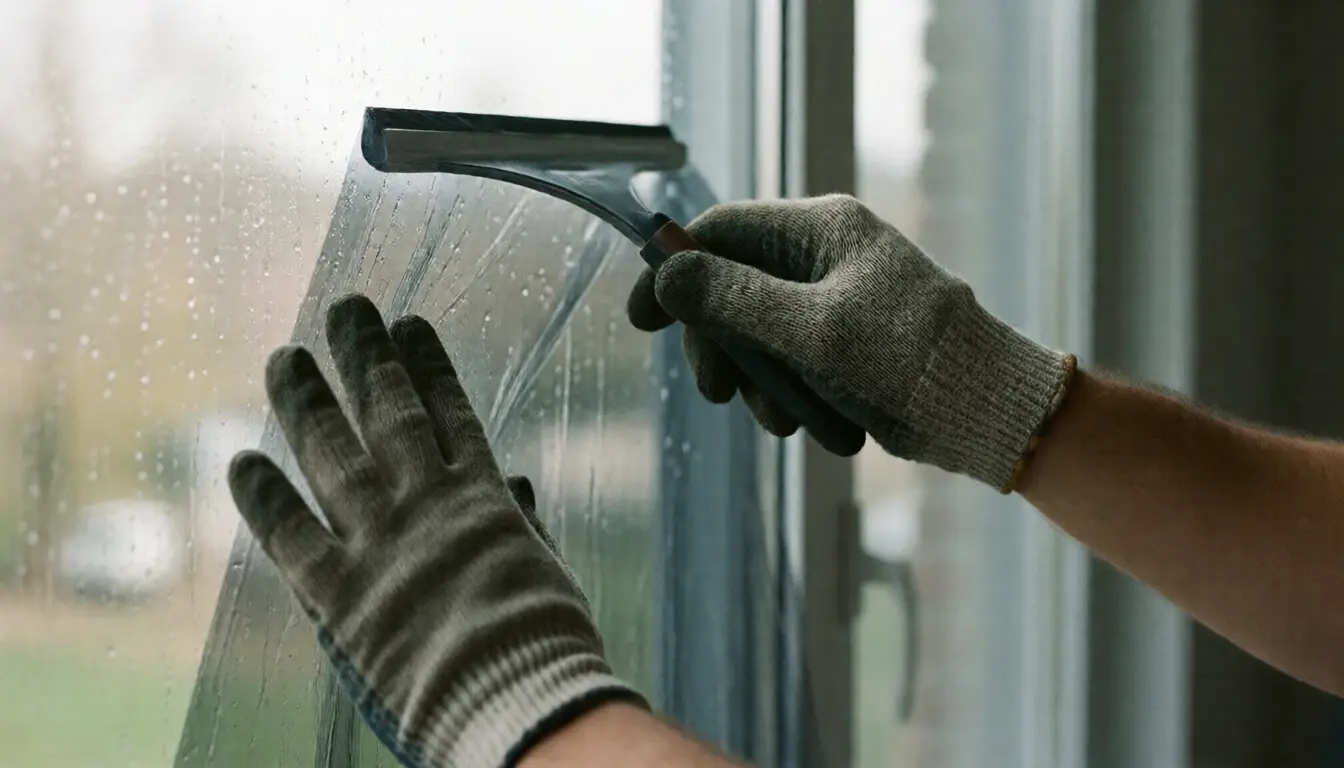
Film deals well with the first, but it works at the inner surface of the glass, meaning the energy has already arrived before the film can do anything. What it reflects back is genuine gain. What it absorbs becomes heat in the glass, which comes into the room anyway.
That is why external shading always beats film, however good the film. An eave with enough projection, external louvres, or a tree in front of a west-facing window stops the energy before it reaches the glass at all, which is solving it at source.
If you are thinking about heat in the house generally rather than just windows, read this alongside ventilation and sun path in light and ventilation in a Thai house.
Ceramic film or metallised film
Film using a metal layer reflects heat well and costs less. The drawback to know first is that a metal layer can interfere with radio signals, which in practice means the phone signal in that room may weaken, and some wireless devices that need to communicate through the glass may work worse.
In a house with cameras, sensors and equipment talking over Wi-Fi, this is not a trivial point, particularly in a room where the mobile signal is already weak.
Ceramic film has no metal layer and so no such problem, and it usually looks clearer without a mirror-like reflection. It costs more and is the one to choose for rooms in daily use. Metallised film remains fine for windows with nothing near them, such as a stairwell light.
What shops rarely mention: the glass can break on its own
Applying film makes the glass absorb more heat and run hotter. If that heat is unevenly distributed across the pane, part of it in strong sun while the edges sit in the shadow of the frame, the differing stress within the glass can crack it with nobody touching it.
The risk varies with the type of glass. Ordinary annealed glass is more vulnerable than heat-treated or toughened glass, and a large pane in half sun is more at risk than a small one lit evenly.
What to do is tell the shop what glass you have, how thick, and how the sun falls on that pane, and let them select a film suited to those conditions. A shop that can discuss this knows its trade. One that says any film goes on any glass is one to question a little further.
How Low-E glass differs from film
Low-E glass carries a thin coating applied at the factory to reduce heat radiating through it. Unlike film, it is part of the glass from manufacture rather than something added afterwards.
The advantages are better performance and a life equal to the glass, with no bubbling or peeling. The limitation is that if the house is finished and fitted with ordinary glass, changing to Low-E means changing the panes, which is a different scale of job from applying film.
The straight advice: if you are building or replacing windows anyway, consider Low-E then, because the price difference is modest compared with correcting it later. If the house is lived in and the windows are sound, film is the more sensible route.
Three things to try before fitting film
In many houses these three return more per baht than film, and can be done immediately.
First, blackout curtains hung close to the glass and covering beyond the frame. A curtain hung away from the window and stopping short of the reveal lets hot air circulate around the edges into the room. One that seals creates a still air layer that genuinely insulates. The difference between the two is larger than people expect.
Second, external shading, whether an eave, louvres or external blinds, because anything that stops the sun before the glass beats anything working behind it. A single dense tree planted to shade a west-facing window shows a clear result within a few years.
Third, check whether that room is hot from the sun at all, or hot because air does not move and heat is coming down from the roof. If it is the latter, film will not help much and the money belongs in roof insulation instead.
Can you film a condominium window?
Yes, but ask the juristic person first, because the external glazing determines how the building looks. Most buildings therefore have rules on the colour and darkness permitted, and some specify the product and the installer.
The questions to ask are whether there are requirements on colour or reflectivity, whether notice is required, and whether it has to be removed if you move out. Ask those three before paying a deposit to a shop. It is cheaper than being told to strip it off afterwards.
Frequently asked questions
Is "blocks 99 percent of heat" true?
That figure usually refers to infrared or ultraviolet rejection, only part of the energy arriving. Ask for total solar energy rejection instead, and read it alongside visible light transmission.
Can film crack my glass?
There is a risk from uneven heat build-up, particularly in large ordinary glass panes lit across only half their area. Tell the shop the glass type, thickness and how the sun falls, and let them select accordingly.
Ceramic or metallised?
Metallised reflects well and costs less but can interfere with wireless signals. Ceramic has no such problem and looks clearer, at a higher price. Rooms full of wireless devices want ceramic.
Can Low-E be added later?
No, it is a factory coating, so changing to Low-E means changing the panes. If the house is finished and the windows are sound, film makes more sense.
Do I need permission in a condominium?
Always ask first, because external glazing defines the building's appearance. Many buildings specify permitted colour and darkness, and some the product and installer.
In short
- Ignore the headline heat rejection figure. Ask for total solar energy rejection and read it with light transmission.
- External shading always beats film, because it stops the energy before it reaches the glass.
- Metallised film interferes with wireless signals. Rooms with devices want ceramic.
- Tell the shop the glass type and how the sun falls, because uneven heat can crack a pane on its own.
- Low-E has to be decided when building or replacing windows; it cannot be added later.
- If the room is hot from the roof rather than the windows, that money belongs in insulation.