
With water leak sensors, where you put them matters more than which brand
They cost a few hundred baht each and every brand works the same way, sending an alert when the contacts get wet. What decides whether they are useful or end up in a drawer is where you place them.
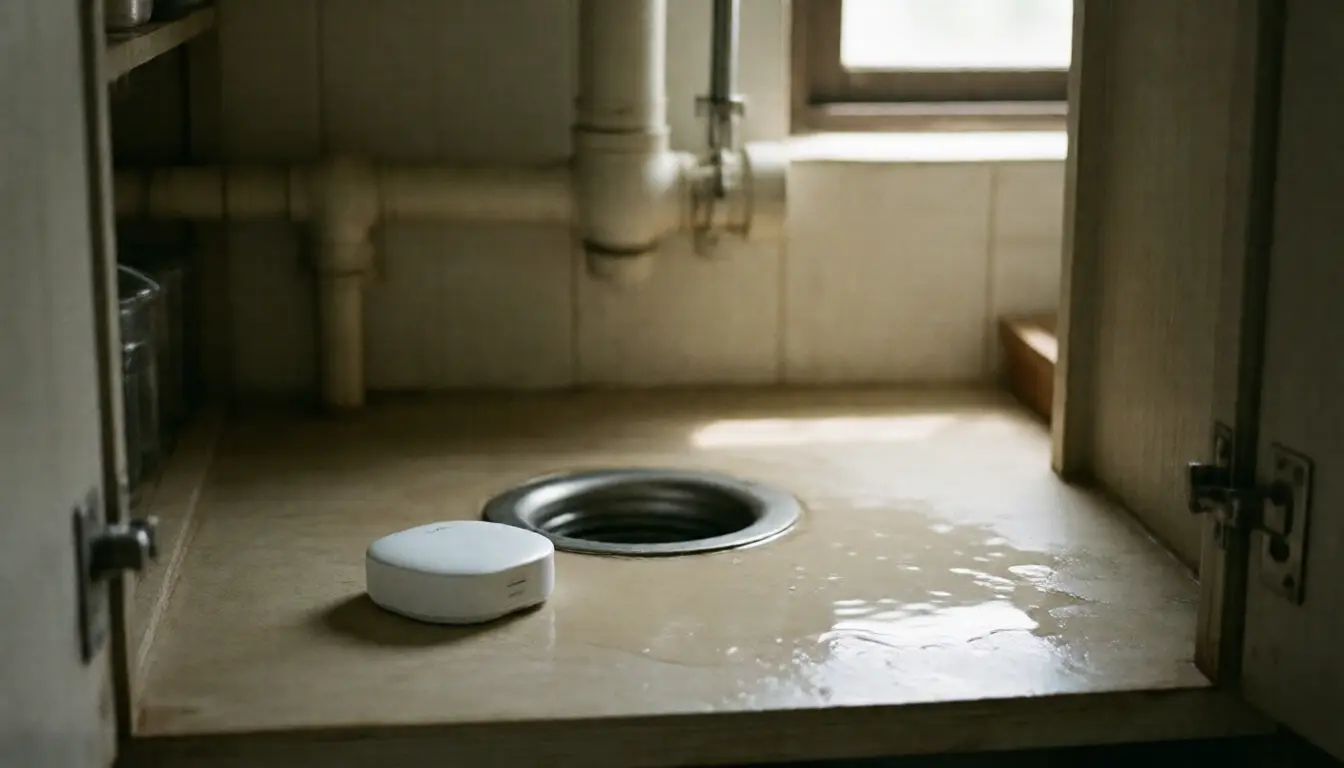
The five that earn their keep are under the kitchen sink, under the bathroom basin, behind or beneath the washing machine, near the water heater or the pump, and near the indoor unit of a wall or ceiling air conditioner. Those five cover almost every source of a leak in a house.
Why a household leak costs more than people expect
Because what is damaged is not the water, it is whatever the water reaches, and in a modern house those materials are all afraid of it.
Laminate flooring swells within hours and cannot be patched in one spot; the whole run comes up. Plasterboard ceilings stain and sag and do not recover. Built-in cabinets made from particle board swell along the bottom edge, which is the part nobody sees until it is opened up.
So the comparison is not the price of a sensor against the price of the water. It is the price of five sensors against relaying the floor of a room, which is not a comparison that takes long.
In a condominium there is another layer, because water reaching the unit below turns this from your own repair bill into liability towards a neighbour, which drags on far longer. That is covered in water leaking from the unit above and who pays.

Alerting only, or shutting the valve as well
An ordinary sensor sounds an alarm and sends a notification, which is enough for a house with people in it, because whoever hears it can go and close the valve within a couple of minutes.
But if what you fear is a pipe letting go while you are away for three days, an alert on its own achieves nothing. It simply tells you what is happening in a house you cannot reach. That case needs an actuator on the main water valve that closes automatically when any sensor gets wet.
The second kind costs several times more and needs someone to fit it at the main valve, so the decision comes down to one question: how often is this house empty? If the answer is hardly ever, five ordinary sensors are far better value.
Three things to check before buying
First, how long the battery lasts and whether you can change it. Anything that needs a ladder and a new cell every six months is something that will be left flat by its second year. Choose a model taking easily bought cells with a low battery warning.
Second, a built-in sounder rather than only an app notification. If somebody is home, a loud noise coming from under the sink tells them faster than any phone will, and in a house with older residents, sound is a far more reliable channel than an app.
Third, the shape of the sensing element. Models with the contacts on the underside detect once the water is already reasonably deep. Models with a lead you can lay flat along the floor catch a thin film, which is much sooner when the problem is a slow seep rather than a burst.
Put one down, then test it
Touch a wet cotton pad to the contacts after installing, to confirm it really does sound and really does reach your phone. Then repeat once a year, because a sensor whose battery died quietly is the same as no sensor, and you will find out on the day it was supposed to work.
One more thing worth doing on day one: find the main water valve for the house and try turning it. A valve nobody has touched in ten years is often seized on the day it is needed, which is something to discover while the floor is dry rather than after it is not.
If you are equipping a whole house rather than one spot, the overall picture is in smart homes in 2026, and for a rented property read it alongside home automation in a rental property, because fitting devices in a home someone else lives in has its own cautions.
Frequently asked questions
How many should I fit?
Five covers almost everything: under the kitchen sink, under the basin, behind the washing machine, near the water heater or pump, and near the air conditioner's indoor unit.
Do I need automatic valve shut-off?
It depends how often the house is empty. With someone home most of the time, an audible sensor is enough because a person can close the valve. If you travel often, an alert alone does nothing.
Does home insurance cover water damage?
It depends on the policy. Many cover water damage in some circumstances but not all, and gradual damage from lack of maintenance is commonly excluded. Read that section of your own policy first.
In short
- Placement beats brand. The five spots are both sinks, behind the washing machine, near the water heater and near the air conditioner indoor unit.
- The expense is what the water touches, not the water. Laminate and plasterboard cannot be patched.
- Choose a model with its own sounder, not app notification alone.
- Automatic valve shut-off pays only for a house that is often empty.
- Test with a wet cotton pad on installation and again once a year.
- Find the main water valve and turn it today.