
Which cracks are dangerous, in one line
A crack on a column, a beam or a slab is always more serious than a crack on a wall, because columns, beams and slabs carry the building. Masonry infill walls in most modern buildings carry nothing; they divide rooms.
The single easiest test is whether you can see reinforcing steel. Concrete that has split or spalled far enough to expose the bar inside is a crack to report immediately, not one to watch.
This article condenses the self-assessment guidance the Bangkok Metropolitan Administration published for residents after the earthquake of 28 March 2025 into a form a homeowner or condo resident can use unaided.
The two groups the BMA uses
Under the self-assessment guidance published by Thairath citing the BMA, damage falls into two groups.
| Can wait for a later inspection | Report immediately |
|---|---|
| Wall cracked but still firm, does not move when pushed | Wall leaning, at risk of collapse |
| Floor tiles lifting, paint flaking | Slab sagging, reinforcement exposed |
| Beam cracked parallel along its underside | Beam cracked diagonally, or split to expose steel |
| Small column cracks with no bowing | Column bowed, or concrete blown off to expose steel |
| Ceiling panels loose or damaged |
Note that this is not primarily a ruler test. It reads shape and position. A column with small cracks that is still straight sits in the first group; a bowed column sits in the second, however modest the cracking looks.
Position matters more than width
Cracks in masonry walls
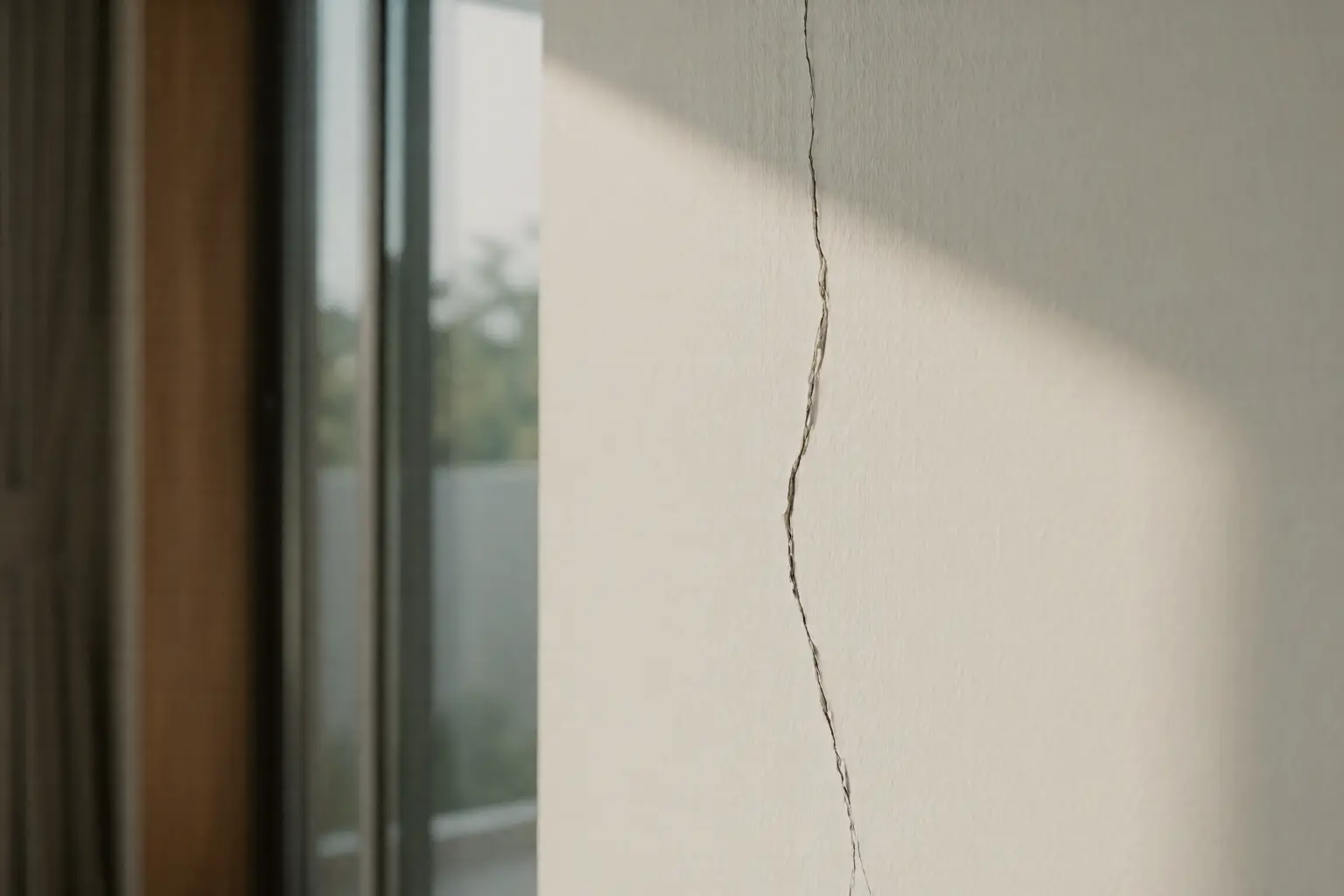
Fine cracks of up to about 1 mm in the plaster skin usually come from the plaster shrinking as it dries, or from the quality of the mortar. The risk is low and the structure is unaffected.
Crazing, the net of fine cracks spread across the face of a wall, belongs in the same group. It is a plaster problem, not a structural one.
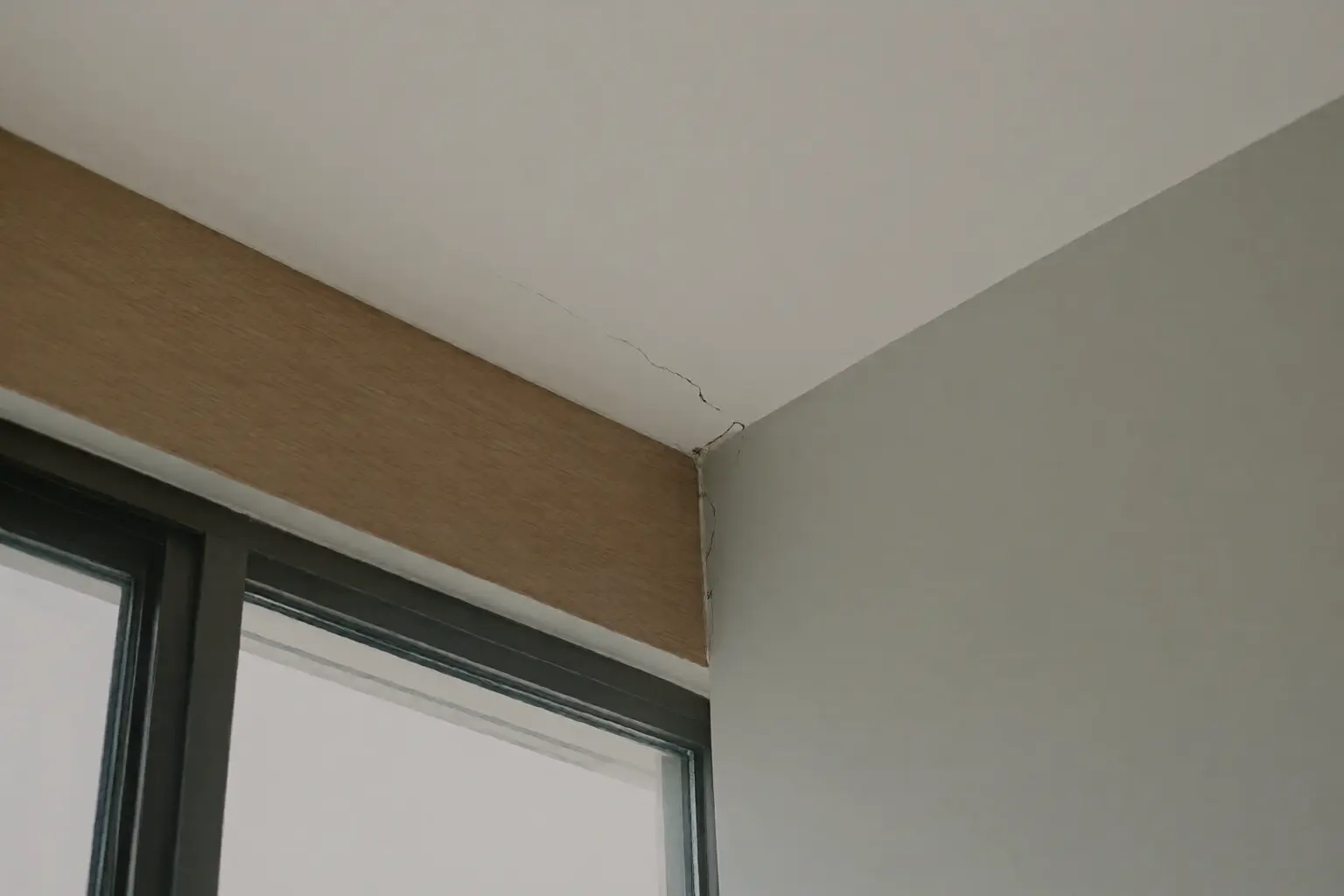
Vertical cracks along the joint between a column and a wall can arise where column and wall sit at different temperatures, or where no starter bars were set between column and wall during construction. This is repairable and is not a sign that the structure is overloaded.
Cracks in columns

Vertical cracking at the base of a column indicates that the column is not carrying its load well, or is carrying too much.
Horizontal cracking at the head and the base of a column comes from torsion combined with shear, commonly where a beam cantilevers too far past the column.
A column whose concrete has spalled to expose reinforcement, or which has bowed out of vertical, is a case for leaving the area and reporting at once, not for photographing and revisiting later.
Cracks in beams
A crack running parallel along the underside of a beam falls in the group that can await inspection, under the BMA criteria.
A diagonal crack in a beam, or a beam split to expose steel, falls in the report-immediately group, because beams carry load from the slab down to the columns.
Cracks in slabs
A slab sagging far enough to expose reinforcement is in the report-immediately group. Floor tiles lifting or cracking are a finish problem, not a slab problem.
What a 45-degree diagonal crack tells you
A diagonal crack at roughly 45 degrees is caused by shear, which commonly arises from differential settlement. It signals that the structure is being pulled in a direction it was not designed to resist.
Diagonals running up from the corner of a door or window are a frequent pattern, because the corners of openings are where stress concentrates most.
One distinction to hold on to: a diagonal on a masonry wall and a diagonal on a beam or column do not carry the same weight. The first may be a by-product of settlement. The second is damage in a load-carrying member.
How to monitor a crack yourself, without instruments
The hardest question is not how wide the crack is, but whether it is still moving. A crack that has stopped is damage that already happened. A crack still opening is a problem still in progress.
- Draw a short pencil line across each end of the crack and write the date beside it.
- Photograph it with a coin or a ruler alongside for scale.
- Repeat from the same angle every two weeks, at least three times.
- If the crack runs past your pencil marks, or is visibly wider in the comparison, it is still moving.
Maintenance sources agree that a crack growing in both width and length over a few weeks needs prompt attention and a specialist inspection.
How far Thai buildings are designed to resist earthquakes
The Ministry of Interior issued the Ministerial Regulation on the load capacity, resistance and durability of buildings and their supporting ground against earthquake forces, B.E. 2564 (2021), published in the Royal Gazette on 4 March 2021, replacing the 2007 regulation, according to the Association of Siamese Architects.
Seismic design requirements apply to buildings over 15 metres tall in Bangkok and its surrounding provinces, per Thansettakij, which explains that the principle of Thai law is that buildings should resist the severe earthquakes that may occur in Thailand.
The event that brought this back into public attention was the earthquake centred near Mandalay, Myanmar, at 13:20 on 28 March 2025, measured at magnitude 8.2 by the Thai Meteorological Department and 7.7 by the USGS, and felt as far as Bangkok.
The question a condo owner should put to the juristic person is therefore not only whether the building has cracked, but which year's regulation it was built under, and whether the annual building inspection report can be seen.
What to do when you find a dangerous crack
- Leave the area first, if a column is bowed, a wall is leaning, or a slab is sagging.
- Photograph both the wide view and the close view, with something for scale.
- Notify the condominium juristic person, or the district office for a house.
- Ask for a licensed engineer, not a general contractor. Plastering over a structural crack destroys the evidence rather than repairing the fault.
- Keep the whole photo series. It is the only record that establishes whether the crack predates a given event.
In a condominium, responsibility divides between common property and private property. Columns and beams are primary structure and therefore common property, so repairs are the juristic person's responsibility, not the unit owner's.
Do cracks affect a property's value
They do, and by very different amounts depending on the type. Crazing on a plaster face barely moves the price, because it is repaired for a few thousand baht and experienced buyers recognise it as a surface issue.
Cracks in columns or beams affect both price and time to sell, because a buyer who brings a builder will see them, and so will the bank's valuer.
The straightforward advice for a seller is to have an engineer inspect and complete the repair with documentation, rather than leaving the buyer to make the discovery. A crack with an engineer's report attached is information. A crack that has been plastered over is a risk, and buyers price risk higher than the actual cost of repair, every time.
If you are buying a resale home, read our guide to structure, risk and hidden costs in Thai resale houses.
Frequently asked questions
Which cracks are the most dangerous
Cracks that expose the reinforcing steel inside the concrete, and cracks on a column that has bowed out of vertical. Both fall in the report-immediately group under the BMA's published criteria and should not be left under observation.
How many millimetres wide is a crack before I should worry
Fine cracks of up to about 1 mm in plaster usually come from shrinkage and carry low risk, but width alone is not the test: a small crack on a bowed column is more serious than a wide crack on a wall that is still firm.
What does a 45-degree diagonal crack in a wall mean
It indicates shear, commonly caused by differential settlement. On a masonry wall, monitor it for movement. On a column or beam, have an engineer inspect it immediately.
How do I tell whether a crack is still growing
Draw pencil marks across both ends of the crack with the date, then photograph from the same angle every two weeks at least three times. If the crack runs past the marks or looks wider in comparison, it is still moving.
Who pays to repair cracks in a condominium
Columns, beams and primary structure are common property, so the juristic person is responsible. Internal walls and finishes inside the unit are the owner's private property.
Must buildings in Bangkok be designed to resist earthquakes
Yes, for buildings over 15 metres tall in Bangkok and its surrounding provinces, under the 2021 ministerial regulation on resistance to earthquake forces, published in the Royal Gazette on 4 March 2021 and replacing the 2007 regulation.
Can I fill a crack myself
Only crazing and fine cracks in the plaster skin. Cracks in columns, beams or slabs should not be filled before an engineer has inspected them, because covering them makes further movement impossible to assess.
In short
Two tests do nearly all the work: is the crack in a load-carrying member, and can you see reinforcing steel. Together they separate cracks that can wait from cracks that must be reported at once, in almost every case.
For anything still unclear, pencil the ends with a date and photograph it every two weeks. What an engineer most wants to know is not how wide the crack is today, but whether it is growing or has stopped.
Looking for a property that has been properly inspected? Browse houses and condominiums for sale. Owners wanting to know how condition affects price can see our house sales service.