
One plot of land carries three prices, and people mix them up
The first is the government assessed value, prepared by the Treasury Department and published as a schedule covering a whole cycle.
The second is the bank's valuation, produced by the bank's valuer for that particular loan.
The third is the market price, which nobody publishes, because it is what somebody actually paid in a deal that has already closed.
Three sets, answering different questions, produced by different people, used for different things.
When people say the assessed value and the market price differ by a factor of two, they usually mean the first and the third.
And the shortest answer is that the two were never trying to answer the same question.
What the assessed value is, and what it is used for
The assessed value is prepared under the Property Valuation for State Benefit Act B.E. 2562 by the Treasury Department.
It is published as a schedule for a whole cycle, rather than valued plot by plot on request.
It is used for two main things.
Calculating fees and taxes at the land office on the day rights are registered, as set out in working out transfer day costs before you get there.
Serving as the base for the land and buildings tax collected by local authorities.
Notice that both of those are the state collecting money.
The assessed value was therefore never designed to say what that plot ought to sell for.
It was designed to provide a base that is fixed, consistent and not open to case by case argument when calculating fees and taxes.
Which is the opposite of a market price, because a market price moves every month and differs from plot to plot.
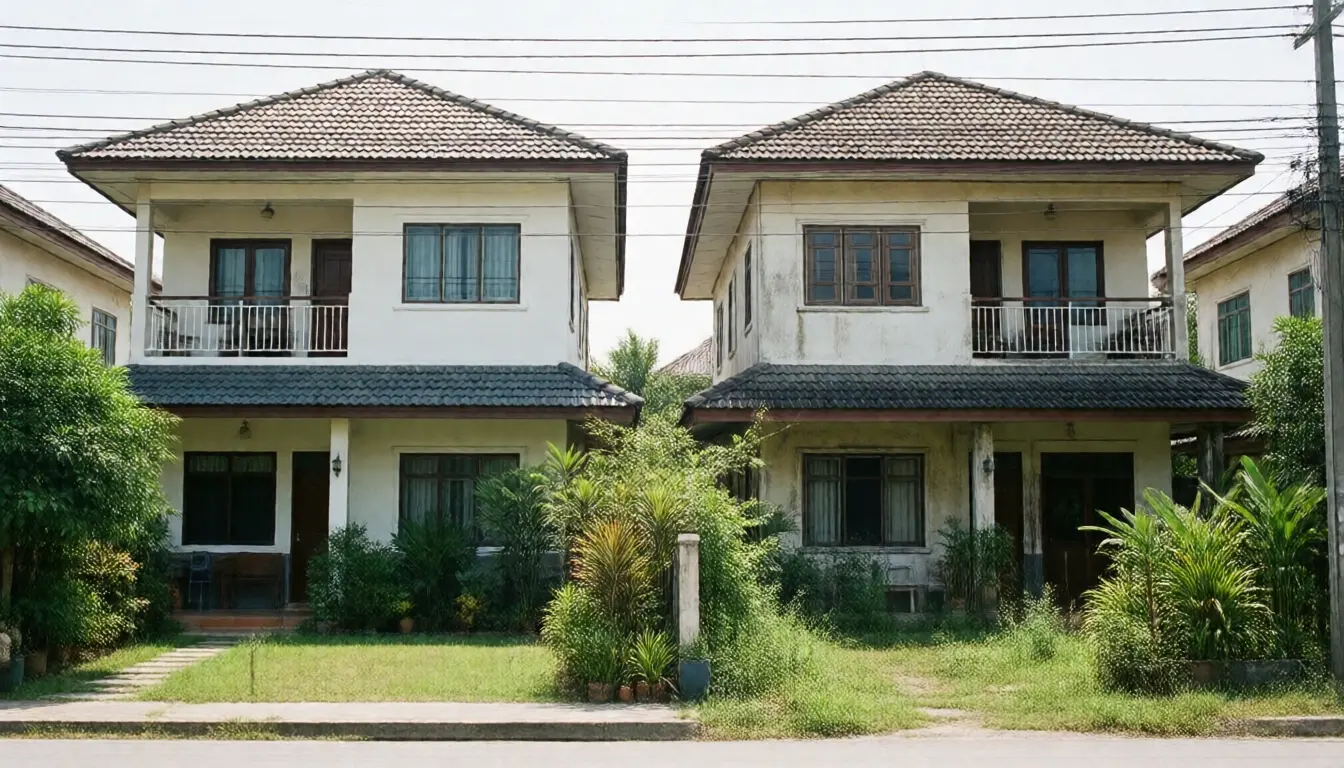
Six reasons the assessed value sits below the market
One, it is assessed in groups rather than plot by plot. Valuation is done by block or by street, and the same figure is applied to every plot in that group.
So a corner plot and a mid lane plot in the same block can carry the same assessed value while the market prices them very differently.
Two, the schedule runs for a whole cycle. The published figure applies for the entire period even where the local market has already moved.
In a fast moving area the gap widens every year until the next cycle.
Three, it does not look at the actual condition of the building. Structures are valued to standard specifications with depreciation by age.
So a completely renovated house carries the same assessed value as the one next door that nobody has touched in twenty years.
Four, it gives no weight to what the market values: the view, the prevailing breeze, quiet, neighbours, schools nearby, or a plot shape that works well.
Those move market prices a great deal and appear nowhere in the schedule.
Five, it does not reflect short term demand. A surge caused by a new project or investment news happens faster than any schedule can follow.
Six, it is deliberately conservative, because it is a tax base, and publishing figures above reality would burden people for no reason.
None of those six is a defect. They are what happens when a number does its own job rather than the job of a market price.
The bank's valuation is a different thing entirely
Anybody borrowing to buy meets this number and is usually alarmed, because it tends to sit below the agreed price.
The reason is the purpose.
The bank's valuer is not engaged to say what the house is worth. They are engaged to say how much the bank would recover if it had to sell at auction on the day the borrower could no longer pay.
Those two questions do not always give the same answer.
And banks generally calculate the loan from the lower of the agreed price and their own valuation.
So a buyer who agreed a price above the bank's figure has to find the difference in cash.
This is among the leading reasons deals collapse in the final week, and why the bank should be asked about it before a large deposit changes hands.

Where the market price comes from, and where it does not
The market price is what a buyer and a seller actually agreed recently, for a comparable property.
The operative words are actually agreed.
An asking price is not a market price. It is the seller's opening position.
A house that has been listed at the same figure for two years does not prove that figure is the market. It proves the figure has been above the market for two years.
And what a neighbour says somebody once offered is not a market price either.
Because an offer that never closed is a number nobody had to pay.
How the two can differ by a factor of two
The gap opens widest in four situations.
Areas that have just received new infrastructure, a station, an expressway or a new road, which move the market immediately while the schedule still belongs to the previous cycle.
Land with plot specific advantages, such as a very wide frontage, a corner position or access from two sides, which group valuation does not separate out.
Houses where the value sits in the building, fully renovated or built with high grade materials, because structures are valued to standard specifications with depreciation.
Areas where the town plan has changed, which changes what can be built there and changes the whole pool of buyers, as covered in how zoning changes land value.
In all four the assessed value is not wrong. It simply was not built to capture any of them.
And sometimes the assessed value is above the market
People assume the assessed value is always lower, which is not so.
Landlocked plots with no access to a public way sell well below their neighbours while carrying a similar assessed value in the same block.
Encumbered land, crossed by a servitude or occupied under a long lease, which reduces what a buyer can do with it.
Property in a declining area, where no real buyer exists at that figure any more while the schedule still belongs to a cycle when the local economy was healthier.
Badly deteriorated houses, where depreciation by age has not kept up with actual damage.
In those cases the seller finds that fees and taxes are calculated on a figure higher than what they could actually sell for.

Which number to use, and when
For transfer costs and property tax, the assessed value, obtainable from the land office holding the deed.
For setting an asking price, the market price from deals actually closed in that area, not the assessed value and not other people's asking prices.
For working out how much cash to have ready, the bank's valuation, because the loan is based on it.
For negotiating, all three, used differently.
The market price says whether the figure under discussion is reasonable.
The bank's valuation says whether this deal can actually close with the money available.
The assessed value says what will be payable on transfer day.
Somebody who knows all three before sitting down is in a very different position from somebody who knows one.
Five ways to find the real market price
One, look at closed prices rather than asking prices. Where closed data is unavailable, look at which listings disappeared quickly and which have been sitting.
Listings that sold quickly show the range the market accepts. Listings that linger show the ceiling it does not.
Two, compare properties that are genuinely alike: similar land size, similar building age, in the same lane or the one beside it.
Different house types in the same lane are not comparable, and the same house type in a different area is not either.
Three, adjust for differences one at a time. A comparable with a wider frontage, add. One on a noisy main road, subtract.
Write the adjustments out as a list rather than doing them in your head.
Four, ask somebody who actually works that area, an agent who closed deals in that lane over the past year, who knows things that never appeared in a listing.
Five, let the market test it. If a listing draws no contact in its first fortnight, the price is too high rather than the market being quiet.
The first fortnight is when a listing gets the most attention, and it is the most direct information you will ever get.

What to do before deciding
Get the assessed value for that plot from the land office holding the deed.
Ask when the current schedule came into use, because the closer to the end of a cycle, the wider the gap with the market.
Gather at least three closed deals in the area, and write down how each differs from your property.
Ask the bank what it will value at before paying a large deposit, not afterwards.
Do not use the assessed value as a negotiating argument, because the seller already knows it is not a market price, and raising it stalls the conversation for nothing.
That last is an extremely common mistake among first time buyers.
Frequently asked questions
What is the assessed value?
A figure prepared by the Treasury Department under the Property Valuation for State Benefit Act B.E. 2562, published as a schedule for a whole cycle, used to calculate fees and taxes at the land office and as the base for the land and buildings tax.
Why is it so far below the market?
Because it is assessed in blocks or by street, applies for a whole cycle, ignores the actual condition of the building, gives no weight to view or plot specific advantages, and is designed as a fixed tax base rather than a selling price.
How does the bank's valuation differ?
In purpose. The bank's valuer answers what would be recovered at auction, not what the house is worth on the market, and banks generally lend against the lower of the agreed price and their own figure.
Is the asking price the market price?
No, it is the seller's opening position. The market price is what actually closed recently on comparable property.
Can the assessed value exceed the market price?
Yes, on landlocked plots, on land carrying a servitude or a long lease, in declining areas, and on houses that have deteriorated faster than depreciation by age allows.
How often is it updated?
By cycle rather than annually with the market, so it is worth asking when the current schedule started, because the gap widens towards the end of a cycle.
Can I negotiate using the assessed value?
You can, but it does not work, because the seller already knows it is not a market price. What negotiates is closed deals in the same area and the condition of the property.
How do I know my asking price is too high?
By the first fortnight after listing, when attention is highest. No contact at all in that window is usually about price rather than a quiet market.
In short
- One plot carries three prices, and each answers a different question.
- The assessed value exists to calculate fees and taxes, not to indicate a selling price.
- It is assessed by block, applies for a whole cycle, and ignores the building's real condition.
- The bank's valuation answers a question about security, not about market value.
- The market price comes from closed deals, not from asking prices.
- The gap is widest where new infrastructure has arrived and where value sits in the building.
- Sometimes the assessed value is higher, as on landlocked or encumbered land.
- Ask the bank what it will value at before paying a large deposit.
- Do not negotiate with the assessed value, because the seller already knows what it is.