
How much earthquake cover does a Thai home fire policy give?
The standard residential fire policy covers four natural perils, windstorm, flood, earthquake and hail, up to a combined limit of THB 20,000 per year, under the standard cover used across the Thai insurance market.
The THB 20,000 figure is where most people are caught out, because the sum insured on the policy may be several million baht while the limit for all four natural perils together is a separate sub-limit rather than the full sum insured.
So a home insured for THB 3 million that suffers THB 200,000 of earthquake damage is indemnified up to the natural-peril limit stated in the policy, not for the THB 200,000, unless extended earthquake cover was bought.
What to do is not to guess but to pull out the policy schedule, read the natural-perils line, and see what limit is written there and whether any extension was purchased.
Who insures what in a condominium
In a condominium, insurance falls into two layers along the line between common property and private property. The juristic person handles insurance of the common property; each co-owner handles their own unit and its contents.
The Condominium Act B.E. 2522 contains no section imposing an insurance duty, so the matter sits in the by-laws and in resolutions of the general meeting, which means a co-owner has to read their own building's by-laws rather than assume somebody has it covered.
Three questions worth asking at the general meeting: what limit does the building's policy carry for earthquake, does the sum insured reflect current construction cost, and what deductible does the juristic person carry itself.
The part of a co-owner's exposure that usually goes uninsured is the fit-out added inside the unit, because it is not common property and is not in the building's policy. The boundary between common and private property and the rights that go with it are covered in our article on condominium common fees.
Was your building designed to resist earthquakes?
The current rules are in the Ministerial Regulation prescribing the loading, resistance and durability of buildings and of the ground supporting them in resisting earthquake vibration B.E. 2564, which divides the monitored areas into Zone 1, Zone 2 and Zone 3 and sets design requirements for buildings in them.
That regulation replaced the B.E. 2550 edition, which was the first to set systematic requirements for resisting seismic vibration.
What a buyer should pin down is the year the construction permit was issued, because a building permitted before the 2550 regulation was not required to be designed to those seismic criteria. That does not mean the building is unsafe; it means the criteria applied at design time were older.
The design standard engineers work to is the Department of Public Works and Town and Country Planning standard for seismic-resistant building design, DPT 1301/1302-61, which you can ask the designer or the building's juristic person for.
What to do first after a quake
Step one is people, not photographs. Leave by the fire escape if there are unusual noises or cracks, and do not use the lift.
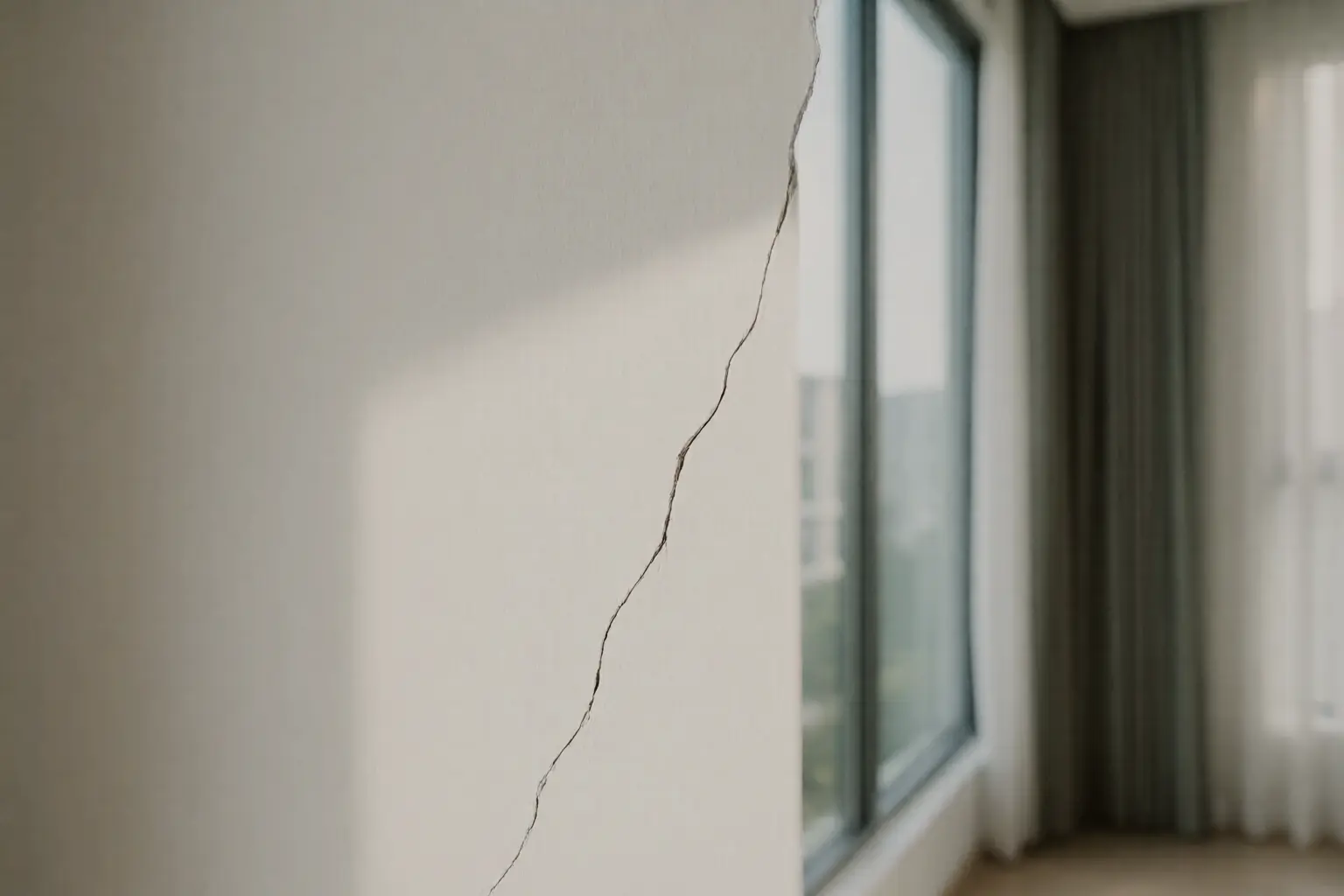
Step two is to record the damage in full before fixing anything. Photograph every crack with something in frame for scale, take wide shots that show where each crack sits in the room, and keep the date and time, because a claim has to show the damage came from that event.
Step three is to notify the condominium juristic person in writing, so that damage to common property enters the building's inspection and claim process rather than sitting in a chat group.
Step four is to notify your own insurer within the period the policy states, and to ask it to say plainly which part of the damage falls under the natural-perils limit and which part falls under any extension you bought.
For reading which cracks are structural and which can wait, start from the criteria in our article on which cracks are dangerous, then have an engineer inspect if the criteria say so.
Buying the right amount of extra cover
Start with two numbers: the cost of rebuilding the structure new, and what it would really cost to replace the contents if they were all gone. Neither is the price you paid for the home, and neither is the appraised value.
Then look at the natural-perils limit in the current policy and ask the insurer what limit is available as a separate earthquake extension and what the additional premium is.
The question to add is the deductible, because a higher limit paired with a higher deductible may do nothing for the medium-sized loss that is far more likely than the total one.
Owners who let their property should separate clearly who insures what as between owner and tenant and write it into the lease. The statutory repair duties are in our article on who pays for repairs in a rented home.
And if you are about to buy in a tower, the permit year and the building's policy are questions for before the deposit, alongside the inspection list in our condo handover checklist.

Frequently asked questions
Does a home fire policy cover earthquake?
It does, but as a sub-limit shared with other natural perils. The standard residential fire policy covers windstorm, flood, earthquake and hail up to a combined THB 20,000 per year unless extended cover is bought.
Is the THB 20,000 per event or per year?
It is a combined limit for all four natural perils per year under the standard cover, so check your own policy schedule to confirm the wording that applies to you.
Can I buy extra earthquake cover?
Yes, by asking the insurer for an earthquake extension, which carries its own limit and premium separate from the standard cover, and you should ask about the deductible as well.
Who claims when a condominium is damaged?
Common property is for the juristic person under the by-laws and the general meeting's resolutions. The unit, its contents and any fit-out added are for the co-owner.
Is a building constructed before 2007 unsafe?
Not necessarily. It means it was not required to be designed to the seismic criteria of the B.E. 2550 regulation, which has since been replaced by the B.E. 2564 edition.
What should I do immediately after a quake?
See to people first, then record the damage with photographs including something for scale before repairing anything, then notify the juristic person in writing and your insurer within the policy's time limit.
Which cracks need an engineer?
Cracks in columns, beams or slabs are more serious than cracks in light partitions, and any crack exposing reinforcement is a signal to have an engineer inspect. The detail is in our article on dangerous cracks.
Should a tenant take out insurance?
The law does not require it, but a tenant's own belongings are not in the owner's policy, so the lease should state clearly who insures what.
Summary
- The standard residential fire policy covers four natural perils up to a combined THB 20,000 per year, a sub-limit rather than the full sum insured.
- Meaningful earthquake cover has to be bought as an extension, and the deductible matters as much as the limit.
- In a condominium the juristic person insures common property while the co-owner insures the unit and the fit-out.
- The seismic design regulation of B.E. 2564 replaced the B.E. 2550 edition and divides monitored areas into three zones.
- The construction permit year tells you which criteria the building was designed to, so it is a question for before the deposit.
- After an event, document the damage before repairing, notify the juristic person in writing, and notify the insurer within the policy period.