
What is happening, and the dates that matter
The Treasury Department will publish the new land appraisal schedule for 2027 to 2030 on 1 December 2026, to take effect on 1 January 2027, with values expected to rise by an average of not less than 10%, according to Bangkok Business (Krungthep Turakij), quoting the department's director-general.
Thansettakij reports a wider forecast range: appraised values nationwide rising by roughly 10 to 20%.
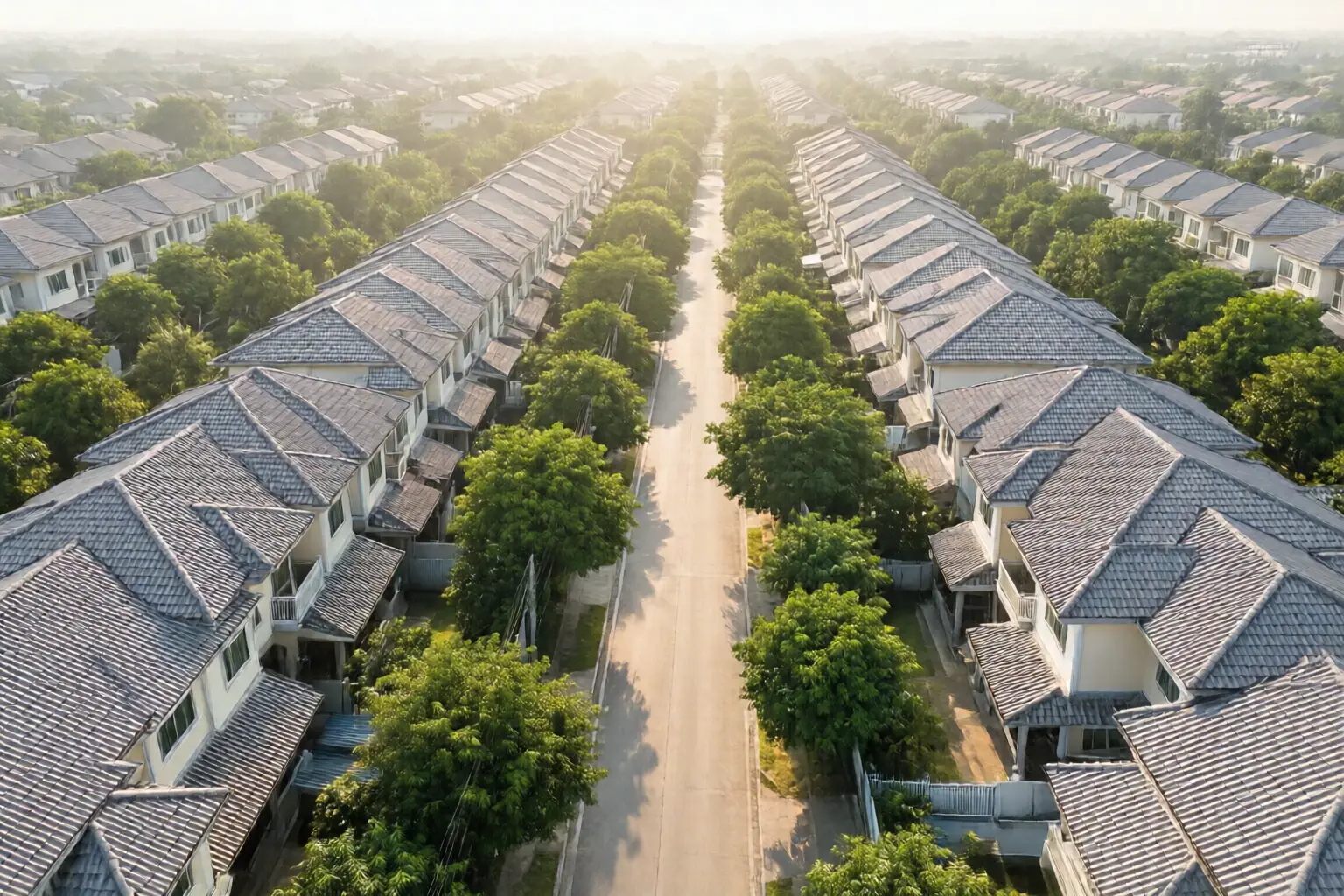
The round currently in force runs from 2023 to 2026 and expires at the end of this year. The reason for the increase is that state appraised values now sit about 40% below market prices, and the plan is to narrow that gap to 15 to 20%.
Note that the rise is not uniform. Provincial sub-committees decide the values within their own jurisdictions, with their proposals expected by September 2026, so locations where market prices moved sharply over the past four years are likelier to rise by more than the average.
Appraised value versus market price
The appraised value is the figure the state sets for calculating fees and taxes. The market price is what people actually pay. The two are not equal and are not meant to be.
Owners who have never looked up the appraised value of their own property tend to treat it as a purely bureaucratic number. In practice it determines the cash needed on transfer day directly, because the transfer fee is calculated on the appraised value, not on the agreed sale price.
You can check the appraised value of your own plot through the Treasury Department's online search using the title deed number and land number, without visiting an office.
Where a higher appraisal costs the seller
Transfer fee
The normal transfer fee is 2% of the appraised value. Thansettakij gives a clean worked example: a house selling for THB 5 million with an old appraised value of THB 4 million attracts a transfer fee of THB 80,000. Reappraised at THB 5 million, the fee becomes THB 100,000, an increase of THB 20,000 with no change in the sale price.
By custom the transfer fee is split fifty-fifty between buyer and seller, so the increase lands on both sides rather than one.
Specific business tax and stamp duty
Specific business tax is 3.3% of the sale price or the appraised value, whichever is higher, charged where the seller has held the property for less than five years or has been on the house registration for less than one year.
"Whichever is higher" is where the new appraisal bites. For a property whose sale price currently exceeds its appraised value, the tax is computed on the sale price and a rise in the appraisal changes nothing. Once the appraised value overtakes the sale price, the base switches to the appraisal.
Stamp duty at 0.5%, charged instead of specific business tax where holding exceeds five years or the seller has been on the house registration for more than a year, works on the same principle.
Land and building tax
Land and building tax is calculated directly from the appraised value. Thansettakij notes that even with no change in the tax rate, a higher appraised value raises the tax payable immediately.
This hits owners simply holding property hardest, particularly vacant land and commercially used property, which are taxed at higher rates than residential. See our guides to land and building tax and vacant land tax.
The trap nobody is talking about: the THB 7 million ceiling is measured on the appraisal too
This is the largest consequence and the least discussed.
The measure cutting transfer and mortgage registration fees to 0.01%, which the cabinet extended to 30 June 2027, requires that the sale price, the appraised value and the mortgage amount each be no more than THB 7 million.
So the appraised value is not merely a calculation base. It is also a condition that decides whether the benefit applies at all.
A property appraised at THB 6.5 million today sits comfortably inside the limit. Reappraised 15% higher, at THB 7.475 million on 1 January 2027, it drops out of the measure immediately, while the measure still has six months to run.
The difference is not small. On a THB 7 million property the transfer fee is THB 700 with the benefit and THB 140,000 without it. For the details of the measure, see the 0.01% transfer and mortgage fees to June 2027.
The calendar to plan against
| Period | What happens | What it means for a seller |
|---|---|---|
| To 30 Sep 2026 | Provincial sub-committees finalise proposed values | Your area's actual figure is not known yet |
| 1 Dec 2026 | New appraisal schedule published | Figures known, not yet in force |
| To 31 Dec 2026 | The 2023-2026 round still applies | Transfers in this window use the lower base |
| 1 Jan 2027 | New appraisal takes effect | Transfer fee and land tax move to the new base |
| 30 Jun 2027 | The 0.01% measure ends | Fees revert to 2%, now on a higher base |
The most favourable window for completing a transfer is between now and 31 December 2026, which captures both the 0.01% rate and the lower existing appraisal base.
What a seller should do now
- Look up your property's current appraised value first. Without that number nothing else can be planned.
- If the appraised value sits between THB 5.8 and 7 million, treat yourself as at risk of losing the benefit, because a 10 to 20% rise carries you past THB 7 million.
- If you already intend to sell, consider completing the transfer within 2026, not to avoid tax but so that your buyer keeps the 0.01% benefit, which is also a negotiating advantage for you.
- Use this with a hesitant buyer. A concrete six-figure difference in fees is more persuasive than a general claim that prices will rise.
- If you are holding vacant land, model your 2027 land tax now. A higher base costs you every year, not once at sale.
- Do not cut your asking price to beat the deadline. The fee difference is usually smaller than what a price cut gives away.
Does this affect buyers too
It does, and in some cases more than sellers, because the buyer pays the mortgage registration fee in full and loses both half the transfer fee benefit and all of the mortgage fee benefit if the property falls out of the THB 7 million band.
A buyer looking in the THB 6 to 7 million range should therefore ask for the current appraised value before agreeing a price, and ask how quickly a transfer date can be booked.
Note that the 0.01% measure is restricted to Thai nationals, so foreign buyers were never eligible. The land and building tax increase and the higher transfer fee base apply to foreign condominium owners in the ordinary way.
Frequently asked questions
When is the new land appraisal announced
The Treasury Department is scheduled to publish the 2027 to 2030 schedule on 1 December 2026, taking effect on 1 January 2027 and replacing the current 2023 to 2026 round.
How much will appraised land values rise
The Treasury Department's director-general has said not less than 10% on average, while Thansettakij reports a forecast range of 10 to 20% nationwide. Actual rates vary by area, because provincial sub-committees set the values in their own jurisdictions.
How much more will the transfer fee cost
The normal transfer fee is 2% of the appraised value. Thansettakij's example: a house appraised at THB 4 million pays THB 80,000; reappraised at THB 5 million it pays THB 100,000, THB 20,000 more with no change in the sale price.
Can a higher appraisal cost me the 0.01% fee benefit
Yes. The conditions require the sale price, the appraised value and the mortgage amount each to be no more than THB 7 million. A property appraised at THB 6.5 million that rises 15% exceeds the ceiling on 1 January 2027.
How far below market are appraised values
State appraised values currently sit about 40% below market prices, and the Treasury Department plans to narrow that gap to 15 to 20% in the new round.
Should I rush to sell before the end of 2026
Consider it if you already intend to sell and your appraised value is near the THB 7 million ceiling, because transferring within 2026 secures both the 0.01% rate and the lower existing base. Do not cut your asking price to meet the deadline: the fee difference is usually smaller than the discount.
Where can I check my land's appraised value
Through the Treasury Department's online appraisal search, using the title deed number and land number, or by asking at the Land Office for the district where the property sits.
In short
The 2027 to 2030 appraisal round is published on 1 December 2026 and takes effect on 1 January 2027, rising by not less than 10% on average and by up to 20% on some reports.
The consequences stack three deep: transfer fees on a higher base, land tax up every year, and properties appraised near THB 7 million dropping out of the 0.01% measure while it is still running.
There is one thing to do today: look up your property's appraised value and compare it to THB 7 million. If it is near that line, the timing of your sale is worth six figures.
To work out what your property should be priced at and when to close, see our house sales service or land sales service, and browse what is currently on the market at properties for sale.