
The difference in one sentence: UF stops what floats, RO stops what dissolves
A UF membrane has pores small enough to hold back sediment, rust and bacteria, but large enough to let dissolved substances through: hardness, minerals and other things in solution.
An RO membrane is far finer, fine enough to hold back what is dissolved too, which is why it deals with hardness, salinity and heavy metals. It is also why it needs pressure, a pump, and somewhere to send reject water.
Since the difference is dissolved versus suspended, the question to answer before buying is not which is better, but what kind of problem your water actually has.
Mains water and well water are two different problems
On mains water, most trouble does not come from the treatment plant. It happens on the way: in old pipework, in a storage tank that has never been cleaned, and in a pump drawing air along with the water.
The signs are water that goes cloudy at certain times, particularly after pipe repairs in the street, rust-coloured sediment on the first draw of the day, or a stale smell that is not chlorine.
Those three respond well to UF, and in some cases they are solved by cleaning the storage tank alone, with no purchase at all.
Well water is a different matter, because the problem is what dissolved into it underground: hardness that leaves white scale on taps and shower heads, iron and manganese that stain sanitaryware and white laundry yellow-brown, and in coastal areas, salinity.
UF does nothing for any of those, because they are dissolved. This is where RO genuinely answers the question.
The sales trick, and how not to fall for it
If someone comes to the house, drops two metal electrodes into a glass of tap water and it turns brown and cloudy with floating sediment, then does the same in water from their machine and it stays clear, that is not a water quality test.
What happens is that the current dissolves metal out of the electrodes themselves as rust. The brown colour comes from the apparatus, not from the water. RO water does not change because it conducts electricity poorly, so the reaction is far slower.
The other thing routinely misused is the total dissolved solids meter. Its reading reflects how well the water conducts electricity, which relates to how much mineral is dissolved in it, but it says nothing about whether the water is safe.
Naturally mineral-rich water reads high and is perfectly drinkable, while water contaminated with bacteria or certain substances can read low and should not be drunk. The number is useful for watching your own water's trend against last month, not as evidence of safety.
To know what is actually in it, send a sample to a laboratory. That is the only thing that answers which system you need, and it usually costs less than buying the wrong machine.
The real price is the cartridges, not the machine
People compare machine prices on the day of purchase and forget that the actual cost arrives every six months for as long as they own it.
Ask three questions first. How many cartridges are there and how often does each need changing? What does each cost? And can they be bought anywhere other than from this brand?
The third matters more than it seems, because a machine using standard-size cartridges available anywhere is a different proposition from one using a proprietary pod that ties you to a single seller for the life of the unit, at prices you have no alternative to.
Multiply the full set of cartridges by two changes a year, then by five years. That is the figure to compare two machines with, not the price on the first day.

A filter nobody changes is worse than no filter
This is something to know before buying rather than afterwards.
A cartridge works by trapping what it removes inside itself. Over time what is trapped accumulates, and a cartridge that is permanently damp with organic material accumulating in it becomes a good place for bacteria to grow.
So a machine whose cartridges have not been changed in two years may deliver water worse than what goes into it, while the owner drinks it confidently because there is a filter.
Preventing that is easy. Write the change date on the housing with a marker every time, or set a calendar reminder. Do not rely on memory, because there is no visible warning for this.
One more thing people forget: if the machine has not been used for several days, say after a week away, run it for a couple of minutes before drinking, to flush out the water that has been standing in the cartridges.
What RO costs you besides money
RO is real technology that is necessary in many cases, but it has costs that are not on the price tag.
Reject water, because pushing water through the membrane requires another stream to carry away what was held back. The ratio varies by model and by the incoming water quality, so ask the seller for a figure and ask where the reject goes, since it needs a drain.
Electricity and a pump, which means moving parts with a life, unlike UF which runs on line pressure alone.
Speed, because RO produces water slowly and therefore usually has a storage tank, which is one more thing to keep clean.
The minerals go too, because it holds back everything dissolved rather than selecting the unwanted parts. Some models add a remineralising stage at the end, which is mainly about taste.
The important caution is that if the incoming water is high in iron or sediment, there must be adequate pre-filtration first, or the RO membrane clogs quickly, and that is the most expensive part of the system.
Clean the storage tank before buying anything
Most Thai houses have a storage tank and a pump, and that tank is something almost nobody ever opens.
What turns up when they do is thick sediment on the bottom, a lid that does not seal so insects get in, and a vent with no screen on it.
Cleaning the tank once a year is half a day's work and often makes cloudy or smelly water go away without buying anything.
Do this before deciding on a machine, because if the symptom disappears after cleaning, you have just saved a large sum and learned where the problem actually was. Pumps and household water pressure are covered in inverter water pumps and pressure tanks.
Choosing in three minutes
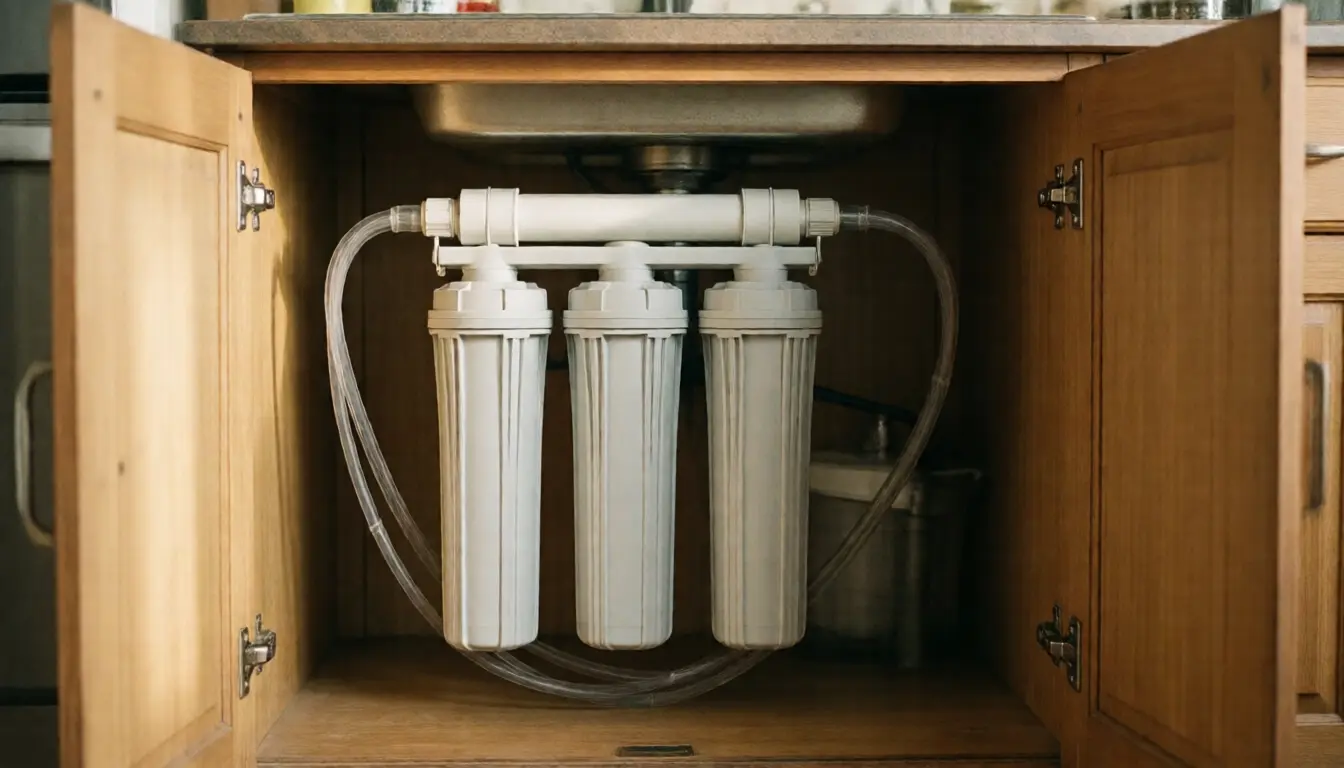
Mains water, no white scale, no yellow staining, you simply want sediment and chlorine taste gone. A three-stage under-sink system or UF is enough. Cheaper, no reject water, no electricity.
Well water, white scale on taps or yellow staining on sanitaryware. Consider RO with pre-filtration suited to that specific problem, and have the water tested first so the system is designed correctly.
In a condominium or a rented place. Start with a tap-mounted filter or a filter jug, since neither needs drilling or a drain connection, and both come with you when you move.
Mainly worried about bacteria, after flooding or a burst main in the street. UF holds back bacteria by pore size, and during such a period boil drinking water as well until the situation is back to normal.
Frequently asked questions
Is RO better than UF?
They are not better and worse, they are different jobs. UF stops suspended things such as sediment and bacteria. RO also stops dissolved things such as hardness and salinity. If your mains water has no dissolved-substance problem, RO is more than you need.
Does a TDS meter tell me whether water is safe?
No. It reads electrical conductivity, which relates to dissolved minerals. Naturally mineral-rich water reads high and is drinkable, and bacterially contaminated water can read low. For a real answer, have it tested.
The electrode demonstration turned the water brown. Is my water dirty?
No. The brown is metal dissolving out of the electrodes under the current, not something from the water. The demonstration tells you nothing about water quality.
Does it matter if I leave cartridges in for a long time?
It does. A permanently damp cartridge accumulating organic material becomes somewhere bacteria grow, and the output can be worse than the input. Write the change date on the housing every time.
How much water does RO waste?
There is always reject water, and the ratio varies with the model and the incoming quality. Ask the seller for a figure and ask where the reject line will go before installation.
In short
- UF stops what floats, RO also stops what dissolves. Choose from your water's problem, not from the word better.
- Mains water problems usually happen on the way to the tap. Well water problems are dissolved.
- The electrode demonstration tells you nothing, and a TDS reading is not a safety measure.
- The real price is five years of cartridges, not the machine on day one.
- A filter nobody changes can be worse than no filter at all.
- Clean the storage tank before deciding to buy, because for many houses that is the whole problem.