
Eight causes, and seven of the eight are not a leak
The first word people use on seeing water drip from an air conditioner is leaking.
But a healthy air conditioner produces water constantly, because moisture in the air condenses on the cooling coil.
That water should fall into a tray and run out of the house along a pipe under gravity.
So water on the floor almost never means the machine is leaking. It means water that should have left through the pipe could not.
Of the eight causes below, only one is actual damage to the machine.
And the first three can be checked by any homeowner with their eyes and bare hands.
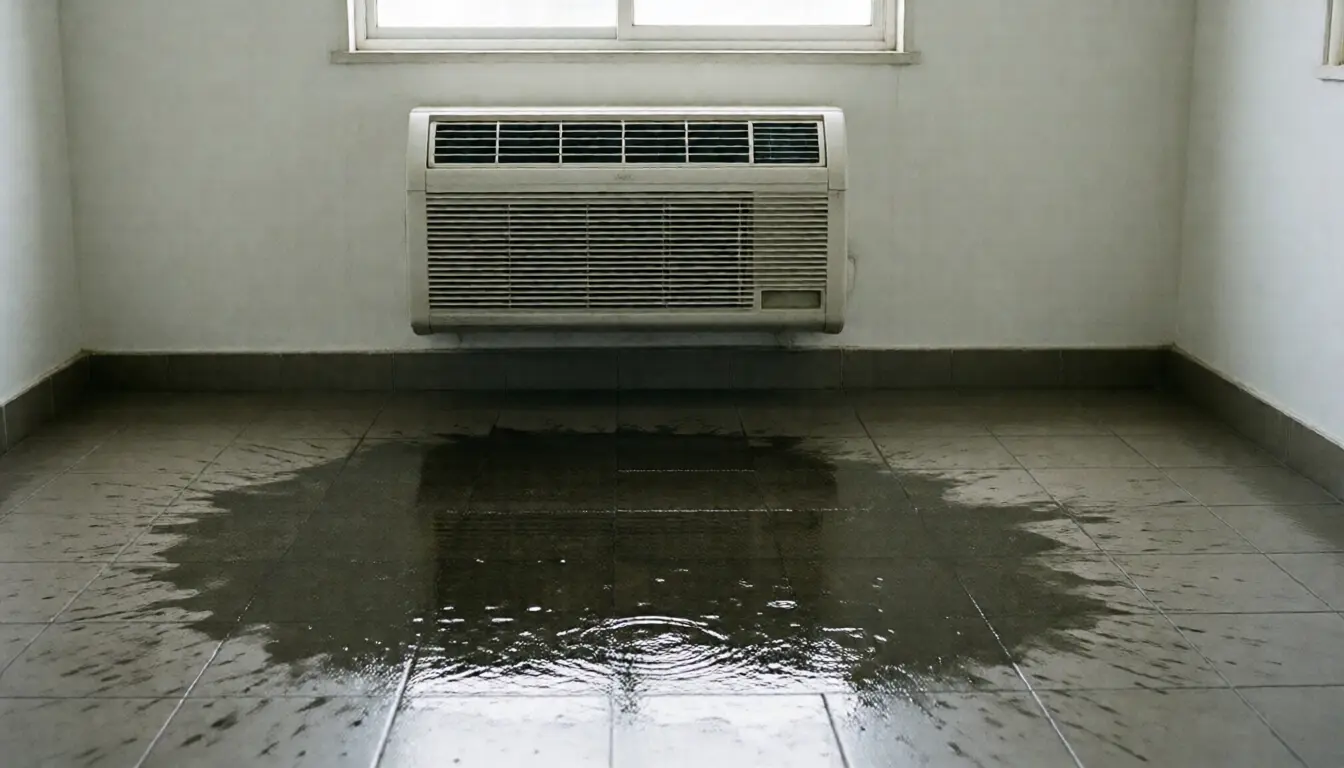
Cause one: a blocked drain line, the most common of all
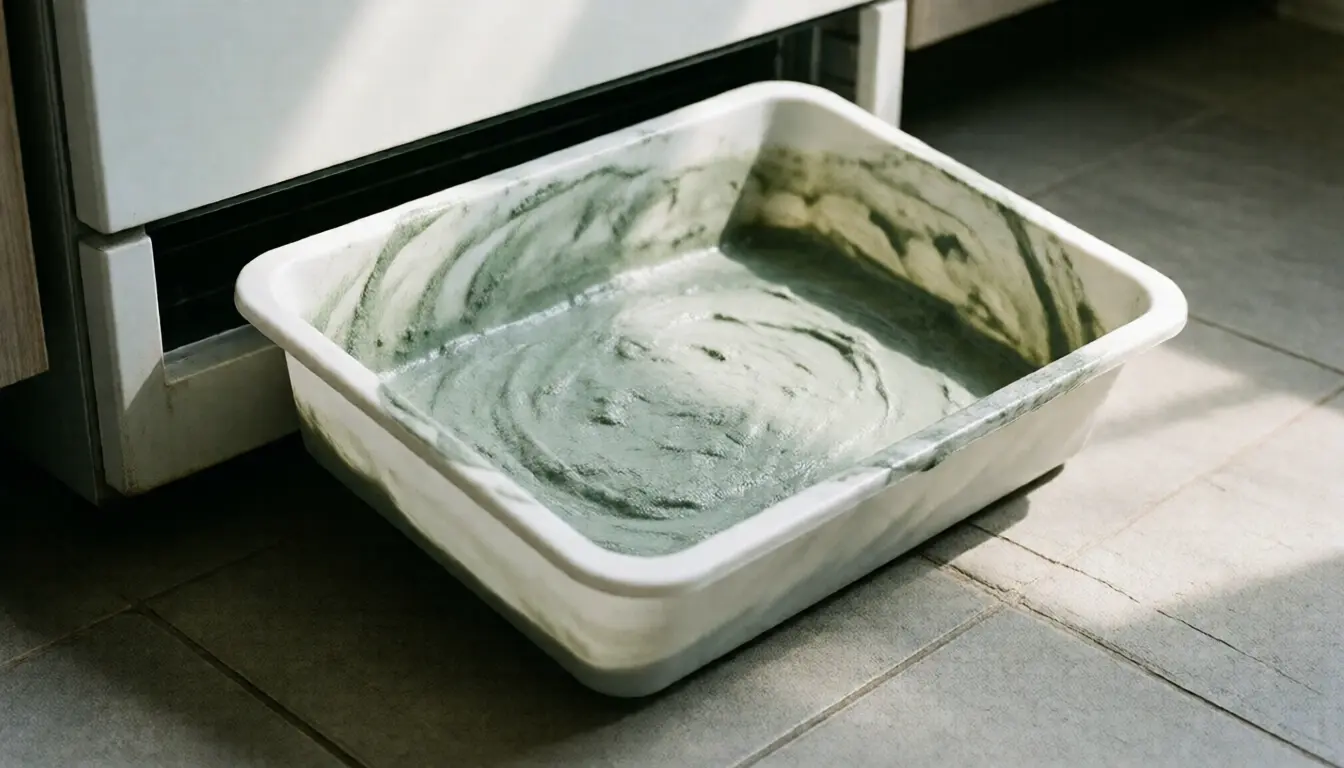
Dust that gets past the filter meets moisture on the coil and becomes a slime that washes down into the pipe.
That slime thickens until water cannot pass, and the tray overflows out of the front of the unit.
The sign of this one is water dripping along the lower edge of the unit in a line rather than from a single point.
And it usually drips worst some time after switching on rather than immediately.
Cause two: the outdoor end submerged or blocked
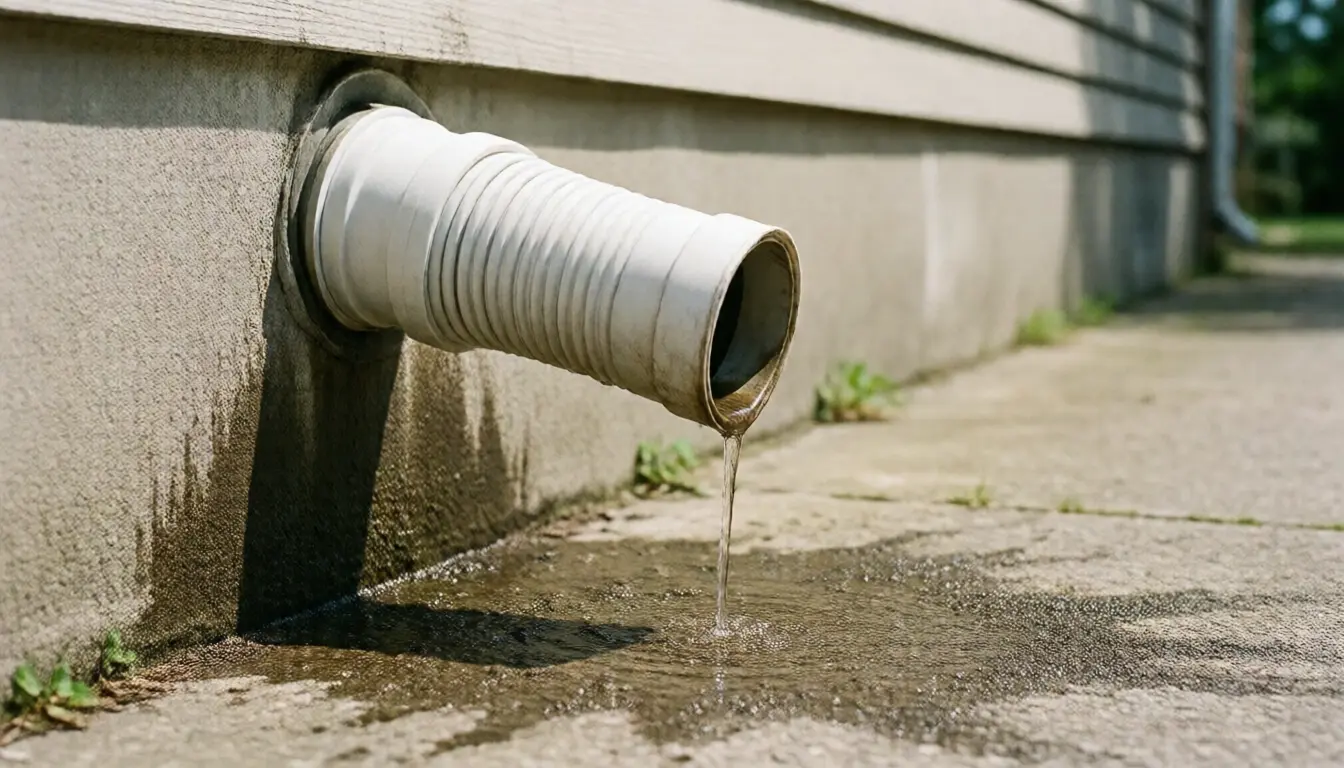
The drain works by gravity, so if the end of the pipe sits under water, nothing can flow out.
What happens commonly is the pipe end dipping into a full collection bucket, or hanging into a drainage channel holding water.
The other case is insects, a gecko or leaves blocking the opening.
This is the easiest of all to check, because you walk outside and look at whether water is coming out while the unit runs.
No water at all while the unit is running and the room is cooling means the water is trapped in the system.
Cause three: no fall in the pipe, or a sag in it
A drain pipe has to fall continuously along its whole length.
If the run has a section that rises, or a dip that sags, water stands there.
Standing water is where slime forms fastest, which is why this problem keeps coming back despite recent cleaning.
The sign is that clearing the pipe works for two or three months and then it returns, every time.
The fix is re-running the pipe, not cleaning it again.
Cause four: the unit is not mounted level
The tray is designed to slope toward the drain outlet.
If the unit is fixed tilted the wrong way, water collects at the far side and spills out.
The sign is water dripping regularly from one particular corner rather than along the whole edge.
This happens most on newly installed units, or units recently taken down for cleaning and refitted.
Cause five: the coil freezes and then melts
When too little air passes through the coil, its surface gets cold enough for moisture to freeze onto it.
Switch the unit off and all that ice melts at once, which is more than the tray can hold.
Three things restrict airflow: a blocked filter, a blocked coil, and a weak fan.
The other cause of freezing is a low refrigerant charge from a leak, which needs a technician with gauges.
The sign of this one is visible ice or frost on the coil or the copper pipe, and weaker airflow than usual.
Cause six: split or displaced pipe insulation
This one is not tray water at all. It is moisture condensing on the surface of a very cold copper pipe.
If the insulation around that pipe splits or slides out of place, the bare surface meets humid air and beads with water.
The clear sign is water dripping where the pipe enters the unit, or along the pipe run, rather than from the unit itself.
Follow the pipe and feel it. A stretch that is wet and very cold with no insulation on it is your answer.
Cause seven: a cracked or corroded tray
A plastic tray that has been through years of heating and cooling can crack.
And a metal tray in an older machine can corrode through.
This is the one cause of the eight that is genuine damage to the machine, and it needs a part replaced.
The sign is continuous dripping even after the pipe has been cleared and the outdoor end is running freely.
Cause eight: a coil so dirty that water is thrown off it
When the coil fins are packed with dust, droplets gather into larger beads instead of running down into the tray.
The fan then throws those droplets out of the front of the unit.
The sign is spray or droplets appearing on high fan speed but nothing on low.
What you can fix yourself
Three things are a homeowner's to do, and they often solve it.
One, wash the filter and check the airflow is normal, because a blocked filter is upstream of both the freezing and the slime.
Two, go and look at the outdoor end of the pipe: is water coming out while the unit runs, is the end sitting in water, and is anything blocking it.
If the end is submerged, lift it clear, which sometimes solves the whole thing with nothing else done.
Three, draw the water out from the outdoor end with a wet and dry vacuum, cupping it over the pipe end and running it in short bursts.
Pulling works and is safer than pushing anything in.
Three things are equally not yours to do.
Do not blow into the pipe with your mouth, because what is in there is years of accumulated slime.
Do not push stiff wire into it, because the end can puncture the tray or the pipe and turn a small problem into a replaced part.
Do not take the unit down yourself, because refrigerant pipes and wiring are attached, and pulling at the wrong moment kinks the copper.
When to call a technician
- Still dripping after washing the filter and clearing the outdoor end, which points to a deep blockage, a dirty tray, or a cracked one.
- Visible ice on the coil or copper pipe, which needs pressures measured to separate low airflow from low charge.
- Cleared, fine for a few months, back again every time, which is usually the fall of the pipe rather than cleanliness.
- Water always from the same one corner, which points to how it was mounted.
- Damp appearing on the wall along the pipe run, which is the insulation and should be fixed before the wall suffers.
How to stop it coming back
Wash the filter every two to four weeks, which cuts off the slime at source.
Have it serviced once a year, including the tray and the pipe rather than only the coil, as covered in cleaning it yourself against calling a technician.
Ask the technician to check the fall of the pipe at the next service, particularly if the problem has returned before.
Keep the pipe end clear of standing water, and never let it dip into a bucket or a channel.
Check the pipe insulation once a year, especially any stretch in full sun, where it degrades fastest.
Frequently asked questions
Does dripping mean the machine is leaking?
Almost never. Air conditioners produce water by condensation, and the problem is that water which should leave by the pipe cannot. Of the eight causes only a cracked tray is damage to the machine.
What can I check before calling anybody?
Three things: wash the filter, check whether water comes out of the outdoor pipe end while it runs, and see whether that end is submerged or blocked.
Can I clear the pipe with a vacuum cleaner?
Yes, with a wet and dry type, cupped over the outdoor end and run in short bursts. Pulling is safer than pushing anything in.
Why does it come back a few months after clearing?
Usually because the pipe does not fall continuously or has a sag holding water, which is where slime forms fastest. That needs the pipe re-run rather than cleared again.
Water drips along the pipe rather than from the unit. Why?
Split or displaced insulation on the refrigerant pipe, letting moisture condense on very cold copper. Follow the run and find the wet uninsulated stretch.
There is ice on the coil. What do I do?
Switch it off and let the ice melt, then wash the filter. If it happens again, have the pressures measured, because it could be restricted airflow or a low charge from a leak.
Can I just let it drip?
Better not, because water soaking into walls and ceilings causes staining and mould, and in some cases reaches the wiring connections behind the unit.
Do I need a new air conditioner?
Usually not, because seven of the eight causes are solved by cleaning or by correcting the installation, and even a cracked tray is replaced on its own.
In short
- Dripping almost never means a leak. It means water cannot leave by the pipe.
- The leading cause is a drain line blocked by slime from dust and moisture.
- A submerged or blocked pipe end is the easiest to check and the quickest to fix.
- Coming back every few months usually means the pipe does not fall properly.
- Always the same corner points to how the unit was mounted.
- Ice on the coil comes from restricted airflow or a low charge, and melts all at once.
- Water along the pipe run is split insulation rather than a tray problem.
- Wash the filter, look at the outdoor end, and vacuum from that end. Those are yours.
- Never blow into the pipe with your mouth, and never push stiff wire into it.