
A drain smell does not mean a dirty pipe. It means nothing is sealing it
Every waste pipe connects to somewhere that smells. That is normal.
What keeps the smell out of the bathroom is not how clean the pipe is. It is the small amount of water sitting in the trap beneath the drain.
That water acts as a lid. Odour rises up the pipe as far as it and stops.
So when a bathroom smells, the first question is not how to clean the drain. It is where the water that should be sealing it has gone.
The answer is usually one of three things, and two of them you can fix yourself in a day.
Three ways the smell gets in
One, a dried out trap. In a bathroom unused for a week, the water in the trap evaporates completely. This happens most in a downstairs guest bathroom and in any house closed up while the family travels.
The test is simple. Pour about a litre of water down the drain. If the smell goes within a few minutes, that was it.
To prevent it, pour water into every drain in a little-used room at least once a month. Before a long trip, add a small amount of cooking oil to the water, because the thin film floating on top slows evaporation considerably.
Two, a drain with no trap at all. This is common in older houses and buildings, and in extension work done in a hurry.
Lift the grating and look. If you see a pipe running straight down with no bend and no water-holding chamber, that bathroom never had anything sealing it in the first place.
The fix that avoids breaking up the floor is a grating with a built-in odour valve, available either as a silicone flap that closes when no water is flowing or as a float type. They are sold everywhere and you can change them yourself.
What to know is that these valves have a service life. Silicone stiffens and stops sealing after a few years, so if the smell returns after a fix that worked, suspect this first.
Three, unsealed penetrations. Where a pipe passes through the floor or a wall, if the mortar around it was never properly filled, odour escapes there regardless of the drains.
Look around the base of the toilet, around the pipes under the basin, and at the opening where pipework passes through the wall to a water heater.
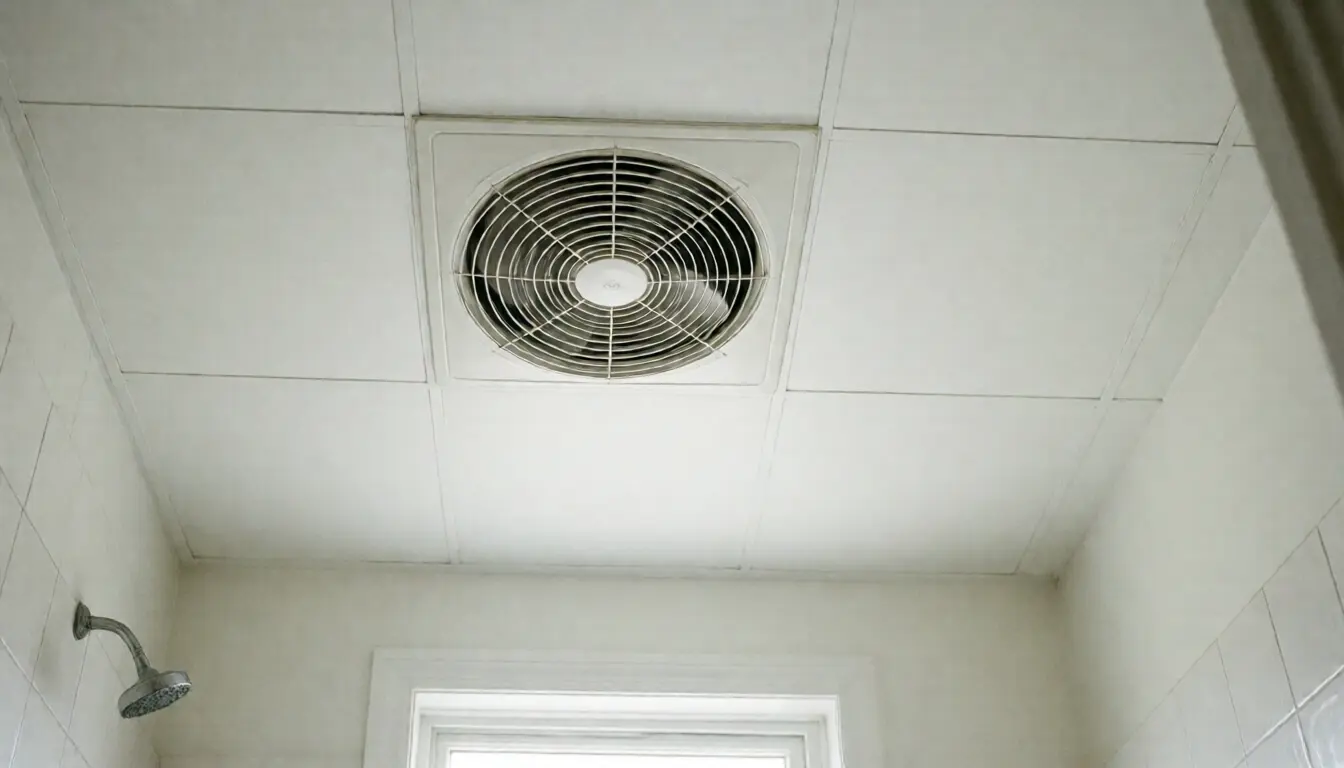
An extractor fan cannot extract if no air can get in
This is the most misunderstood part, and the reason so many bathrooms are no better after fitting a more powerful fan.
A fan only works if air can flow in to replace what leaves.
With the door sealed tight, no gap underneath, no louvre and the window shut, the fan creates negative pressure and air is pulled in through the only route left.
That route is the waste pipe. So you switch on the fan to clear a smell and the fan draws the smell up for you.
The test takes ten seconds. Switch the fan on and hold a single sheet of tissue against the grille. If it stays there on its own, the fan is working. If it falls or barely holds, either not enough air is getting in or the duct has a problem.
The fix is an air path. The simplest is a gap of one to two centimetres under the door, or a louvre fitted in the lower part of the door leaf.
The other is leaving the door open while the fan runs after a shower, which works immediately and costs nothing.
Ducts that discharge into the ceiling void instead of outside
You have to go up and look to find this one, and once found it usually explains everything.
A great many ceiling fans are installed with no duct running outside the building at all, so damp air from the bathroom is blown into the ceiling void.
What follows is staining on the ceiling, damp timber in the void, and a musty smell whose source nobody can find because it is not in the bathroom.
Open the access hatch, shine a torch, and see where the fan's duct ends. If it stops in mid-air above the ceiling, that is what to fix before anything else.
Moisture collecting in a ceiling void is also mistaken for a leaking roof. Telling the two apart is covered in how to find a roof leak.
Two more things about ducting. Every fold in flexible ducting costs airflow, and the longer and more bent the run, the less comes out the far end, so keep it as short and as straight as the layout allows.
And any duct that sags collects the water condensing inside it until, one day, that water drips back down through the grille. Fix the duct so it falls continuously towards the outlet.
The outlet itself should have a backdraft damper, so that wind and insects do not come in while the fan is off.
Condominium bathrooms have a problem houses do not
Most condominiums vent bathrooms into a shared shaft running the height of the building.
When one unit runs its fan, air is pushed into that shaft, and if other units have no backdraft damper, some of it flows back into the units whose fans are off.
That is why you smell a neighbour's cigarettes or cooking in your own bathroom with the door closed.
What you can do inside your own unit is fit a fan or fitting with a backdraft damper and seal the gaps around any pipework.
What you cannot fix alone is the shaft, which is common property. Report it to the juristic person in writing, because if several units have the same experience it becomes work the building has to handle.
Other condominium problems that tend to arrive together are in why a condo electricity and water bill runs high.
Work through it in this order
- Pour a litre of water into every drain and wait ten minutes. If the smell goes, you are done.
- Lift the grating and check for a trap or odour valve. If there is neither, fit a grating with a valve.
- Test the fan with tissue. If it does not hold, open the door and try again.
- If it holds with the door open, you need an air path through the door.
- If it still does not hold, go up and look at where the duct ends.
- Check the seal around the toilet base and any pipe passing through a wall.
The order matters, because most people start by buying a new fan, which is the most expensive step and the one that fixes the least.
If you do replace the fan, look at the airflow figure in cubic metres per hour on the box and compare it with the room volume, which is width times length times height. A fan needs to move several times the room volume every hour to change the air fast enough.
And choose a model with a timer or a humidity sensor, because running for another ten to twenty minutes after the shower is what actually dries the room, rather than switching on while washing and off on the way out.
Frequently asked questions
Why does the bathroom smell of drains?
Because the water that should be sitting in the trap has evaporated, or the drain has no trap at all. Pour in a litre of water and wait ten minutes. If the smell clears, it was evaporation.
What should I do about a rarely used bathroom?
Pour water into every drain at least monthly, and before a long absence add a little cooking oil to slow evaporation.
I fitted a stronger fan and nothing improved. Why?
Usually because no air can flow in to replace what leaves. Add a gap under the door or a louvre, then repeat the tissue test with the door open.
Why does the smell get worse when the fan is on?
Because the room is sealed tightly enough that the fan creates negative pressure and pulls air in through the waste pipe, the only route left.
Can I stop smelling my neighbours in a condominium?
Inside your unit, use a fan or fitting with a backdraft damper and seal around pipework. The shared shaft is common property, so report it to the juristic person in writing.
In short
- A drain smell means the water sealing the trap has gone, or there was never a trap.
- Pouring a litre of water in is the cheapest test and gives the fastest answer.
- A grating with an odour valve fixes it without breaking up the floor, but valves wear out.
- An extractor needs replacement air, or it draws the smell up the waste pipe instead.
- Test with one sheet of tissue. If it does not hold, open the door and repeat.
- Check that the duct genuinely runs outside rather than ending in the ceiling void.
- In a condominium, fit a backdraft damper in your own unit and report the shaft in writing.