
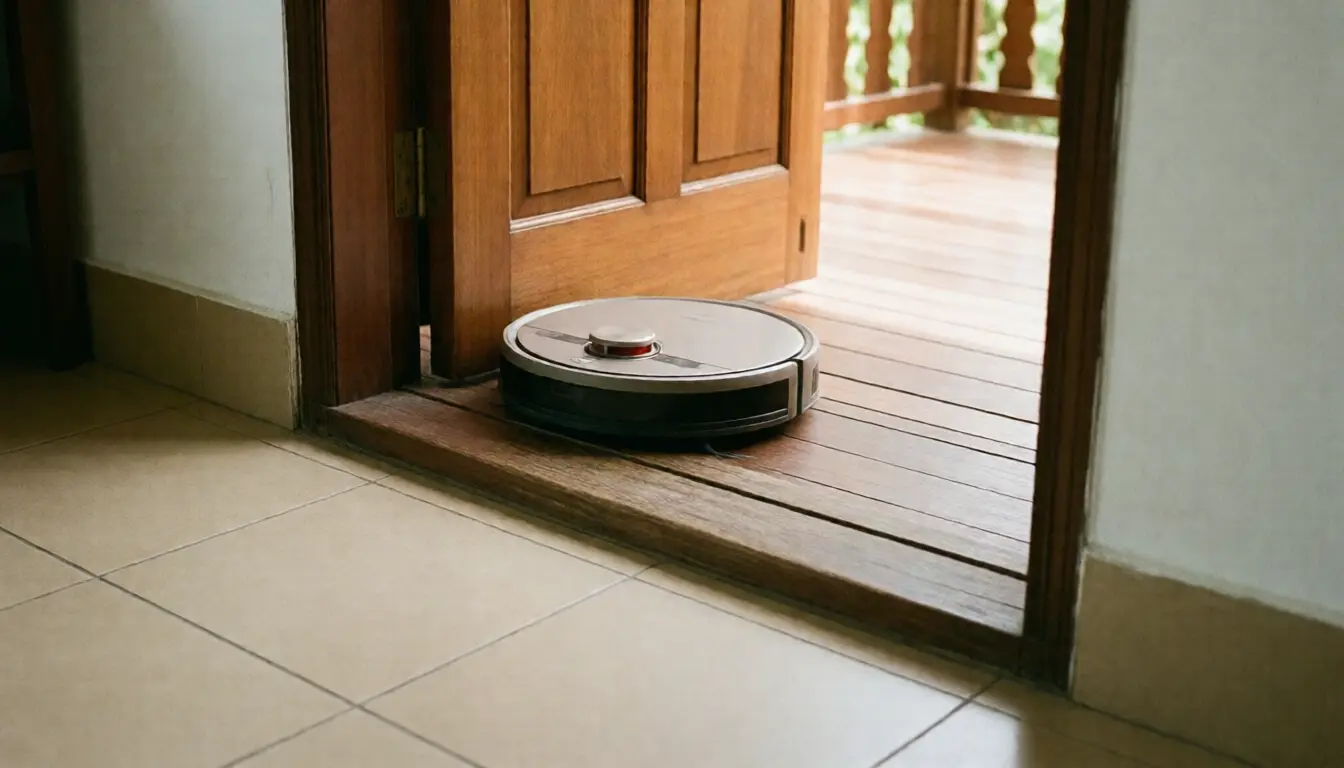
Before choosing a model, take a tape measure to the tallest threshold in the house
This is the one step that decides whether a robot vacuum cleans the whole house or one room, and almost nobody does it before buying.
Thai houses have a raised threshold at nearly every door, split levels between the living area and the rest, and usually a step down into the bathroom, which houses in the countries where these machines are designed rarely have.
The specification states the height the robot can climb, in centimetres. Ordinary models manage a thin threshold strip, and cannot manage a Thai timber threshold that stands higher than that at all.
Walk round and measure every point it would have to cross, write down the tallest, and compare with the specification before buying. If your number is higher, you are about to buy a robot that will be stuck in one room for its whole life.
What to do when the threshold is too high, and what each option costs you
Threshold ramps are small wedges laid against the step so the robot can climb it. Cheap and effective, but with a drawback worth thinking about: they become something people trip on, particularly in a house with an older person or a small child.
If you use them, choose a colour that contrasts with the floor and do not put them on the route people walk at night. Reducing fall risk in a house with an older person is covered in home technology for elderly parents.
Accepting that it works zone by zone means lifting it over yourself once a day, which sounds like a contradiction of the word automatic. In practice plenty of households do this and are happy, because lifting it over a threshold once a day is still easier than sweeping the whole house.
Buying two, one per floor, is expensive and the most effective answer in a two-storey house, since one robot cannot climb stairs anyway and carrying it up and down every day is something people stop doing within the first month.
If you are building or renovating, tell the builder you want thresholds as low as possible, or flush with the floor, which costs nothing extra if it is decided at the design stage.
A Thai bathroom is the place to keep it out of
Most Thai bathrooms are wet rooms with a floor drain and usually some standing water, an environment that can destroy a robot vacuum in a single pass.
The bigger problem than the machine failing, though, is that a robot that drives through water in the bathroom and comes out will drag that water across the whole house, along with whatever was in it.
There are three answers. The easiest is closing the bathroom door, which works completely and needs no configuration.
The second is a no-go zone in the app, which models with mapping support, and which should be set on the first day before it gets forgotten.
The third is a magnetic boundary strip laid on the floor, for models without mapping, which is one more thing people can trip over.
Wooden floors and the mopping function
Many Thai houses are tiled downstairs and floored in wood upstairs, a combination that turns the mopping function into a problem.
Tile handles water without difficulty. Solid wood and some engineered boards do not like repeated damp, and mopping daily with a wet pad makes the joints swell over time.
If the house has both, configure the mopping off in the wooden zones, which mapping models allow. On a model that cannot separate them, take the water tank out when cleaning the wooden floor.
And whatever the floor, wash and dry the mop pad after every use, because a wet pad stored in Thai humidity grows mould within days, and that smell then gets dragged around the whole house on the next run.

Camera or laser, and what to think about before choosing
Robots navigate in two main ways, and the difference is not only accuracy.
Laser navigation uses a spinning turret on top measuring distances all around. It maps accurately and works in the dark. The drawback is that the turret makes the machine slightly taller, so it cannot pass under some low furniture.
Camera navigation uses images to find its way, which makes the body lower and better at getting underneath things, but it needs reasonable light to work well.
What is worth considering with a camera model is that it is a camera moving around your whole house and connected to the internet, which should be a decision made knowingly rather than something you did not realise was there.
If you choose one, check whether image upload can be turned off, set a password not used anywhere else, and enable two-step verification if offered. The same principles as household cameras, covered in home CCTV and PDPA.
What to pick up first, and the real benefit
A robot vacuum only works well on a clear floor, so what has to be picked up first every time is cables lying across the floor, curtain tie cords hanging down, plastic bags and children's toys.
In a Thai house there are three more to watch: anything on the floor by the household shrine, the doormat in front of every door, and floor drainage channels in some places, which a robot's wheel can drop into.
On the real benefit, it should be said plainly that a robot vacuum does not replace a proper clean. It replaces the daily sweep, which keeps dust from accumulating so the proper clean is needed less often.
And the benefit least talked about but worth the most is that it forces you to clear the floor every day, because anything left down gets caught. A house whose floor is clear every day is already cleaner before the robot has started.
Frequently asked questions
My house has high thresholds. Can I still buy one?
Measure first. Measure the tallest threshold and compare it with the climbing height in the specification. If yours is higher, the options are ramps, working zone by zone, or one machine per floor.
Should I let it into the bathroom?
No. Thai bathrooms are wet rooms with standing water, which damages the machine and means it drags water round the house. Close the door or set a no-go zone.
Do I need two for a two-storey house?
If you want it to work by itself, yes, because it cannot climb stairs and carrying it up and down daily is something people stop doing in the first month.
Can it mop a wooden floor?
Turn mopping off in wooden zones, because repeated daily damp makes the joints swell over time. Mapping models can be set per zone; on others, remove the water tank.
Why has the robot started to smell?
Because a mop pad put away still wet grows mould within days in Thai humidity. Wash and dry it after every use.
In short
- Measure the tallest threshold in the house before buying and compare it with the climbing specification.
- Ramps solve thresholds but become a trip hazard in a house with an older person.
- Keep it out of the bathroom, because water ruins the machine and gets dragged everywhere.
- Turn mopping off on wooden zones, and dry the mop pad after every use.
- Camera models are lower and get under furniture, but they are cameras moving around your house.
- The real benefit is replacing the daily sweep and forcing the floor to stay clear.