
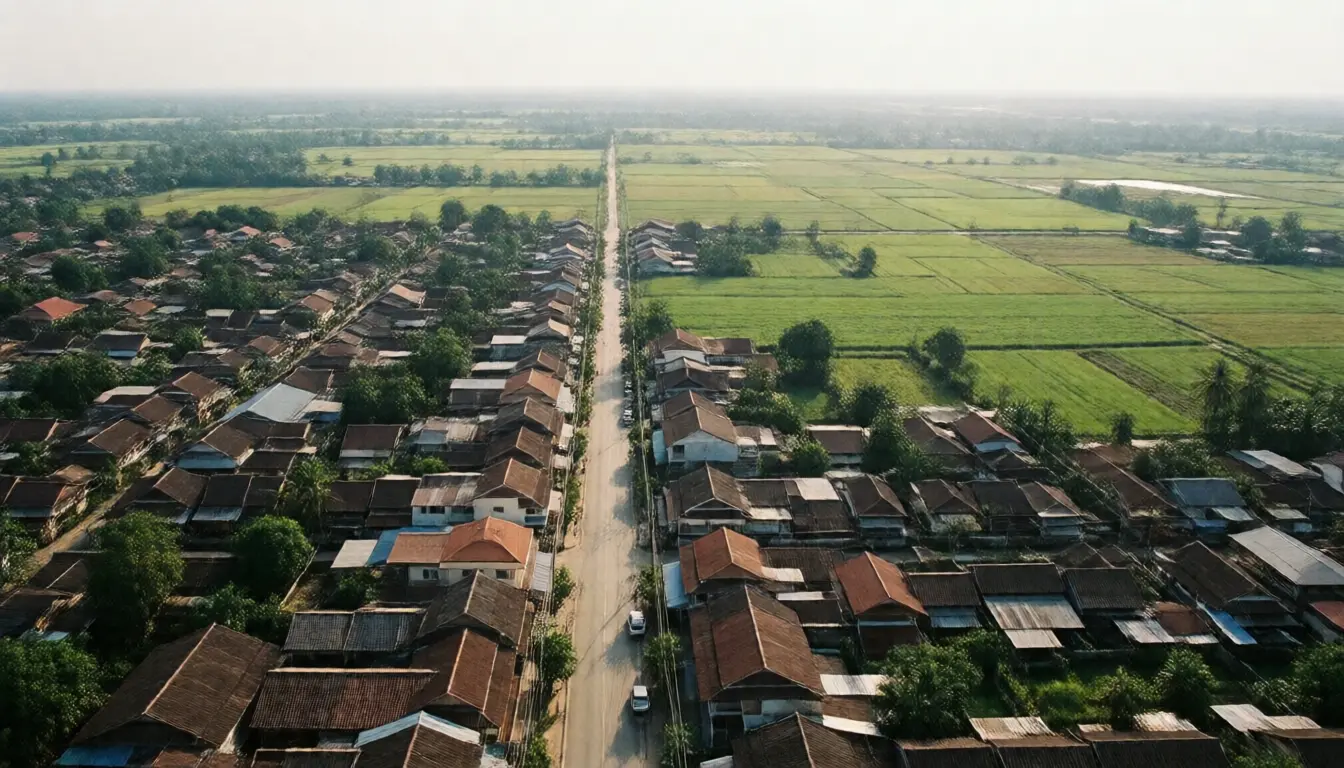
Two plots side by side, same road, same size, and prices almost double apart
Two owners had lived next to each other for twenty years. Fences touching, same road, same view.
Then somebody came to buy, and the two offers differed in a way neither of them could explain.
The explanation was on a map neither had ever looked at.
The zoning boundary in the comprehensive town plan ran exactly between them. One plot sits in a zone where commercial buildings are allowed, the other does not.
Nobody did anything wrong and nobody did anything clever. It is a line the state drew, and it changed the value of the land without either owner lifting a finger.
What a town plan does
A comprehensive town plan sets out what each area of land may and may not be used for.
It does not say whether you own it. It says what your ownership can be used for.
And that is what sets the price, because land value does not come from the soil. It comes from what can be built on it.
Land where a tall condominium is permitted and the plot next door where only a detached house is permitted have completely different land costs per square metre of saleable space, and developers price from exactly that.
Learning to read the colours
The colours on a town plan are a language that says everything, and being able to read them changes how you look at land.
- Yellow: low density residential.
- Orange: medium density residential, usually in areas continuous with the inner city, and able to take mid-sized condominium buildings.
- Brown: high density residential, in inner city or business districts, and the group where land values are highest.
- Red: commercial, for trade, offices and hotels.
- Purple: industrial.
- Plum: industrial of the warehousing kind.
- Green: rural and agricultural.
- White with a green diagonal border: rural and agricultural conservation, which is stricter than plain green.
Moving from yellow to orange to brown is moving from land where little can be built to land where much can, and price per unit area follows the same line.
The green and green-diagonal groups carry the tightest restrictions, and are where people who bought cheap land discover afterwards that they cannot build what they intended.
A town plan changes prices in three ways
One, by rezoning, which happens when a plan is revised.
Land that was green and becomes yellow or orange changes from agricultural to developable in a day, with the owner having done nothing at all.
And it works both ways. Land that was developable and becomes conservation loses value with the owner equally blameless.
Two, by marking planned roads. Town plans commonly mark roads that do not exist yet.
Landlocked land that will have a road cut through changes status the moment that line appears on the plan.
Conversely, land with a planned road across the middle has a different problem entirely, which connects to how to check for an expropriation corridor before you pay.
Three, through the detailed provisions, which is the part most people overlook.
Even within the same colour, the rules on floor area ratio, minimum open space, building height and permitted activities make an enormous difference to what can actually be built.
Developers read that before they look at the price, because it is the multiplier deciding how many units a plot can carry.
How to check the zoning on your own land
- Go to the provincial Public Works and Town Planning office, or the city planning department in Bangkok, with the title number and plot location.
- Ask at the municipality or subdistrict organisation, which usually holds the plan and knows about revisions in progress.
- Ask two things clearly: which colour zone the land is in now, and whether a revision is currently under way.
- Ask to see the provisions for that zone, not just the colour, because the provisions are what say what can actually be built.
The second point matters most to anybody buying or selling, because a revision in progress is when information is most asymmetric.
Somebody who knows what colour it is about to become and somebody who does not are sitting on opposite sides of the negotiating table.
What owners should do
If you hold land long term, check the plan whenever a revision is announced, because revisions include public consultation stages that citizens can take part in.
If you are selling, know your own zone and what can be built there, because that is what professional buyers price from, and you should price from it too.
If you are buying, check before paying a deposit, every time. Do not wait until the building permit application, because by then the money has gone.
And do not believe everybody around here builds whatever they like, because what the neighbours built may predate the current plan.
Frequently asked questions
What does a comprehensive town plan do?
It sets out what each area may and may not be used for, which determines land value, because price comes from what can be built rather than from the land itself.
What do the colours mean?
Yellow is low density residential, orange medium, brown high, red commercial, purple industrial, plum warehousing, green rural and agricultural, and white with a green diagonal border is rural and agricultural conservation.
Does rezoning really change prices?
Yes, because the zone decides what can be built, and developers price land from the saleable area achievable rather than from plot size alone.
Where do I check the zoning?
The provincial Public Works and Town Planning office, or the city planning department in Bangkok, and it is worth asking the local municipality as well.
Why ask whether a revision is under way?
Because that is when information is most asymmetric. Somebody who knows what the zone is about to become and somebody who does not are on opposite sides of the table.
The neighbours built it, so can I?
Not necessarily, because what they built may predate the current plan, or they may be in a different zone despite being adjacent.
Is checking the colour enough?
No. You also need the provisions for that zone: floor area ratio, minimum open space, height and permitted activities, because the same colour with different provisions permits different buildings.
In short
- Land value comes from what can be built on it, not from the soil.
- The colours on a town plan are a language worth learning to read.
- Plans change prices three ways: rezoning, planned roads, and detailed provisions.
- Adjacent plots can be in different zones and priced far apart through nobody's doing.
- Check at the provincial planning office, and ask the local authority too.
- Always ask whether a revision is currently under way.
- Read the provisions of the zone, not merely the colour.
- What the neighbours built does not tell you what you may build.