
The strip is almost never the cause. What gets plugged into it is
An extension strip that meets the standard and is used for what it was designed for hardly ever burns a house down.
What burns houses down is plugging in loads beyond what it can carry, chaining strips together, running one while the cable is still wound up, and a plug that does not sit tight.
Those four account for almost every extension strip fire.
And all four are behaviour, not brand.
One: plugging in high draw appliances
Anything that makes heat is the biggest consumer in the house, and almost none of it belongs on an extension strip.
- The electric kettle
- The iron
- The microwave
- The air fryer
- The water heater
- The hair dryer
- Hotplates and large rice cookers
The reason is not that any of them is dangerous on its own, but that together they exceed the strip's rating very easily.
A strip marked 10 amps at 250 volts carries roughly two thousand three hundred watts in theory.
One kettle and one hair dryer nearly fill that on their own.
And once the rating is exceeded, the thing that gets hot first is not the appliance. It is the cable and the connections inside the strip.
The simple rule that works throughout the house is that anything which makes heat goes into a wall socket directly, one appliance to one socket.
Two: plugging one strip into another
This is more dangerous than it looks.
Because the overcurrent protection in the first strip sees the combined load of everything hanging off the chain behind it.
But the cable and plug of that first strip were never designed to carry the whole procession.
So the hottest point becomes the one nobody looks at: the plug of the first strip sitting in the wall socket.
If one place genuinely needs many sockets, use a single strip with enough of them, rather than joining two together.
Three: using it while the cable is still wound up
Few people know this one, and it is the one that melts a whole reel of cable before anything trips.
A cable carrying current always warms up, and normally that heat sheds along the length of the cable.
When the cable is wound on a reel, the heat from each turn accumulates in the middle of the coil instead of escaping.
The temperature at the centre therefore runs far above the surface, until the insulation softens and the turns fuse together.
And once two conductors touch, there is a short circuit somewhere you cannot see.
The correct practice is to unwind the cable completely before any heavy load, even when the whole length is not needed.
Cable reels usually carry this warning printed on them, and it is a warning worth reading.
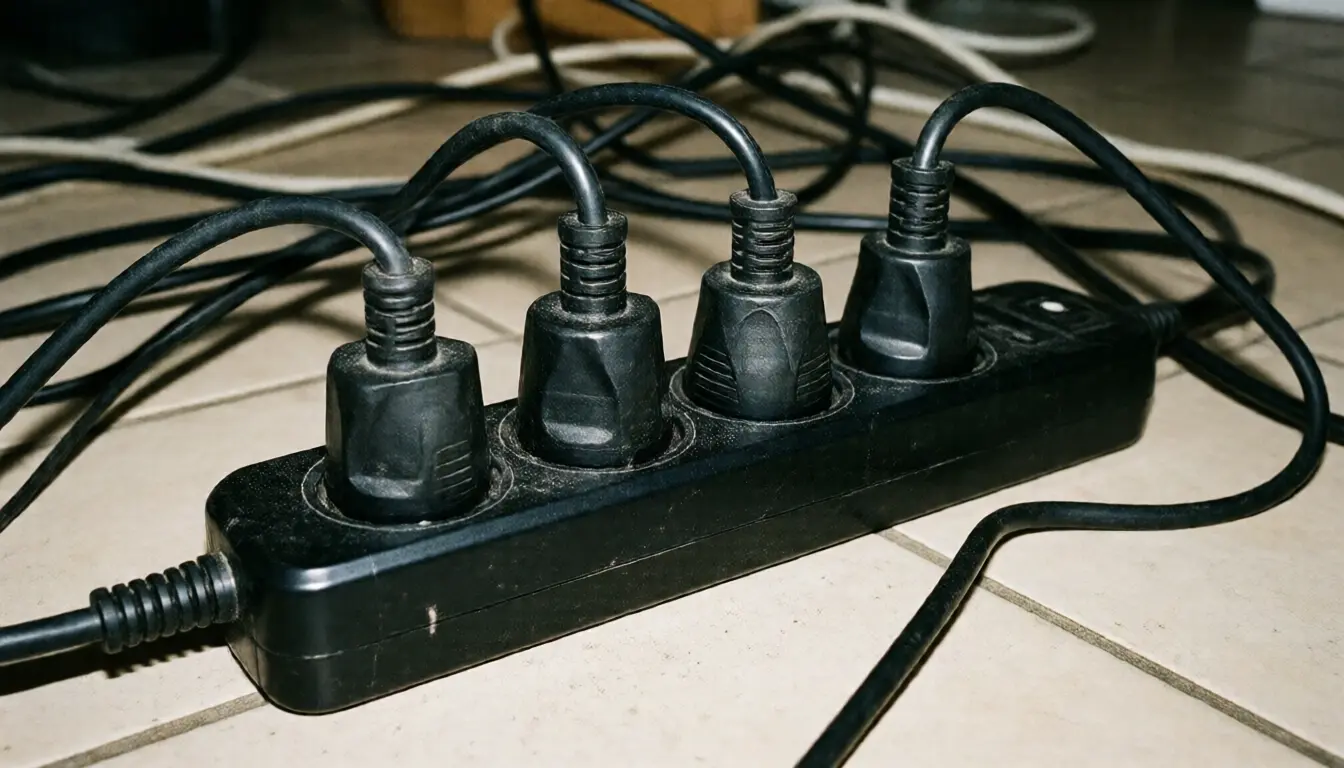
Four: a loose plug, which is the quietest one
The first three are about heat from too much current. This is a different mechanism entirely.
When a pin does not sit tightly against the contact in the socket, that junction develops a higher resistance.
High resistance in a tiny spot creates intense local heat and a repeated small spark.
That spark chars the plastic around it into a black deposit, which conducts better than the original plastic did.
As the deposit spreads it becomes a current path in its own right, and then it burns.
There are only a few reasons a plug goes loose.
- Contacts inside the socket fatigued by years of plugging and unplugging
- A cheap strip with thin, soft contacts
- Bent pins, or pins with corrosion on them
- A heavy plug that levers itself out under its own weight, such as a large adapter block
That last one explains why the socket that burns most often is the one at the end.
Warning signs that mean stop using it now
A strip nearly always gives warning first. The problem is that people read the warning as normal.
- Warm to the touch. A strip working within its limits should be at room temperature. Warm means heat is accumulating.
- A smell of hot plastic, which is instantly recognisable once you have met it.
- Plastic around a socket changing colour, going yellow or brown.
- Black marks on the plug pins, which are the traces of sparking that has already happened.
- A faint crackle when plugging in, distinct from the normal click.
- A plug that falls out easily, or power that flickers when it is moved.
Any one of those and that strip is finished. Do not keep it for light loads either, because a damaged junction does not repair itself.
The standard to look for before buying
Extension strips in Thailand fall under TIS 2432-2555, mandatory since 24 February 2018.
Several of its requirements bear directly on fire risk.
- The plug must be the three round pin type to TIS 166-2549, with insulated pin bases so that fingers cannot touch a live part while plugging in.
- The material must be flame retardant, which is the most important difference from cheap non-compliant products.
- A strip with three or more sockets must have overcurrent protection, which is the button that pops out when the load is exceeded.
A multi socket strip without that button is something that should not be in the house.
Cable size matters just as much, because an undersized cable overheats before any protection operates, which is the same principle set out in what goes wrong when the cable size is chosen badly.
Where it can and cannot go
Position changes the risk more than people expect.
Where it should not go
- Under a rug or mat, where heat cannot escape and it is trodden on daily
- Behind the sofa or a cabinet against the wall, where it gets hot unseen
- In a drawer or closed cupboard, for the same reason
- Near curtains or piles of fabric, which are fuel sitting right beside it
- On the bed or under a pillow, exactly where people leave phone chargers
- In bathrooms or on balconies within reach of driving rain
Where it should go is a hard surface, in the open, visible, with air around it.
If cables must be hidden for tidiness, hide the cables and leave the strip itself where you can see it.
The real fix is more sockets, not more strips
If a room needs two or three strips to cope, that room has too few sockets.
Having an electrician add wall sockets is not a large job, and it treats the cause instead of stacking risk on the floor.
Tell them how many points you want and what will be used at each, so the circuits can be arranged sensibly.
For a kitchen or a work corner with several heavy appliances, ask whether a separate circuit is needed.
And if the breaker already trips often, more sockets is not the whole answer, because the problem may be the circuit itself, which you can trace as in finding out why the breaker keeps tripping.
Frequently asked questions
Can I plug the microwave into an extension strip?
You should not. It draws heavily and in bursts. Put it straight into a wall socket, one appliance per socket, along with the kettle, the iron and the water heater.
What exactly is wrong with joining two strips?
The cable and plug of the first strip end up carrying the combined load of everything behind it, which they were never designed for, so the hottest point becomes the one nobody looks at.
Why unwind the cable before use?
Because a wound coil traps heat in its middle instead of shedding it, until the insulation softens and the turns fuse, producing a short circuit somewhere you cannot see.
Is a slightly warm strip normal?
No. A strip working within its limits should be at room temperature. Warmth means heat is accumulating, so reduce the load or stop using it.
Do extension strips wear out?
Yes. The internal contacts fatigue with repeated use, and once loose they generate local heat. Signs that it is time to replace one are a plug that sits loose, power that flickers when moved, and black marks on the pins.
What is the button that pops out?
Overcurrent protection, which TIS 2432-2555 requires on any strip with three or more sockets. If it trips often, the load really is over the rating, not the button failing.
Can a strip go under a rug?
No. Heat cannot escape, and being trodden on damages the cable internally. Worse, if it does overheat nobody sees it until it is too late.
Is leaving a phone charger plugged in overnight dangerous?
A compliant charger draws very little and is not the main risk. The real risk is where it sits: on the bed or under a pillow, heat cannot escape and fuel is right beside it.
In short
- Almost every extension strip fire comes from four behaviours, not from the brand.
- Anything that makes heat goes straight into a wall socket, one appliance per socket.
- Never chain two strips, because the hottest point becomes the one nobody looks at.
- Unwind the cable fully before any heavy load, every time.
- A loose plug sparks repeatedly until the plastic itself becomes a current path.
- Warm, discoloured, smelling, or marked with black means stop using it now.
- TIS 2432-2555, mandatory since 24 February 2018, requires round pins, flame retardant material and overcurrent protection from three sockets up.
- Never under a rug, behind a cabinet, in a drawer or on a bed.
- If you need several strips, the fix is more wall sockets, not more strips.