
Home fire insurance covers more than fire, and less than you assume, at the same time
Most people buy fire insurance because the bank required it when they took the mortgage, then file the policy in a drawer and never open it.
So when something happens, they are usually wrong in two directions at once.
In one direction, they assume it covers only fire, when it also covers lightning, explosion, a vehicle hitting the house, and a burst pipe.
In the other, they assume it covers everything in the house, when the gold in the cupboard, the trees in the garden and the car in the garage are all outside it.
This article follows the wording of the standard residential fire policy used in Thailand, concentrating on the parts people do not learn about until the day they claim.
Wording differs a little between insurers. The document that governs your case is your own policy schedule and its endorsements.
The six perils the standard policy covers
The residential fire policy covers damage from six causes:
- Fire
- Lightning, including damage to electrical appliances and equipment caused by a short circuit from lightning
- Explosion
- Impact by a vehicle or draught animal, including goods carried on it falling onto the property
- Aircraft or objects falling from aircraft
- Water damage arising accidentally from the discharge, leakage or overflow of water or steam
The fourth has a trap in it. The policy does not cover impact by a vehicle belonging to the insured, to a family member living with them, or to their employee.
So somebody in the household reversing into your own gatepost is not a matter for this policy.
The sixth is used most often in practice and misunderstood most often too. It covers water leaking or overflowing from pipes, tanks, cooling systems, air conditioning and pumps.
It also covers rainwater entering the building through a damaged roof, window, door, frame, vent, skylight, pipe or gutter.
What it does not cover is surface water, flooding from outside the building, and water seeping through walls, foundations and floors.
The line sits exactly there. A broken roof letting rain in is water damage. A damp wall from seepage is deterioration you pay for yourself. Tracing where a leak actually comes from is in finding a roof leak in a detached house.
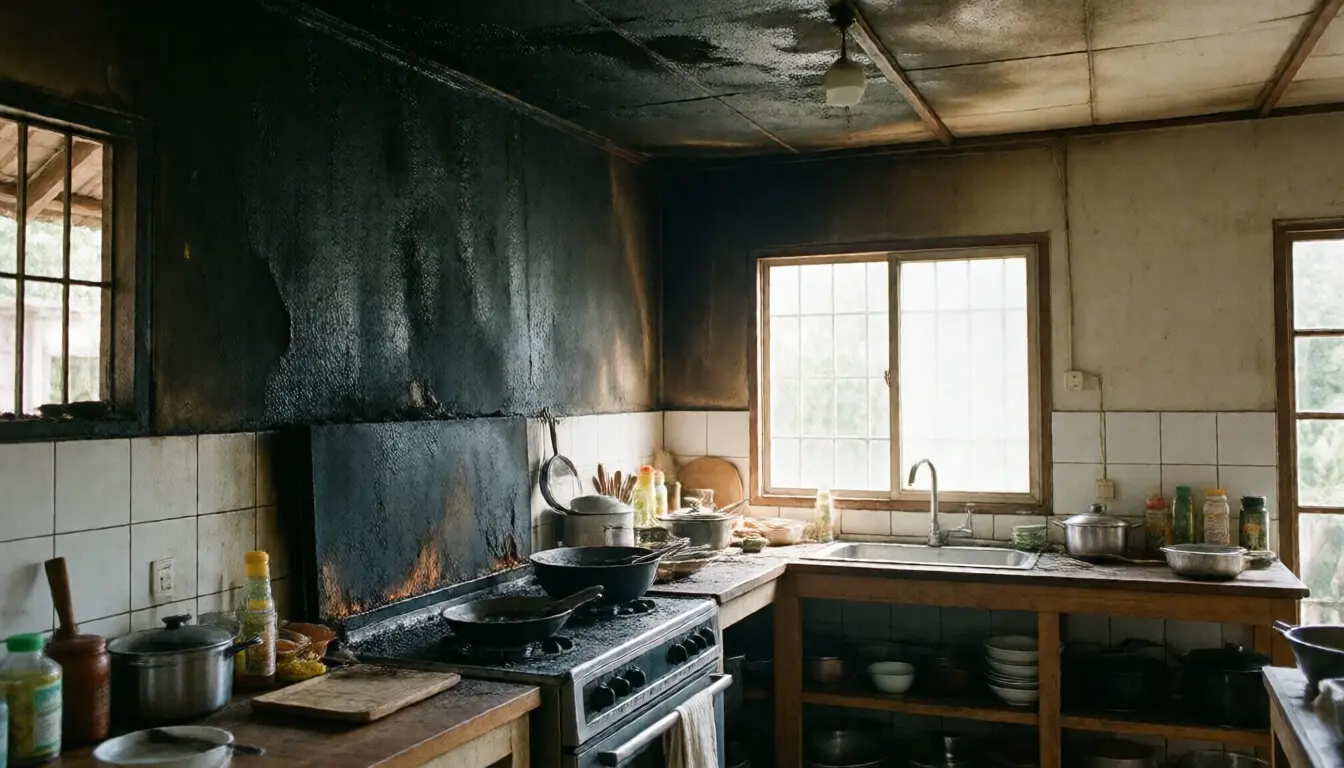
Four natural perils, capped at 20,000 baht a year between them
Alongside those six, the policy covers four natural perils: windstorm, flood, earthquake or volcanic eruption or tsunami, and hail.
But this is the number to remember. All four together are limited to 20,000 baht per year.
Twenty thousand baht replaces ten roof tiles that blew off. It does not repair a house whose ground floor went under.
If your house sits in an area that floods repeatedly, or near the coast, treat this standard cover as effectively meaningless and buy an endorsement raising the limit.
One small benefit does apply here: for these four perils the insurer does not apply the underinsurance condition that averages a claim down, which is the subject of the next section.
The most important number in the policy is 70 percent
This is what reduces payouts more than anything else, and almost nobody explains it at the point of sale.
The policy states that if the sum insured equals or exceeds 70 percent of the actual value of the property at the time of the loss, the insurer pays the actual damage without applying the underinsurance condition.
If the sum insured falls below 70 percent, you are treated as self-insuring the shortfall and the claim is averaged proportionally.
The formula is claim = sum insured divided by the property value at the time of loss, multiplied by the value of the damage.
Try it with real numbers. Say the house has an actual value of 3 million baht and is insured for 1.5 million, which is 50 percent.
A kitchen fire causes 400,000 baht of damage. You might expect 400,000, since it is well inside the sum insured.
What you receive is 1.5 million divided by 3 million, or 0.5, multiplied by 400,000, which is 200,000 baht.
The missing half is the price of having insured for less than the property was worth.
So what should the sum insured be? The rebuilding cost of the structure, not the price you paid.
The purchase price includes the land, while the policy covers the structure excluding foundations.
Land does not burn with the house, so insuring for the full purchase price means paying a premium for nothing. Insuring for the outstanding mortgage balance, on the other hand, usually lands below the threshold and triggers averaging.
There is a second choice to make when the policy is written, because it offers two ways of setting the sum insured.
The first is replacement cost, paying what it takes to rebuild or buy new.
The second is actual cash value, which is the new value less depreciation at the time of loss.
The premium for the first is higher, but the second means a fifteen-year-old roof that burns is worth a fifteen-year-old roof, not the cost of a new one.
Check your policy schedule for which one you have, because it changes the amount paid on the day of a claim substantially.

Property in the house that is not covered unless it is named
The policy lists property it does not cover unless expressly stated otherwise. The items that matter in an ordinary house are:
- Gold bullion, gold and silver ornaments, and gemstones
- Antiques or works of art with a total value above 10,000 baht
- Documents of title, securities, currency, banknotes, cheques, plans and drawings
- Vehicles of every kind, land, water or air
- Trees, garden landscaping and lawns
The one that surprises people most is the car. If the house burns and the car in the garage burns with it, that is a motor claim, not a fire insurance claim.
There is another clause worth reading slowly. The policy does not cover electrical appliances, circuit boards, electronic equipment, wiring or lamps damaged by overloading, short circuit, arcing, self-heating of the wiring, current leakage or deterioration, for the specific item damaged by that cause.
Set against the second peril, which covers appliances short-circuited by lightning, the line becomes clear.
Short circuit caused by lightning is paid. Short circuit caused by the appliance itself is not.
If that short circuit then spreads into a fire that damages the house, the house and other property remain covered under the fire peril. What you do not recover is the appliance that failed on its own.
Protecting appliances from supply problems is covered in voltage sags and surges, which is damage to prevent with equipment rather than with a policy.
The temporary accommodation benefit almost nobody claims
This extension already sits inside the policy, and virtually no household knows it is there.
If the structure is damaged by one of the first six perils and the damage exceeds half the cost of rebuilding, the insurer pays for temporary accommodation.
For a house with masonry walls over 80 percent of the wall area, the limit is 1,000 baht a day up to 50,000 baht in total.
If the damage equals the full rebuilding cost, that total rises to 100,000 baht.
Houses whose walls are other materials, or less masonry than that, get up to 500 baht a day with proportionally lower totals.
The important part is that this limit is an additional liability separate from the sum insured on the building. It is not deducted from the repair money.
The condition is that you must produce evidence of rent actually paid, so if you have to move out, sign a tenancy agreement and keep receipts from the first day rather than staying with relatives and wondering later whether you could have claimed.
The bank, for a house still on a mortgage
Where the house is mortgaged, the bank will require fire insurance naming it as beneficiary to the extent of its interest, which is normal and reasonable since the house is its security.
What to keep separate is that requiring insurance and dictating which insurer sells it are two different things.
The Bank of Thailand maintains market conduct rules on fair dealing with customers, which cover selling products alongside a loan.
In practice, ask the bank plainly before renewal whether it accepts a policy from another insurer, and ask for its requirements in writing, such as the minimum sum insured and how the beneficiary must be named.
Then compare premiums across several insurers on identical terms, rather than comparing premiums alone without checking how the sum insured is set and what the natural peril limits are.
If you feel you are being forced into a bundled sale with no choice, the Office of Insurance Commission hotline on 1186 handles policy matters, and the Bank of Thailand's financial consumer protection centre handles the sales conduct of financial institutions.
One more habit worth keeping is reviewing the sum insured at every renewal, because construction costs move every year. A sum insured that fitted five years ago may already be below 70 percent without your noticing.
And if you have just extended or heavily renovated, tell the insurer and adjust the figure, since improvements and extensions count as part of the insured structure.
Finally, insurance pays after the event rather than preventing it. Equipment that warns you in time is a separate subject, covered in smoke, gas and carbon monoxide detectors.
Frequently asked questions
What does home fire insurance cover?
Six perils: fire, lightning, explosion, impact by a vehicle or draught animal, aircraft or falling objects from aircraft, and water damage from leaking or overflowing pipes and tanks, plus four natural perils within a limited sum.
How much does it pay for flooding?
The four natural perils of windstorm, flood, earthquake and hail are limited to 20,000 baht a year in total under the standard policy. In a flood-prone area you need an endorsement raising the limit.
What sum insured should I choose?
The rebuilding cost of the structure, not the purchase price which includes the land, and not the mortgage balance. Below 70 percent of actual value, your claim is averaged down proportionally.
How does the 70 percent condition work?
At or above 70 percent of actual value the insurer pays the damage in full. Below it the claim is proportional, so insuring for half the value pays half the damage.
Is an appliance destroyed by a short circuit covered?
If the short circuit came from lightning, yes. If the appliance short-circuited or overloaded on its own, that appliance is not covered, although fire damage spreading to the house still is.
The house burned and the car in the garage burned too. Who pays?
The motor insurer, because vehicles of every kind are on the list of property the fire policy does not cover unless expressly stated otherwise.
Can the bank force me to buy its own insurance?
It can require insurance and require to be named as beneficiary. Ask plainly whether it accepts another insurer, and get its requirements in writing before comparing premiums.
In short
- Six perils, not just fire, and water damage from a burst pipe is the one used most.
- Flood and the other three natural perils are capped at 20,000 baht a year between them.
- A sum insured below 70 percent of actual value gets averaged down proportionally.
- Insure the rebuilding cost of the structure, not the purchase price with land, and not the mortgage balance.
- Gold, gemstones, vehicles, trees and lawns are excluded unless expressly named.
- Temporary accommodation is a separate limit, but you need receipts for rent actually paid.
- Review the sum insured at every renewal and tell the insurer about any extension.