
Your lights are bright enough. They are the wrong colour for the room
A great many Thai homes run daylight tubes throughout, from the kitchen to the bedside, because in the shop the bluish white bulbs look brighter and cleaner than the rest.
Which means we switch on the same light an office uses at three in the afternoon, directly above our heads, at ten at night.
The bedroom then reads like a workplace, and the body reads that signal exactly as it evolved to: not yet time to sleep.
This costs a few hundred baht to fix and can be fixed tonight, once you know which number on the box to look at.
What colour temperature is, and what belongs where
The figure ending in K on a bulb box is colour temperature. Lower numbers give oranger light, higher numbers give bluer light.
Three bands are sold everywhere:
- About 2700K to 3000K, warm white, the orange light of an old incandescent bulb
- About 4000K, cool white or neutral, sitting between the two
- About 6500K, daylight, the bluish white that most Thai homes use
The way to organise it is by the time of day you use the room, not by what kind of room it is.
Rooms used in daylight where you want alertness, such as the kitchen, a desk, and the bathroom in the morning, take 4000K and above.
Rooms used at night before sleeping, such as the bedroom, the hallway after midnight, and any bedside lamp, take 2700K to 3000K.
A living room used across the whole day needs two sets: ceiling lights for daytime, and a warm floor lamp or side lamp for evening, on separate switches.
The commonest mistake is converting the entire house to warm white after reading an article like this one, then discovering that chopping vegetables is unpleasant and desk work makes you drowsy. Light does not have one answer for the whole house.
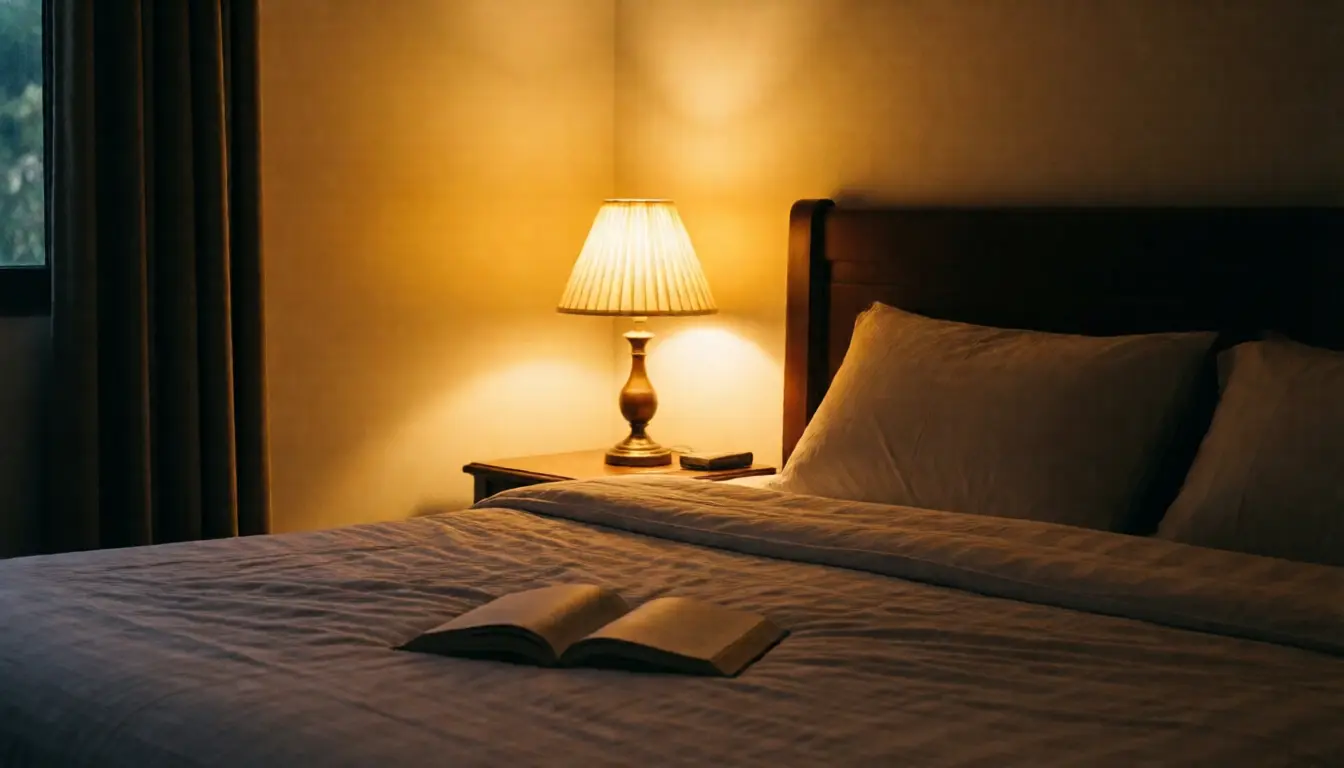
Why light at night makes sleep harder
The body uses light as a clock, not only for seeing.
When light reaches the eye, the brain delays the release of melatonin, the hormone that rises as bedtime approaches, and short-wavelength light towards the blue end affects this more strongly than long-wavelength light towards the orange.
Which is why a daylight tube above your head late in the evening is a worse choice than a small orange lamp beside the bed.
Colour is not the only factor though. Brightness, how long you are exposed, and how close the source sits to your eyes all matter.
That last point explains why phones matter more than people assume. A screen thirty centimetres from your eyes delivers a great deal of light into them even though it looks dimmer than a ceiling fitting.
Night modes that warm the screen help on the colour dimension, but with brightness at full and another hour of scrolling, the benefit is limited. Research on this is genuinely mixed, so reducing brightness and reducing time are the more reliable moves rather than changing screen colour alone.
Three things you can do tonight
One, change the bedside bulb to 2700K. Not the whole room, just the last light you switch off. A few hundred baht and under a minute.
Two, stop using the ceiling light as the last light of the night. Use a low lamp instead. Light below eye level puts far less directly into your eyes than light coming down from the ceiling.
Three, put an orange night light in the route to the bathroom, because what really damages a night's sleep is switching on a full ceiling light at three in the morning and then needing half an hour to get back to sleep.
The third matters especially in a house with an older person, who gets up more often and is more at risk of a fall. Equipment for that situation is covered in home technology for elderly parents.
If you automate any of it with sensors or bulbs that shift colour by time of day, hold to one rule: everything must still work by hand. The reasons are in a smart home that works when the internet is down.
Two other numbers on the box
Besides the K figure, two things noticeably change how a room feels.
Colour rendering, usually printed as CRI or Ra. The closer to 100, the more the colours of real objects match what you would see in daylight.
Cheap bulbs with a low figure make food look washed out, fabric look wrong and skin look bloodless. Fine in a warehouse, but in a kitchen or a dressing area choose bulbs rated 90 and above.
Flicker. Some LED bulbs flicker faster than the eye can consciously see, but sitting under them for a long stretch produces eye strain and headaches.
The simple test is to point a phone camera at the bulb. Clear dark bands rolling across the screen mean strong flicker.
The other cause of flicker is putting ordinary LED bulbs on a dimmer designed for incandescent lamps. If you want to dim, buy bulbs marked dimmable and a dimmer made for LEDs.
Bulbs that change their own colour temperature come in switch-selected and app-controlled versions. Both work, but check what colour they return to after a power cut, because a bulb that snaps back to daylight at three in the morning is the problem you just tried to solve.
Frequently asked questions
What colour temperature suits a bedroom?
Around 2700K to 3000K for anything used before sleep, especially the bedside lamp. The ceiling light can be higher if you also use the room during the day.
Does blue light really keep you awake?
Short-wavelength light towards the blue end delays melatonin more than orange light does, but brightness and duration of exposure matter as well. It is not colour alone.
Do phone night modes help?
They help on colour, but at full brightness for another hour the benefit is limited. Lowering brightness and shortening the time are more dependable.
Should I convert the whole house to warm white?
No. Kitchens and desks need cooler light and good colour rendering. Choose by when the room is used rather than making everything the same.
Why do some lights give me a headache?
Possibly flicker. Point a phone camera at the bulb, and if dark bands roll clearly across the screen, replace it. On a dimmer, check that the bulb and dimmer are made for each other.
In short
- Choose colour temperature by when the room is used, not by what kind of room it is.
- Bedrooms and night-time hallways take 2700K to 3000K. Kitchens and desks take 4000K and above.
- Short-wavelength light delays melatonin more than orange light, but brightness and duration matter too.
- Changing only the bedside bulb and dropping the ceiling light as the last one of the night is enough to notice.
- Put an orange night light on the route to the bathroom so nobody switches on the big light at three.
- Look for colour rendering of 90 and above in kitchens and dressing areas, and test for flicker with a phone camera.