
Get the order right: preventing a fall comes before detecting one
When adult children start thinking about their parents' house, the first purchase is usually a fall-detection watch or a camera, although both sit at the far end of the chain. They work after the event.
The order money should be spent in is: stop the fall happening, then know about it quickly, then be able to call for help.
The reasoning is blunt. A fall for an older person rarely ends in a graze. It ends in a fractured hip, surgery, and months of recovery during which muscle disappears and walking never fully returns. Something costing a few thousand baht that prevents a fall is therefore worth more than a device costing tens of thousands that only announces one.

The three places where falls actually happen
If you walk the house once, look at these three first, because falls at home cluster here.
The bathroom, where the floor is wet, the person changes from standing to sitting and back, and there is nothing to hold at the moment balance goes.
The route from bed to toilet at night, walked while not fully awake, in the dark, and usually past rugs, thresholds or things left on the floor.
The stairs, particularly the top step and the bottom one, which are where people misjudge the distance most often.
If the budget is genuinely small, spend all of it on these three before considering any electronics.
Sensor night lighting: the cheap thing that works best
Of everything in this article, lights that come on by themselves when someone walks past give the most per baht. A few hundred baht a point, installable without a tradesman, and they fix one of the places falls happen most.
They work because an older person at two in the morning does not want the main light on. The glare is uncomfortable, the eyes cannot adjust quickly, and sleep afterwards is worse, so people walk in the dark instead. A sensor light solves that with a dim warm glow that shows the floor without waking anyone fully.
Fit them under the edge of the bed on the side the person gets out, along the hallway wall, and inside the bathroom. Mount them low, below knee height, because light from down there shows the floor and anything on it, which is what needs to be seen rather than shone into the eyes.
Choose a warm tone rather than a cool white, and if they run on batteries, write down the date they were changed. A sensor light with a flat battery is something nobody discovers is dead until the moment it is needed.
Grab rails must go into structure, nothing else
Grab rails are where people go wrong most often, because suction-cup rails that stick to tiles are sold everywhere. Cheap, easy, no drilling, and more dangerous than having none.
They come away under real weight, which is the same second the person is already losing balance. The result is a fall with the rail still in their hand, and usually a worse injury than a plain fall.
A grab rail that works is fixed with plugs and screws into a wall that can carry the load. Rendered masonry is fine; a lightweight partition needs a support behind the board first. Have the fitter test it by hanging their own weight on it, not by pulling with a hand.
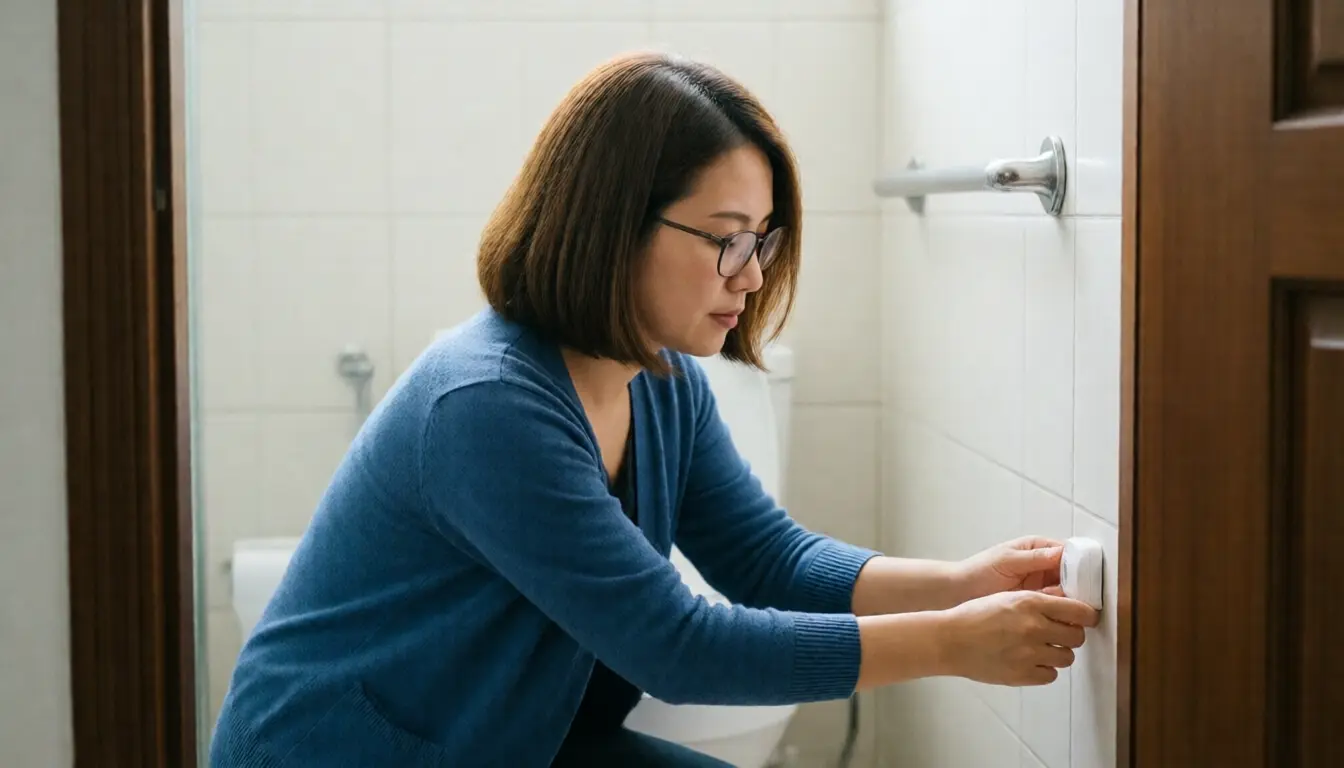
The positions worth having are beside the toilet, for pushing up from sitting, and horizontally in the shower area, for balance. A rail beside the bed helps a great deal in a house where someone gets up at night, and it is easier to fit than a bathroom one.
An emergency button has to be reachable from the floor
A house with the emergency button on the wall at light-switch height is a house where that button is useless in the situation it was bought for, because a person who has fallen and cannot get up cannot reach something at one metre twenty.
There are two answers. The first is a pull cord hanging down to just above the floor, which is what hospitals use and which works precisely because someone lying on the floor can still catch it.
The second is a wearable button on a neck cord or wrist strap, which has the advantage of always being on the person, and one condition that matters more than any specification: they have to actually wear it.
A button taken off and left on a table because it was annoying protects nobody. If you buy one, take them along to choose it, pick a waterproof one so it can be worn in the shower, since the bathroom is where it is most needed, and settle clearly who the button calls. Not a notification into an app nobody has open.
Fall-detection watches: know the limits before buying
Watches and pendants that detect a fall automatically are genuinely useful in one case that matters enormously: the person falls and is unconscious or unable to press anything.
Two limits are worth knowing. They detect from movement patterns, so they produce false alarms when someone sits down heavily, and they can miss the slow slide to the floor, which is a common way older people go down.
The second is that they need charge and a connection. A watch that must be charged every night is a watch with a fair chance of being on its cradle when something happens. Choose a model lasting several days and set the charging time to the middle of the day when someone is around.
Do not treat it as the main safety system. Treat it as the last layer, after the floor, the lighting and the grab rails are all done.
Cameras: the line not to cross
A camera in a parent's home is something children want and parents usually do not, and the discomfort is reasonable, because being watched constantly in your own house is losing privacy in the last place a person still has it.
The arrangement that works is this: cameras in shared space such as the living room or the front of the house only, never in a bedroom or bathroom, and the person knows where every camera is rather than finding out later.
If they are not comfortable with cameras, there is an alternative giving almost the same information with no images at all: door sensors and motion sensors, which tell you what time the bedroom door opened, whether the fridge has been opened today, and when there was movement in the house.
That answers nearly everything the family is actually worried about, which is whether they got up today, whether they have eaten and whether anything is out of the ordinary, without a picture of anyone.
If you do decide on cameras, read where they may point and what the data protection law requires in home CCTV and PDPA first, particularly if the view reaches a neighbour's property.
Kitchen and electrics, where the risk changes with age
What people do not anticipate is that kitchen risk changes shape when memory becomes less reliable. A gas hob and a kettle, safe for forty years, become a risk once there is a chance of forgetting them.
What helps, cheaply, is a smart plug set to cut power automatically after a period of use, for an iron and a kettle, and a gas leak detector fitted low near the floor, because LPG is heavier than air and collects at the bottom of the room.
The other thing worth having in a house with an older person is a residual current device, because thinner skin and wet hands in the bathroom make the consequences of a leakage current more severe than for a younger person. How many you need and where they go is in residual current devices at home.
Doors and getting in during an emergency
The problem that shows up when something real happens is this: the person is home alone, the door is locked from the inside, and the child who has driven over cannot get in.
A digital lock addresses that directly, because every family member has their own code, nobody carries a key, and anyone can get in the moment a call goes unanswered. The thing to watch is the battery, so choose a model with an external emergency power contact and leave a spare key with a relative living close by.
The other thing to change is the bathroom door lock. If it locks from the inside with no way to release it from outside, replace it with the type that has an emergency release hole, a few hundred baht that solves one of the worst situations there is: someone on the floor of a locked bathroom.
What to look for in a digital lock is in choosing a digital door lock.
Voice assistants, and the things that look good but go unused
A voice speaker has two real uses for an older person: making a call without finding a phone, and turning lights on and off without getting up.
Before buying, test it with them, not with your own voice, because how well each brand understands Thai varies, and someone who speaks slowly or quietly may fail often enough to abandon it.
The other category that gets bought and never used is anything requiring a phone app to operate, because if the person has to pick up a phone, unlock it, find the app and tap, it is slower than getting up and using the switch. What gets used is what works automatically or has a real button to press.
The rule that decides almost every case: if a device requires the older person to change their behaviour in order to use it, the chance of it being used is low. Choose the things that work quietly in the background instead.
What is possible in rented accommodation
A tenant caring for a parent in a rented place can do nearly everything in this article without drilling anything.
Battery sensor lights stick on with tape, door and motion sensors are all wireless, a wearable button needs no installation, non-slip mats sit on the floor, and a smart plug just plugs in.
The only thing needing the landlord's permission is a grab rail, because it has to be drilled. Ask in writing and offer to remove it and make good the wall when you leave. Most landlords agree, because a grab rail adds more to a place than it takes away.
Frequently asked questions
With a small budget, what comes first?
Sensor lights along the route from bed to bathroom, non-slip matting, and a grab rail beside the toilet. Those three genuinely prevent falls and together still cost less than one fall-detection watch.
Are suction-cup grab rails acceptable?
Not as a load-bearing rail. They release under real weight, which is the second the person is already losing balance. A grab rail must be plugged and screwed into a wall that can carry the load.
How accurate is fall detection?
It reads movement patterns, so it can false-alarm when someone sits down heavily and can miss a slow slide to the floor. Use it as the last layer, not the main system.
Can I put a camera in my parent's bedroom?
You should not. Keep cameras to shared space and make sure they know where each one is. If you want to know how they are, door and motion sensors give you nearly the same information with no images.
Where should the emergency button go?
Somewhere reachable from the floor, so either a pull cord hanging almost to floor level or a waterproof wearable button they will genuinely wear. A wall button at switch height does nothing for someone who cannot get up.
How much of this works in a rental?
Almost all of it without drilling: stick-on sensor lights, wireless sensors, a wearable button and non-slip matting. Only the grab rail needs written permission first.
Do voice assistants really work for older people?
They can, if you test with their voice before buying, because Thai recognition varies by brand and someone speaking slowly or quietly may fail often enough to give up on it.
In short
- Spend in order: prevent the fall, then detect it, then call for help.
- Falls cluster in the bathroom, the night route to the toilet, and the stairs.
- Sensor lights mounted below knee height are the cheapest thing that works.
- Grab rails must be screwed into structure. Suction cups release under real weight.
- An emergency button must be reachable from the floor and be something they will wear.
- Door sensors answer nearly everything the family worries about, with no bedroom camera.
- A device that requires the older person to change their habits usually goes unused.