
The biggest consumer in the house is not the one with the highest wattage
The kettle says 2000 watts on its label and the bedroom air conditioner draws around 1200, so most people assume the kettle is the problem.
But the kettle runs for three minutes a day and the air conditioner runs for eight hours a night.
What the bill charges for is not watts. It is watts multiplied by time, which means the number on the label tells you only half the story.
This is why guessing what uses the electricity is usually wrong, and why measuring settles it in a week.
The good news is that the meter costs a few hundred baht, and the method for things you cannot plug a meter into, like an air conditioner or a water heater, needs no equipment at all.
The one formula worth remembering
The electricity authority charges by the kilowatt hour, called a unit on the bill.
Units = watts divided by 1000, multiplied by the hours of use.
Try it on the two examples. A 2000 watt kettle for 3 minutes a day is 2 multiplied by 0.05 hours, or 0.1 units a day.
A 1200 watt air conditioner for 8 hours is 1.2 multiplied by 8, or 9.6 units a day if the compressor ran continuously.
Almost a hundred times the difference, from the appliance with the lower number on its label.
For what that costs, use the figure from your own bill rather than one somebody quoted you. Divide the total amount on the bill by the number of units used that month, and you have your real price per unit, with the fuel adjustment charge, service charge and tax already inside it.
That figure differs between households because residential electricity is charged in bands, so the more you use the higher the price per unit, and it moves whenever the fuel adjustment charge is revised. There is no single number that applies to everybody.
Reading the label on the back
Every appliance carries a rating label, usually on the back, underneath, or beside the battery compartment.
If it gives watts, use it directly. If it gives amps, multiply by the mains voltage, which in Thailand sits at roughly 220 to 230 volts.
So something rated 5 amps draws around 1100 to 1150 watts.
The catch is that the label states the maximum the appliance can draw, not what it uses continuously.
A refrigerator is the clearest example. It is plugged in for 24 hours but the compressor only runs in bursts, so multiplying the label by 24 gives a figure far above reality.
An inverter air conditioner is the same. It raises and lowers compressor speed according to the heat in the room, so the power it actually draws changes all night.
That is the point at which the label stops being useful and measuring starts to matter.
Measuring anything with a plug
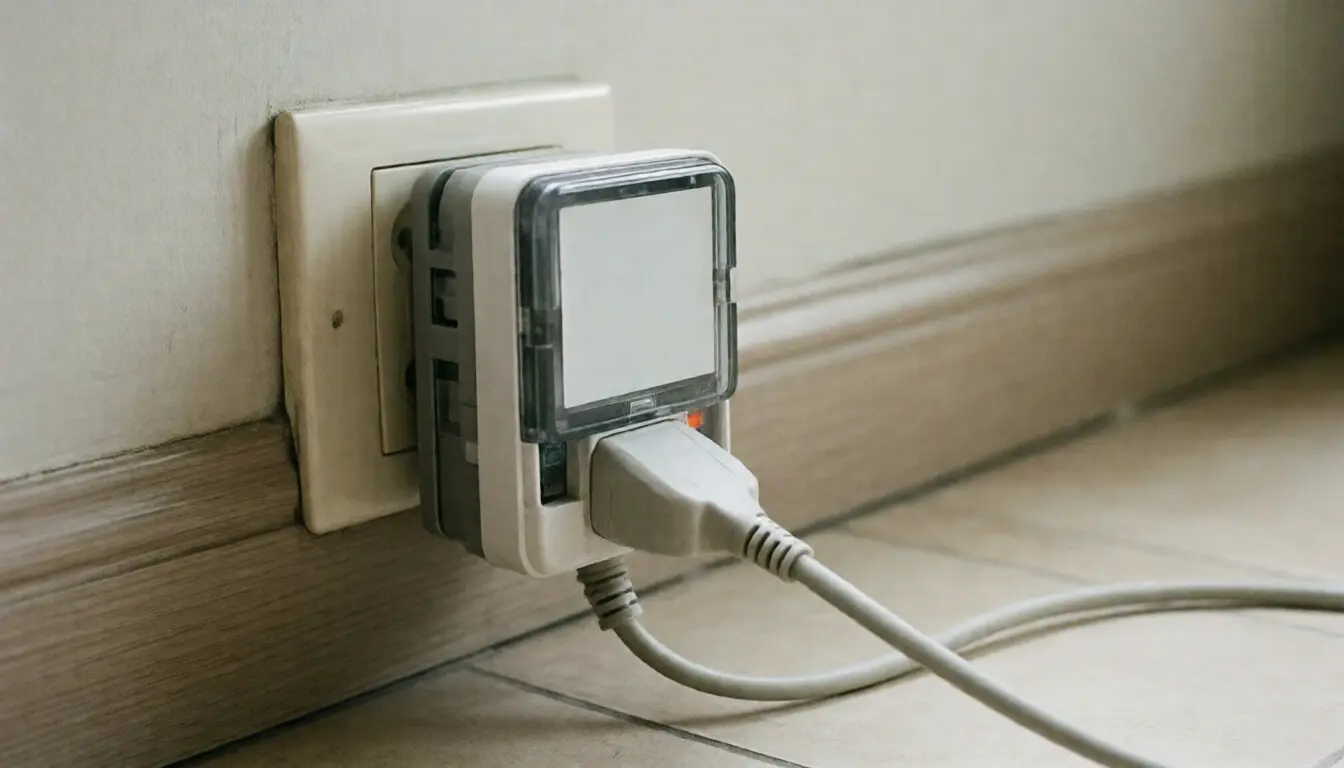
The tool is a plug-in energy meter, which sits between the socket and the appliance plug and costs a few hundred baht.
It shows the power being drawn at that moment, and more usefully it accumulates units over time.
The way to get a real answer is to leave it on one appliance for a full week, then read the accumulated total.
A week rather than an hour, because most appliances work in cycles. A refrigerator switches its compressor on and off, a washing machine draws heavily only while spinning and while heating water, so a single reading tells you nothing.
Multiply the week's units by 4.3 for a monthly estimate, then by your price per unit.
Measure in this order: things that make heat or move heat. The refrigerator, the rice cooker, a washing machine using hot water, a tumble dryer, and any electric hob.
The devices people suspect, such as the television, the router and the set-top box, can be measured the same way, but usually turn out to total less than one heating appliance on its own.
Standby draw is measurable too. Switch the device off with the remote and see whether the meter still shows a figure. If it does, that is power being supplied with nothing being used.
For anything wired directly, use the meter outside
Air conditioners, water heaters and built-in hobs are usually wired straight to a breaker, with no plug to interrupt.
They can still be measured, using the utility meter outside the house, with nothing to buy.
Do it like this. Pick a quiet hour, switch off everything that can be switched off, unplug what can be unplugged, and let the refrigerator run because it cannot be.
Write down the meter reading, wait an hour without switching anything on, and read it again. The difference is your household baseline per hour.
Then switch on only the appliance you want to measure, leave it an hour, and read again.
Subtract the baseline from the second difference, and you have what that appliance actually uses per hour.
It works best on an air conditioner, because it shows two things at once: what the unit really draws, and how differently it draws in the first hour with a hot room compared with the third hour once the room is cool.
If you want to know why the room is hot enough to make it work that hard, see why Thai houses get hot and what to fix first.
For condominium residents with an unexpectedly high bill, there are causes specific to condominiums, covered in why a condo electricity and water bill runs high.
Frequently asked questions
Which appliance uses the most electricity?
Generally the ones that make or move heat and run for long periods: air conditioning, water heating and tumble drying. What it is in your house depends on your hours of use, so measure rather than assume.
How do I work out what one appliance costs?
Divide the watts by 1000, multiply by the hours used to get units, then multiply by your price per unit, found by dividing the bill total by the units used that month.
Does a refrigerator plugged in for 24 hours use its label wattage times 24?
No, because the compressor runs in bursts. Multiplying directly gives a figure far above reality. Use a plug-in meter over a week instead.
How do I measure a hard-wired air conditioner?
Use the utility meter. Read it before and after an hour with everything off to get the baseline, then repeat with only the air conditioner running. The difference minus the baseline is the real figure.
Does standby power really raise the bill?
Measure it with a plug-in meter, but in most houses the total is still less than a single heating appliance. Start with the big ones.
In short
- The bill charges watts multiplied by time, so a high-wattage appliance used briefly is rarely the problem.
- Units equal watts divided by 1000, multiplied by hours.
- Find your real price per unit by dividing the bill total by the units on it.
- Labels state the maximum draw, not the actual one, especially for refrigerators and inverter air conditioners.
- Measure anything with a plug using a plug-in meter left on for a full week.
- For hard-wired appliances, use the utility meter: baseline first, then that appliance alone.