
Stand outside your house at nine in the evening and look at what you can see
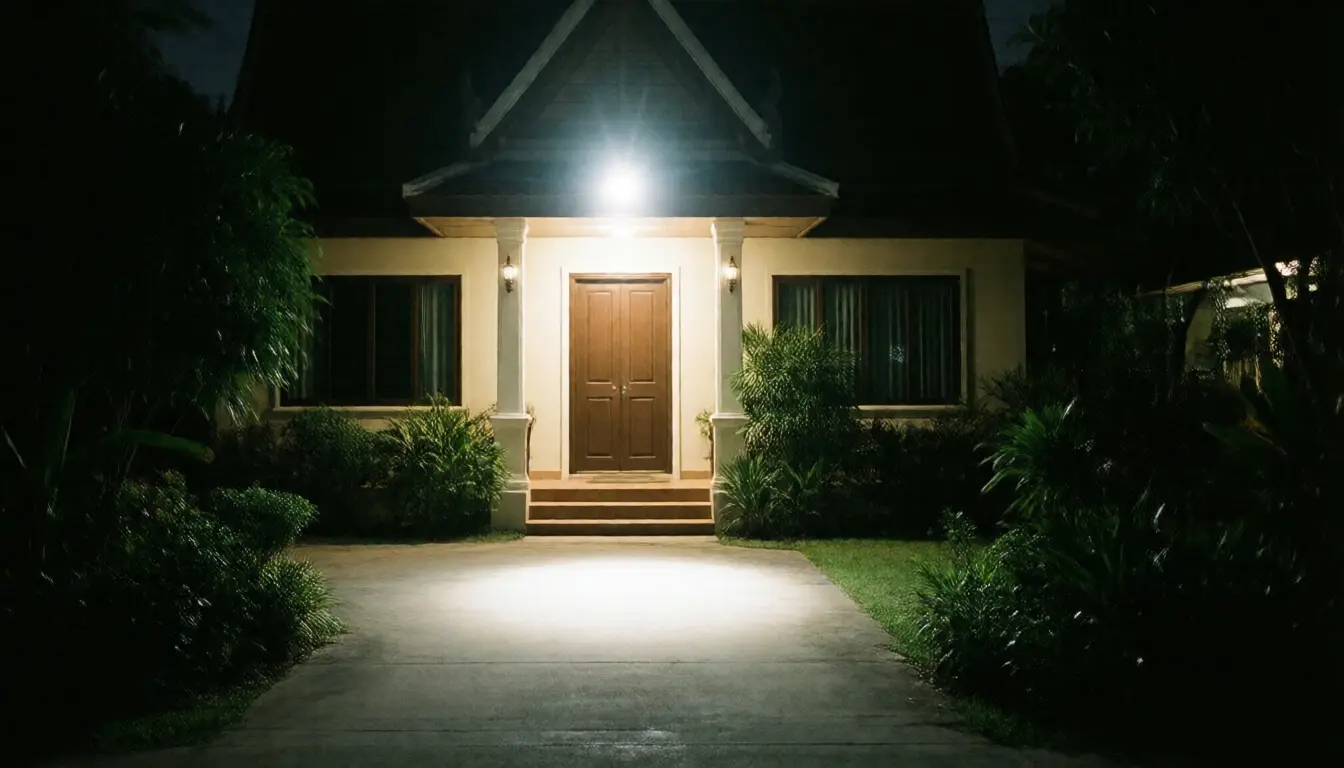
A large floodlight sits above the front door, throwing the driveway into hard white light.
The middle of the drive is bright enough to read by.
Now look at the side of the house, the corner of the wall, behind the shrubs, the gap between the car and the boundary.
Black.
Not black for want of light. Black because of the light.
Because your eyes have just adapted to the brightest thing in the scene, and everything dimmer than it has disappeared.
Meanwhile somebody standing in that shadow can see you perfectly well.
This is why the brightest house on the street is not the safest house on the street.
Bright is not the same as visible
The eye adapts to the average brightness of what it is looking at, not to each part of it separately.
Put one very bright point in the field of view and the pupil closes down to cope with it.
Every detail in the darker areas goes with it.
This is glare, and it does not only happen when looking straight at a lamp.
A light off to one side produces it too, which is why a fitting at eye level causes more trouble than one mounted high and aimed down.
There is a two minute test for whether your outdoor lighting works.
Switch off every light inside the house, walk out to the road, and look back.
If you can see the lamps more clearly than you can see the house, that lighting is working for whoever is standing in the dark, not for you.
Four principles of outdoor lighting that actually works
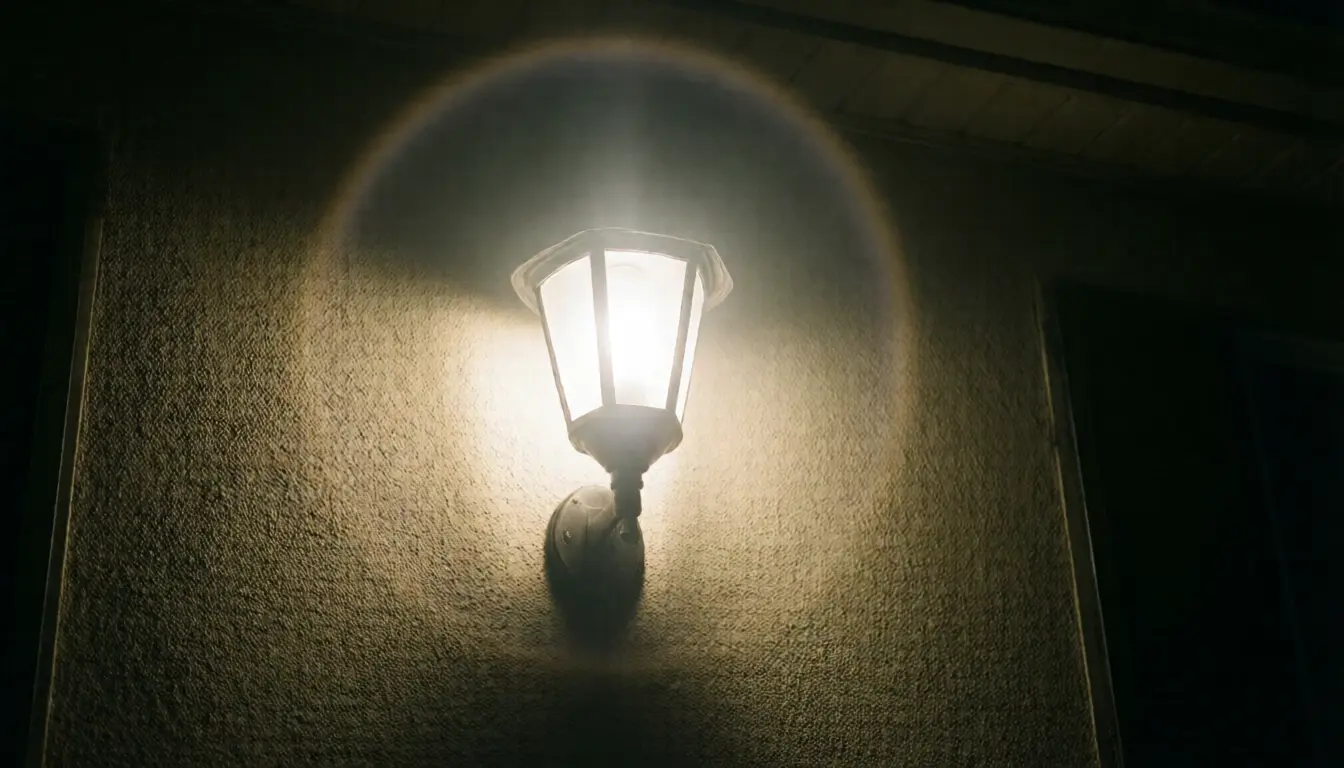
One, light the things, not the eyes. Fittings should aim downward and be shielded so the lamp itself is not visible from eye level.
What you should see is a lit area, not a bright lamp.
Two, several moderate lights beat one very bright one, because uniformity matters more than quantity.
A garden with five modest lights is more visible throughout than a garden with one powerful floodlight.
Three, light where people must pass and where people can hide, rather than the middle of a lawn nobody crosses.
The places that need light are the gate, the path to the door, the back door, narrow side passages, and any corner not visible from the road.
Four, do not make the house invisible from the street, because what genuinely deters is neighbours and passers by being able to see somebody there.
Tall shrubs plus glaring light turn the front of a house into a private room for whoever should not be in it.
Six positions that go wrong most often
A floodlight above the front door aimed outward rather than downward, so everybody approaching is dazzled, and anybody inside opening the door can see nothing at all.
That fitting belongs aimed down at around forty five degrees, mounted high enough.
Uplighting on the house wall, which photographs beautifully, but sends most of the light into the sky and casts hard shadows under the balcony and the porch roof.
The shadow under a porch roof is exactly where somebody can stand unseen.
A light that creates deep shadow behind shrubs, because it was mounted behind or beside the planting rather than throwing light through it or avoiding it.
The rule of thumb is that if a spot creates a shadow a person could hide in, move the fitting or cut the shrub.
Boundary lights aimed into the neighbour's house, which starts a quarrel and also makes them keep their curtains shut permanently.
A neighbour who can see your boundary from their window is the best security system you own, and glare aimed at them is you switching it off by hand.
A sensor light aimed to cover the road, which triggers on every passing vehicle until nobody in the house pays any attention when it does.
A sensor light that is always on is an ordinary light that costs more to run.
A light aimed straight into a security camera, which turns every person recorded into a black silhouette rather than a face.
Lighting and cameras, where most people go wrong
Cameras have different limits from eyes, and plenty of houses light themselves until the camera is useless without knowing.
Never put a light opposite the camera, because light entering the lens directly turns everything in front of it into a silhouette.
The right position is behind the camera or beside it, throwing light the same way the camera looks.
Do not mount a camera with infrared illumination tight against a wall or a soffit, because the infrared bounces straight back into the lens and washes the whole night image white.
This is extremely common, and people usually conclude the camera is faulty.
Watch for spiders and insects, because infrared attracts insects, insects attract spiders, and a web across the lens ruins an entire night.
If there is enough light, disable the camera's night mode, because a colour image carries far more information than a monochrome one, particularly about the colour of clothing and vehicles.
That last point changes the value of the recording enormously on the day it is actually needed.
Sensor lights, how they work and how to aim them
The motion sensors used in houses detect changes in heat across the area they are watching.
The part people do not know is that they detect somebody crossing the field of view far better than somebody walking straight towards them.
Which means a sensor facing along a path triggers later than one mounted side on to it.
Only a few things make a sensor misbehave.
- Facing where the evening sun falls on it
- Mounted near an air conditioning outdoor unit blowing hot air
- Mounted so low that cats and dogs set it off
- Facing a road with traffic on it
- Positioned where moving leaves enter the detection field
The off delay matters too, because a light that goes out too soon leaves somebody in the dark halfway along the path, while one that stays on for ages tells you nothing about whether something just passed.
The wrong colour temperature makes seeing worse
Very cold white outdoor light makes skin and objects look washed out and detail hard to separate, and it produces more glare.
Light that is too warm shifts colours until the colour of a car or a shirt cannot be identified.
The usable range around a house is soft white through to natural white, which shows detail without dazzling.
Colour temperature by room and by use is covered in choosing colour temperature room by room.
The other thing worth checking is colour rendering, which on cheap lamps is often poor enough that dark blue and black cannot be told apart on camera.
The electrical safety side of outdoor lighting
This part is not about seeing. It is about not being electrocuted and not setting fire to the house.
The fitting's protection rating must suit its position. A fitting under eaves out of the rain can be rated lower than one fully exposed.
A garden fitting at ground level where water may pool needs to be rated higher still.
Outdoor circuits need residual current protection, because moisture and water reach them constantly.
The rating used to protect people is thirty milliamps, and it needs a genuine earth to work as designed, as explained in why a three pin socket does not mean you have an earth.
Outdoor junction boxes belong above any level where water can pool, with the cable run so it has a low point before the box, letting water drip off rather than run in.
Outdoor conduit must be rated for sunlight, because ordinary conduit goes brittle and cracks within a few years in constant sun.
Never use indoor extension leads permanently outdoors, which is what happens when decorative lighting goes up and never comes down.
A workable outdoor lighting plan, in six places
Starting from scratch, start with these six rather than with more floodlights.
- The gate, with enough light to see the face of whoever is standing there, without dazzling whoever opens it.
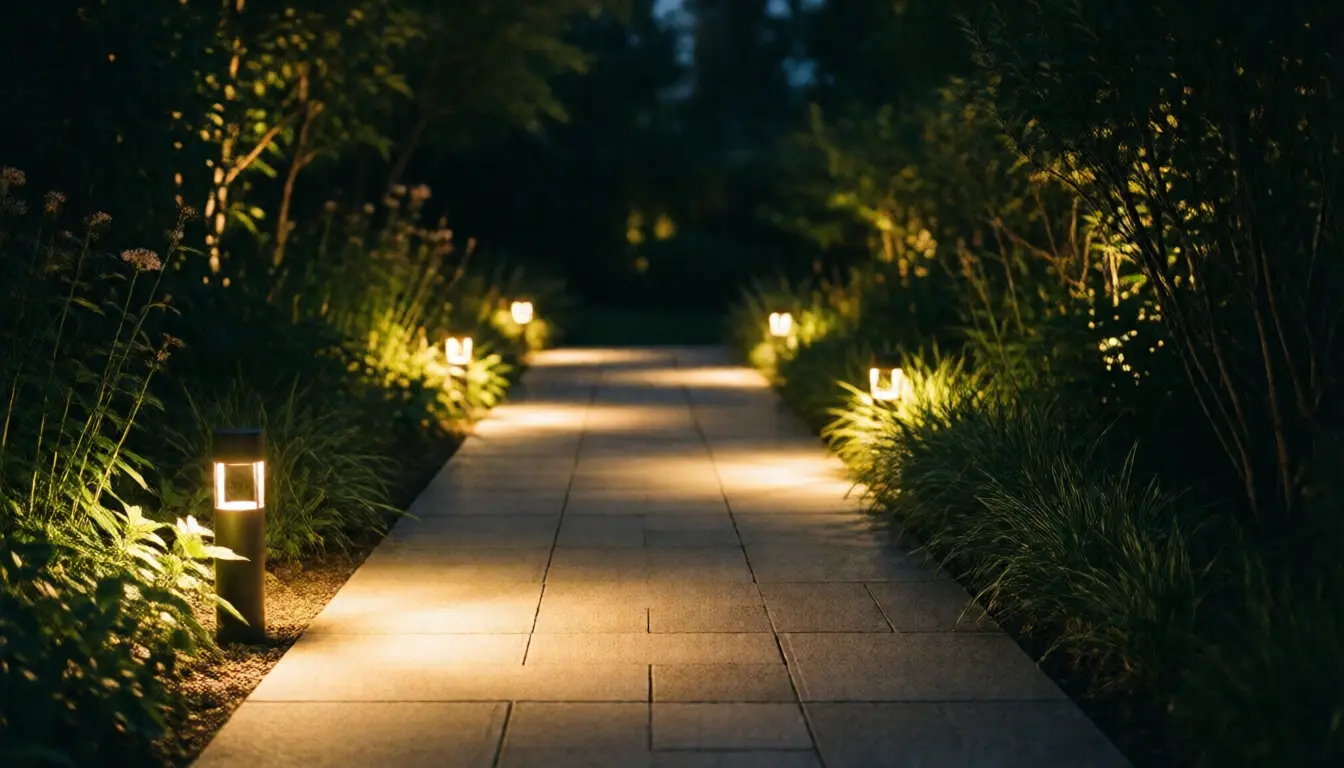
- The path from gate to door, using several low fittings throwing light down onto the ground.
- The front door, aimed down, and better as two fittings either side than one above the middle.
- The back door and the side passage, which is the way people actually get in, and the darkest part of most houses.
- The parking area, evenly lit rather than one strong point, so no shadow forms between the car and the wall.
- Wherever a camera looks, with the light behind the camera throwing the same way it faces.
Notice the list contains no lawn, because nobody enters a house across the middle of the grass.
Frequently asked questions
Is brighter really safer?
No. A very bright point closes the pupil down and every detail in the darker areas disappears with it, so somebody in the shadow sees you while you cannot see them. Uniformity matters more than quantity.
Where should the money go first on a limited budget?
The gate, the path to the door, and the back door and side passage, because that is the route people actually use. Almost nobody crosses the middle of the lawn.
Why is my night camera image washed out white?
Usually the camera's own infrared bouncing back off a wall or soffit it was mounted too close to, not a faulty camera. Move the camera off the wall or separate the infrared source from it.
My sensor light triggers constantly. What do I check?
Whether it faces a road, faces the evening sun, sits near hot air from an air conditioning unit, or watches moving leaves, and whether it is mounted so low that pets set it off.
Does outdoor lighting need an earth?
Yes, and the circuit should have thirty milliamp residual current protection as well, because water and damp reach it constantly, and that protection needs a genuine earth to work as designed.
Can solar lights replace mains lighting?
They are fine as a supplement in secondary places such as path edges, but not as the main light at the gate or the door, because batteries fade with age and several overcast days in the wet season is exactly when the light disappears.
In short
- Bright is not the same as visible, because a very bright point erases everything dimmer.
- Test it by switching off the house lights, standing in the road, and looking back.
- Fittings should aim down and hide the lamp from eye level.
- Several moderate lights beat one very bright one.
- Light the routes in and the places somebody can hide, not the lawn.
- Never place a light opposite a camera, and never let infrared bounce off a wall into the lens.
- Sensors detect somebody crossing the field far better than somebody approaching head on.
- Outdoor circuits need a genuine earth and residual current protection.
- A neighbour who can see your house is the best security system you already have.