
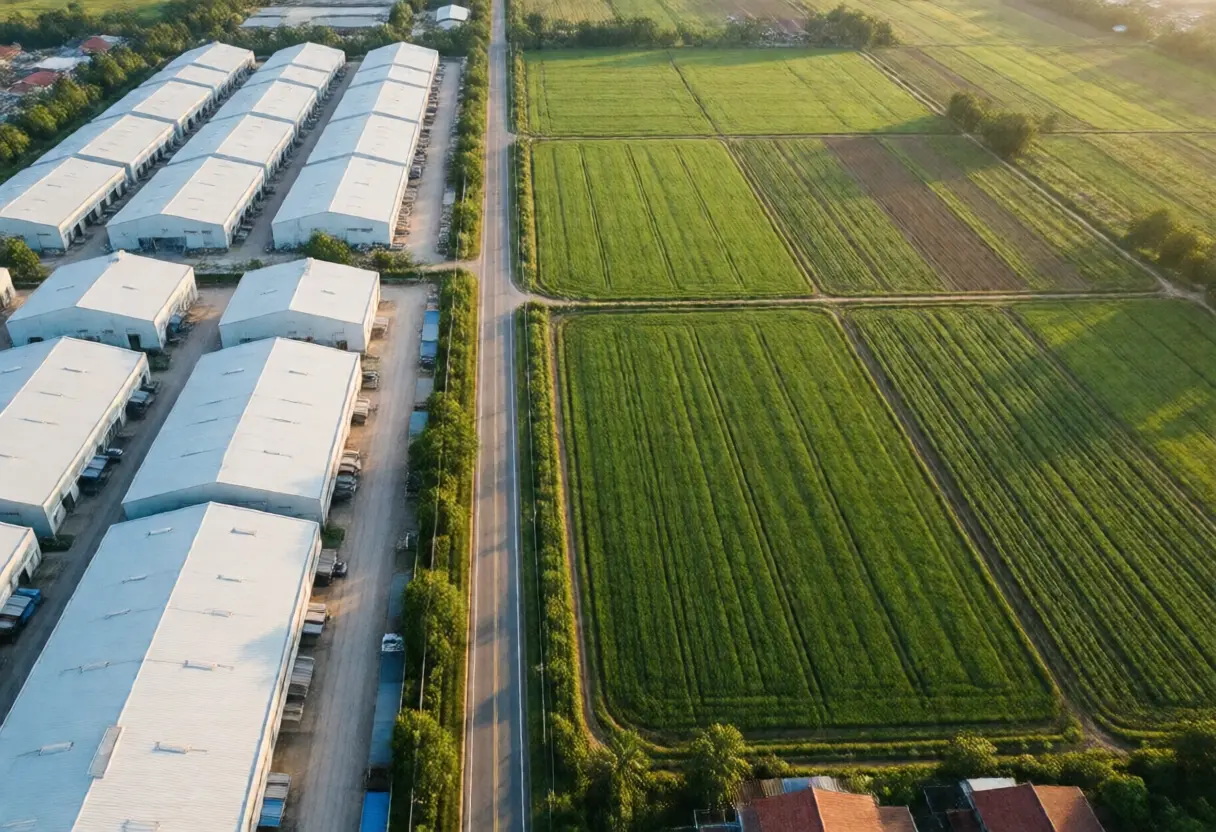
What purple land means on a Thai city plan
Purple on a Thai comprehensive city plan marks industrial and warehouse land. It is the category the plan sets aside for factories and storage. Some residential and commercial use is permitted but capped as a proportion of the zone, and tall buildings and extra large buildings for residential use are prohibited outright.
That definition is not enough for anyone about to buy, because purple is not a single shade, and the code printed beside it on the map does not carry the same meaning from one province to the next.
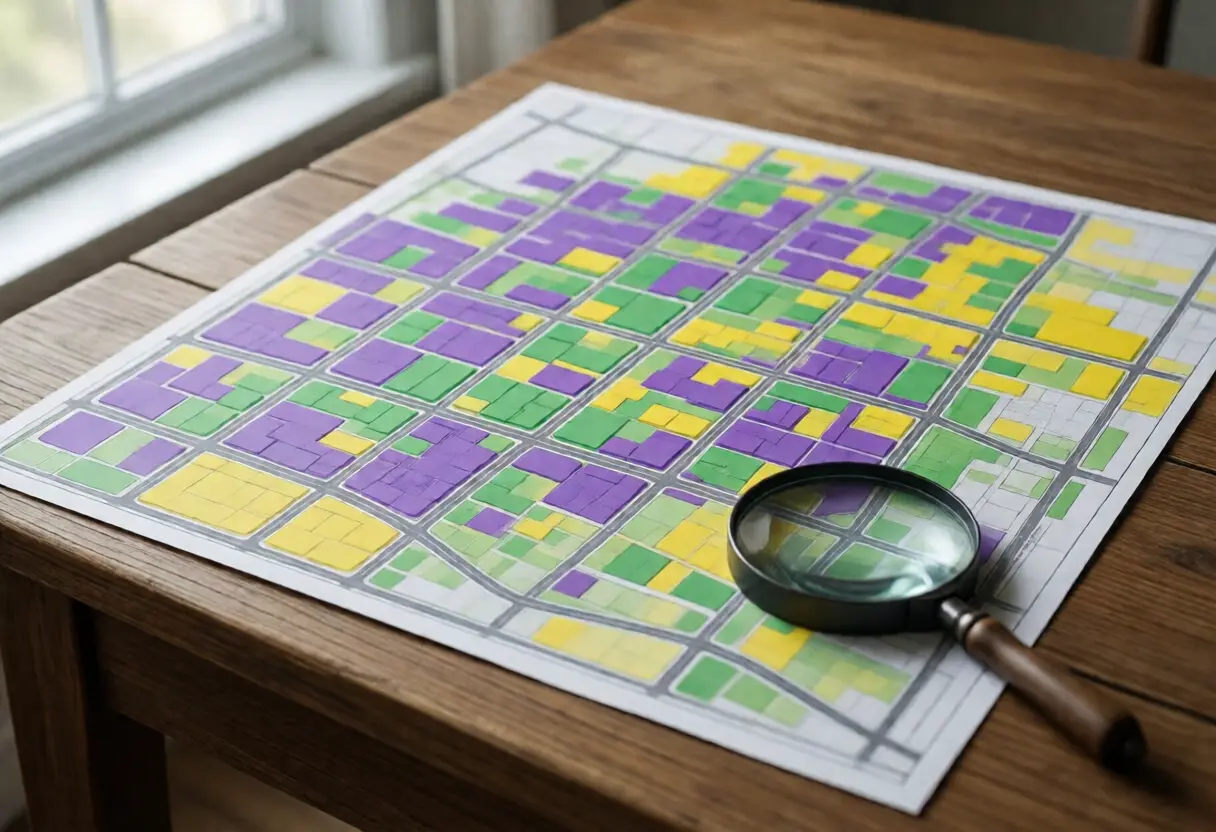
There are four purple categories, not one
Within the industrial group a plan uses four distinct map colours. Taking the Ministerial Regulation for the Samut Prakan Comprehensive Plan B.E. 2556 as the worked example, published in the Government Gazette on 5 February 2014:
| Code | Colour on the map | Category and stated purpose |
|---|---|---|
| Or 1 | Purple | Industrial and warehousing, intended to promote a general industrial district |
| Or 2 | Purple | Industrial and warehousing, intended for industrial estates established under the Industrial Estate Authority of Thailand legislation |
| Or 3 | Plum | Warehousing, intended for storage and handling of goods for Southeast Asian regional distribution |
| Or 4 | White with a purple border and purple diagonal stripes | General industry that does not pollute the community or the environment, plus warehousing |
The bottom two rows are where people slip. Plum looks like a pale purple at a glance, but it is a different category set aside for warehousing rather than manufacturing. And the white field with purple diagonals is one many buyers have never heard of and read straight past as empty space on the map.
Code Or 1 does not mean the same thing in every province
This is the most important point in this article, and it is the point almost every summary table online gets wrong.
A comprehensive plan is a separate ministerial regulation for each province and area. The letter and number printed against a colour, Or 1, Or 2, Or 3, is defined afresh inside that particular regulation. There is no national meaning that carries across.
The clearest example is Or 2 in the Samut Prakan plan. It does not mean heavier industry than Or 1. It means industrial estate, which is an entirely different proposition. A plot can sit in an Or 2 area with its owner assuming they may build their own plant, when the provision reserves that area for estates established under the Industrial Estate Authority of Thailand legislation.
Each code is then subdivided into numbered areas, and the rules attach to the area rather than the code. In the Samut Prakan plan Or 1 runs from area Or 1-1 through Or 1-13, and they do not all share the same terms. The allowance for other uses in Or 1 is generally ten per cent, but in areas Or 1-2 and Or 1-3 it is twenty.
So reading that a plot is purple and concluding what can be built on it skips the step that actually decides the answer. What you need is the name of the comprehensive plan in force over that plot, the full area code, and the provision for that area in the matching regulation.
What purple land prohibits
The detail varies between plans, but the shape of the prohibitions is consistent. This is the list for Or 1 land in the Samut Prakan plan.
| Group | Prohibited on this category of land |
|---|---|
| Residential | Land subdivision for residential purposes, and residential use in tall or extra large buildings |
| Commercial | Land subdivision for commercial purposes, and commercial use in tall or large buildings |
| Public services | Schools, hospitals and clinics, care homes for children, the elderly and people with disabilities, except where provided to staff as a workplace benefit |
| Other | Hotels, entertainment venues, amusement parks and zoos, cemeteries and crematoria, keeping livestock commercially |
Read together, the list shows that purple does not mean anything goes. It means the land is held for industry, and uses that would bring people to live or spend their daily lives there are deliberately kept out.
The ten per cent rule, and what it actually measures
The provision reads that land of this category is to be used principally for industry, warehousing, utilities and public facilities, and that use for other purposes may not exceed ten per cent of land of this category in each area.
Owners routinely read that as meaning they bought ten rai of purple land and may put one rai to another use. That is not what it says.
The ten per cent is measured across the whole area of that category, not across your plot. The allowance belongs to the area collectively, and once the area has used it up, the next application is refused. No individual owner holds a share of it by right.
That is why the question of whether you can build a house on purple land has no yes or no answer. It depends on whether the area still has headroom, which is a question for the provincial public works and town planning office or the district office, not a calculation you can run off your own plot size.
Some factories are barred even on purple land
Purple is industrial land, but that does not mean every category of factory may be built on it.
The Samut Prakan plan bars a list of factory categories from Or 1 land by reference to their numbering under the factory legislation, including categories 7(1) and (4), 42(1) and (2), 43(1) and (2), 44, 45(1) and (2), 48(4), 49, 50(4), 89, 91(2) and 99.
Or 3, the plum land, is stricter again. Its provision prohibits factories of every class except the specific types, kinds and classes listed as permitted in the schedule to the regulation. In other words plum is warehousing land that lets a named handful of factories in by exception, not factory land that also stores goods.
Those factory category numbers come from the same schedule used to determine factory class. If you are not yet sure which class your operation falls into or whether it needs a licence at all, read who needs a Ror Ngor 4 factory licence alongside this. Both tests have to pass. Zoning that permits you with a licence you cannot get, or a licence you can get on land the plan forbids, produce the same result.
The setbacks people forget when they calculate usable area
A plan provision does not only govern what may be built. It also imposes open space along various boundaries, and that eats real usable area.
- Along the named trunk highways in the provision, open space of at least 15 metres parallel to the road reserve
- Along the sea shore and the Chao Phraya river, at least 15 metres
- Along canals and public waterways, at least 6 metres
A plot with two hundred metres of canal frontage therefore loses a six metre strip along its whole length before the building layout starts. That belongs in the arithmetic while you are still negotiating price, not at the design stage.
Comprehensive plans stopped expiring in late 2019
The Town Planning Act B.E. 2562 was published in the Government Gazette on 29 May 2019 and took effect 180 days later, on 25 November 2019, replacing the Town Planning Act B.E. 2518.
The change that reaches landowners directly is this: under the old Act a comprehensive plan ran for five years and had to be extended periodically. The new Act sets no expiry for a comprehensive plan. Instead it requires an evaluation report at intervals of no more than five years to consider whether revision is needed, under section 34.
In practice a plan in force stays in force until it is actually revised. Anyone who was waiting for a plan to lapse so that the colour would change on its own needs a different strategy, because the colour changes only when a new plan is drawn, and the moment a landowner's voice carries most weight is the public display period of that new plan.
The 2019 Act also added tiers above the comprehensive plan. Where there were previously comprehensive plans and specific plans, there are now national, regional and provincial policy plans sitting above them.
Bangkok's new plan is on public display right now
The draft Bangkok Comprehensive Plan, fourth revision, was approved by the Bangkok provincial town planning committee on 9 April 2026 and has entered the public display stage under section 30 of the Town Planning Act B.E. 2562.
The display period runs from 10 August 2026 to 9 November 2026. Interested parties may file a petition to amend, change or revoke a provision within that window. The committee then considers the petitions and revises the draft before it is enacted as a city ordinance, expected during 2027.
There are four filing routes: the Bangkok Department of City Planning and Urban Development, any of the 50 district offices, by post to Mitmaitri Road, Din Daeng, Bangkok 10400, and online through the city's system.
If you hold land in Bangkok, this is the window to open the draft, see what colour your plot carries in it, and compare that against the plan in force. If it has moved in a direction that reduces what you may do, this period is when the law gives you a route to object. Once the plan is enacted, changing it is considerably harder.
Changes already announced in this draft include cutting planned roads from 148 routes to 96, revoking five water retention areas, revising land use around Bang Sue Grand Station and Makkasan, and dropping the transfer of development rights measure.
How to check the colour on your own land
- Locate the plot first on the Land Department's LandsMaps service, so you know where it actually sits before comparing it against a plan.
- Compare it against the comprehensive plan in force over that location. Not another province's plan, and not a general summary table. Find the ministerial regulation that covers the area.
- Record the full area code, not just Or 1 but which Or 1 area, because the provisions attach to the area.
- Confirm with the officials at the provincial public works and town planning office or the district office before you pay a deposit, because their written confirmation is what holds up when you apply for construction permission.
If you are also unsure about the title to the plot, how to check a plot before paying a deposit covers appraised value, parcel position and the expropriation route. And if you are still searching, our factories, warehouses and land for sale are listed with locations and areas.
Frequently asked questions
Can I build a house for myself on purple land?
Sometimes, but not as of right. Purple land prohibits residential subdivision and residential use in tall or extra large buildings. A single house falls under other uses, which are capped at ten per cent of that category across the whole area, so the question is whether the area still has headroom.
What is the difference between purple and plum?
Purple is industrial and warehousing land. Plum is warehousing land specifically. In the Samut Prakan plan, plum land prohibits factories of every class except those listed as permitted in the schedule to the regulation.
Does code Or 1 mean the same thing everywhere in Thailand?
No. Each comprehensive plan is its own ministerial regulation and defines its own codes. In the Samut Prakan plan Or 2 means industrial estate land, not heavier industry than Or 1. You have to read the regulation in force over that particular plot.
Do comprehensive plans still expire after five years?
No. The Town Planning Act B.E. 2562, in force since 25 November 2019, removed the expiry. It instead requires an evaluation report at intervals of no more than five years under section 34.
If my land is purple, can I build any kind of factory?
No. Each plan lists factory categories prohibited on that land, and zoning approval is only one of two tests. The factory legislation applies separately and both have to be satisfied.
What is the deadline for petitions on the Bangkok draft plan?
9 November 2026, the last day of the 90 day display period that opened on 10 August 2026. Petitions go to the Bangkok Department of City Planning and Urban Development, any of the 50 district offices, by post, or online.
When does the new Bangkok plan take effect?
It is not in force yet. It is at the public display stage. After petitions are considered and the draft revised, enactment is expected during 2027. Until then the current plan continues to apply.
What setback applies along a canal on industrial land?
The Samut Prakan plan requires open space of at least 6 metres parallel to a canal or public waterway, and at least 15 metres along the named trunk highways and the Chao Phraya river. These figures differ between plans.
Key takeaways
- Purple is industrial and warehousing land, plum is warehousing land, and a white field with purple diagonals marks non-polluting industry with warehousing.
- Codes Or 1, Or 2 and Or 3 are defined separately inside each plan's own regulation and carry no national meaning. In the Samut Prakan plan Or 2 means industrial estate.
- The ten per cent allowance for other uses is measured across the whole area of that category, not across an individual owner's plot.
- Purple land still bars specific factory categories, and clearing the plan is only half the test because the factory legislation applies on top.
- Setbacks of 6 metres along canals and 15 metres along named highways and the Chao Phraya consume real usable area and belong in the price negotiation.
- Comprehensive plans have had no expiry since 25 November 2019, with an evaluation report due at intervals of no more than five years under section 34.
- The Bangkok fourth revision is on public display until 9 November 2026, the window in which landowners can petition.