
The answer first: standing water around a house is usually not an undersized pipe, it is levels
Almost every owner who finds water pooling after rain thinks the same thing: the drain is blocked, or the pipe is too small.
Sometimes true. Far more often it is levels.
Because water does not flow because a pipe exists. It flows because somewhere lower exists.
A large pipe laid almost flat drains worse than a smaller one with the right fall, which is why upsizing the pipe usually changes nothing.
This article works through the causes in order, from what you can see with your own eyes on a wet day to the point where something has to come up, and says which parts you can handle and which need a contractor.
Three things explain nearly everything
One, water always runs from high to low. It sounds obvious, but the usual problem is that the ground around the house does not fall in the direction it should.
Many houses have had slabs poured later: a car park, a path, a laundry area. Each pour raises the level, until one day the ground around the house sits higher than the point the water is supposed to leave through.
Two, the fall has to be continuous, not just present at the start. A pipe that falls for the first ten metres and then rises slightly in the middle collects water and silt at that rise immediately.
The rule of thumb tradespeople work to is roughly one centimetre of fall per metre of run, which is almost invisible to the eye and completely decisive in practice.
The exact figure depends on pipe size and volume, which is for the designer to calculate, but the principle is simple: if you pour water in and it does not run away by itself, the fall is not enough.
Three, the destination has to be lower than the source, which some houses can do nothing about, because the public drain at the front sits higher than the ground inside the property.
In that case no amount of good pipework makes water leave on its own, and the only answer is a pump.
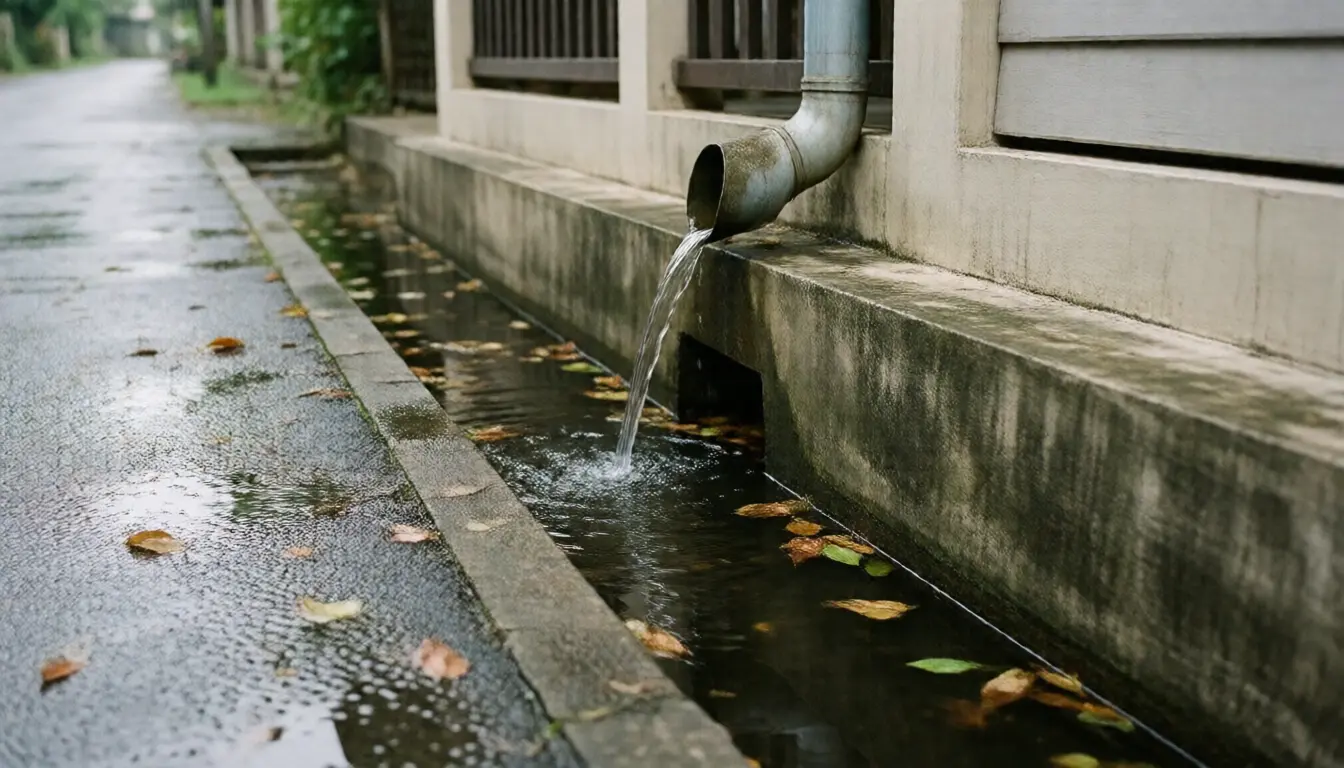
Working through it in order, starting with nothing to dig up
Step one, watch it in real rain, which nothing else replaces.
Go out while it is falling hard and note:
- Where water starts pooling first, and which way it moves.
- Whether the gully takes the flow or the water simply runs past it.
- Whether anything comes back up out of a gully, which is an entirely different signal.
- Where roof water goes once it lands.
Film it too, because when a contractor visits on a sunny day, what you describe will never be as clear as footage.
Step two, test with a hose on a dry day.
Run water onto various points around the house and watch where it goes. Wherever it stops moving, or runs back towards the building, is where the level is wrong.
Very simple, almost nobody does it, and it locates the problem more accurately than guessing.
Step three, open every inspection chamber.
Chambers are where silt collects, and they tell you whether the system is working.
- Water standing in a chamber days after the rain stopped means the outfall is not flowing.
- Silt built up nearly to the pipe invert means it has never been cleaned and is about to block.
- Water higher than the incoming pipe means the outgoing pipe is blocked or set too high.
Step four, check the destination at the front: what your pipe connects to, and whether that point is above or below the ground inside.
If the public drain is full whenever it rains, the problem is not your house, and fixing things inside will not help.
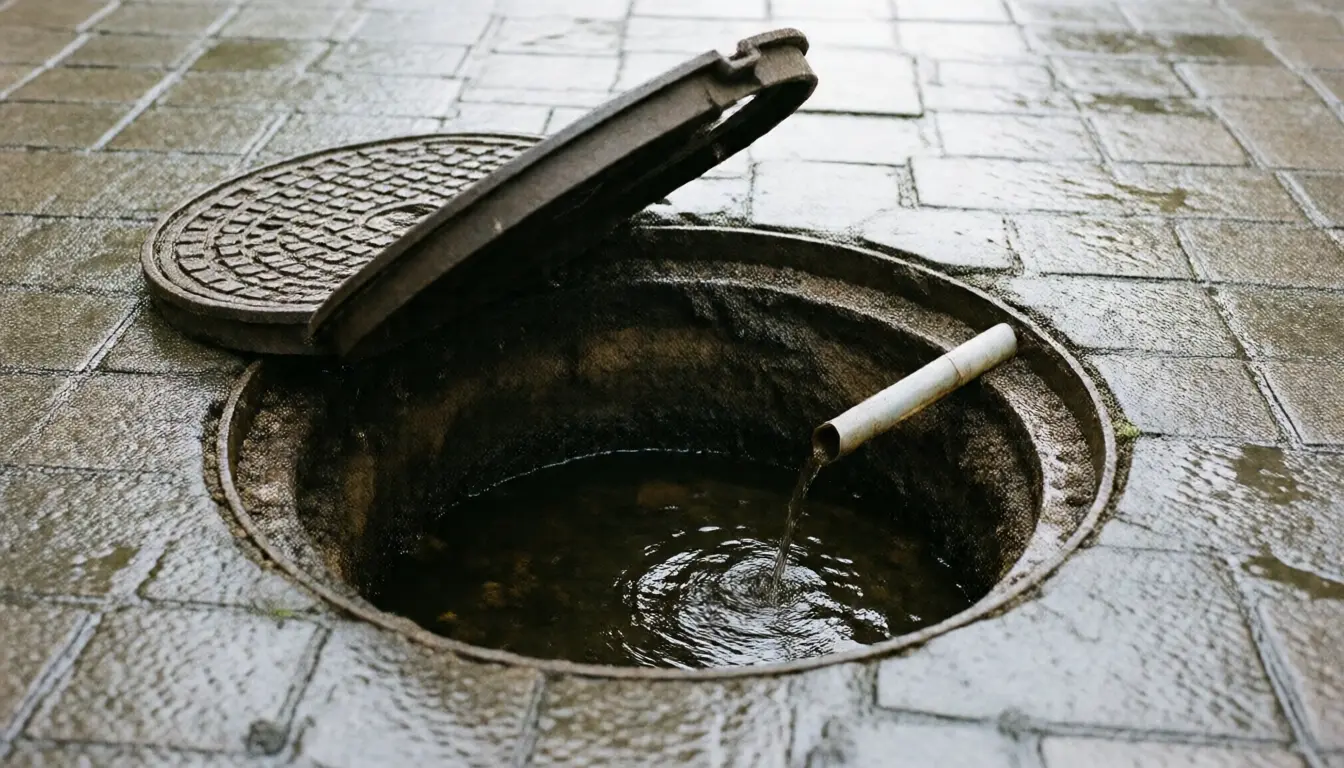
Seven real causes, easiest to fix first
One, gullies and channels blocked with leaves and sand. The number one cause and a ten minute job. Houses with mature trees need it far more often than others.
Two, chambers never cleaned out. Years of silt reduce the working cross section of the pipe with nobody noticing.
Three, roof water dumped in one spot with nowhere to go. A downpipe discharging straight onto the ground pours an entire roof at the foundations.
Four, later slabs blocking the old path of the water. A newly poured car park or path sitting higher than before becomes a dam holding water in the garden.
Five, insufficient or wrong-direction fall, which means breaking out and regrading. The most expensive item on this list.
Six, everything paved. A house with concrete over every square metre leaves no soil for water to soak into, so the volume needing to drain is far greater than at a house with a lawn.
Seven, backflow from the public drain, which is an entirely different problem from the six above and gets its own section.
Backflow is not the same as slow drainage
They look identical, standing water, and their causes are opposite.
Slow drainage is water unable to get out.
Backflow is water from outside coming in, through the same pipe that is supposed to be the exit.
Telling them apart is easy: watch a gully in heavy rain. If water is rising out of it, that is backflow, not slow drainage.
The remedy differs too, because cleaning your own pipes does nothing about water arriving from the street.
The answer there is a non-return valve, or a chamber and pump arrangement that isolates from the public drain when the level outside rises above yours.
Houses in areas that flood repeatedly should plan for this during construction or renovation rather than waiting for the first flood.
What to do immediately, before anything is dug up
- Pipe roof water somewhere that can actually take it, not onto the ground beside the foundations. Carrying it two or three metres away changes more than people expect.
- Clean out every chamber, at least yearly and always before the rainy season.
- Clear the roof gutters, because a gutter full of leaves overflows in one place instead of flowing along its length.
- Make the low point a deliberate collection point. If water already gathers somewhere, designing it as a collection point beats leaving it an accidental puddle.
- Leave soil, or use permeable materials, wherever concrete is not actually needed.
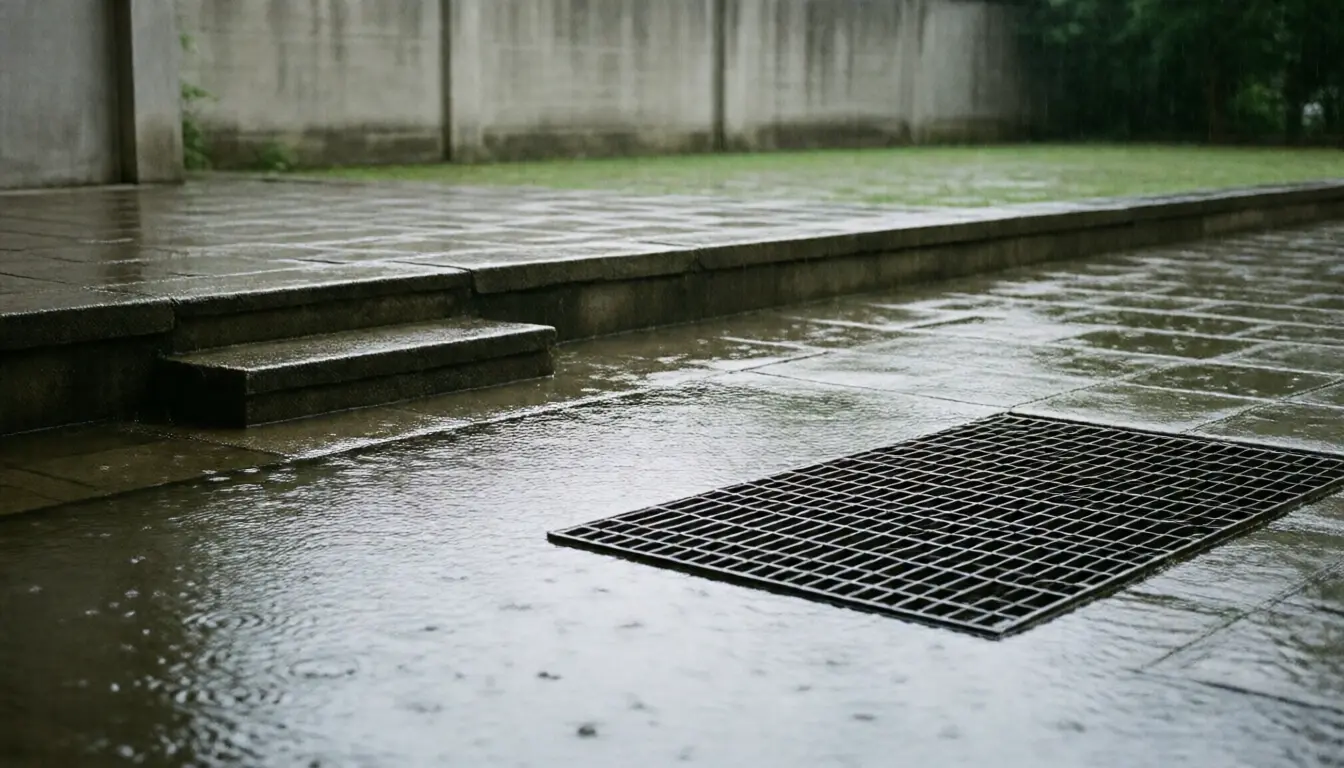
Why this matters more than it seems
Standing water is not merely a nuisance.
Water sitting against a wall drives moisture up it until paint blisters and mould grows, a problem no amount of repainting fixes, because the cause is outside rather than in the wall.
Water near the foundations changes the condition of the soil beneath them season by season, one of the contributors to uneven settlement.
Standing water breeds mosquitoes, which is a straightforward health reason.
And buyers notice it when they view on a wet day, which affects price directly.
For houses on a borehole there is an additional point: surface water pooling near the wellhead can seep down and contaminate it, which is covered in a borehole at home, the licence and whether the water is drinkable.
When to call somebody, and what to ask
Call once you have cleaned the drains and dealt with the roof water and it still pools, because that means the problem is levels or the outfall.
Questions to ask:
- How far below the pooling point is the outfall? If they cannot answer, they have not measured.
- What is the current fall on the pipe, and how was it measured?
- Is this water failing to leave, or water arriving from outside? They should be able to separate those before quoting.
- If a pump is needed, where does it sit and which circuit feeds it? A pump that loses power along with the storm is a pump that helps nobody.
Anybody who starts by proposing bigger pipes without measuring levels is guessing.
Frequently asked questions
Will bigger pipes fix standing water?
Usually not, because the problem is normally levels and fall rather than pipe size. A large pipe laid almost flat drains worse than a smaller one with the correct fall.
How much fall should a drain have?
The rule of thumb tradespeople use is around one centimetre per metre of run. The exact figure depends on pipe size and volume and is for the designer to calculate.
How do I know if it is backflow from the public drain?
Watch a gully in heavy rain. If water rises out of it, that is backflow rather than slow drainage, and cleaning your own pipes will not help.
How often should chambers be cleaned?
At least once a year, and always before the rainy season. Houses with mature trees need it more often.
Can a downpipe just discharge onto the ground?
It should not, because that pours an entire roof at the foundations. Pipe it to somewhere that can take the volume, away from the building.
What if the ground inside is lower than the public drain?
Water will never leave on its own however good the pipework. The answer is a chamber and pump, and backup power should be part of that plan.
In short
- Standing water is usually about levels rather than pipe size.
- A large pipe laid flat drains worse than a small one with proper fall.
- Go and watch it in real rain, and film it. Nothing replaces that.
- Test with a hose on a dry day to find where the level is wrong.
- Open every chamber, because they tell you whether the system works.
- Backflow is a different problem from slow drainage and needs a different fix.
- Piping roof water away from the foundations is immediate and effective.
- Anybody proposing bigger pipes before measuring levels is guessing.