
Weak water upstairs has three causes, and only one of them needs you to buy anything
Before shopping for a pump, answer one question: is the pressure normal downstairs?
If downstairs is fine and upstairs is weak, water is reaching the house but cannot get up, which is a different problem from a house that is weak throughout.
And if only one fitting upstairs is weak, say the shower in one bathroom while the basin beside it runs strongly, that is not a pressure problem at all.
Those three questions separate almost every cause before you spend a baht.
Weak at one fitting means the problem is at that fitting
Always start with the easiest thing.
The aerator on the spout, the small screen at the end of a basin or kitchen tap, unscrews by hand or with pliers wrapped in a cloth.
Inside it you will usually find white scale grains and rust flakes packed in. Clean it, put it back, and in a great many cases the flow returns immediately.
The angle valve under the basin or behind the toilet, the small valve people knock halfway closed while cleaning. Open it fully and try again.
A kinked flexible hose. The braided hose running from the valve to the tap loses a great deal of flow when it is bent sharply by things pushed into the cupboard underneath. Shine a torch under the basin.
The filter screens inside a mixer. A mixer shower has small screens at both inlets, and they collect more sediment than anywhere else in the house.
With a hand shower, take the head off and run the water first. If it comes strongly out of the hose, the head is blocked. Soak it in vinegar overnight and brush the holes clear.
Weak across the whole upper floor means pressure or pipework
The first thing to understand is that height consumes pressure.
Lifting water about ten metres uses roughly one bar, purely to arrive up there, before a single drop comes out of a tap.
The upper floor of an ordinary house sits about three metres above the ground floor, which takes a share already, and for a third floor or a low-mounted tank the figure matters more still.
Four causes account for nearly all of it.
One, no pump, or a pump too small. A house plumbed straight off the mains with no tank and no pump relies on the utility's pressure alone, which is enough downstairs and often not enough upstairs at the hours when everybody is using water.
An easy test is to run the upstairs tap at five in the morning. Strong then means the mains pressure is adequate when nobody is drawing, and inadequate the rest of the time.
Two, a pump that is there but not performing. Check the pressure vessel and the switch first, because a pump with no air in its vessel delivers pressure that swings widely and feels weak in bursts. How to check is in why a household pump short cycles and how to size one.
Three, the riser to the upper floor is too small. Plenty of older houses run the main riser in the same size as the branches feeding individual taps, so it collapses the moment two outlets are open.
The tell is that one outlet alone is acceptable, but the shower loses half its flow as soon as somebody opens another tap.
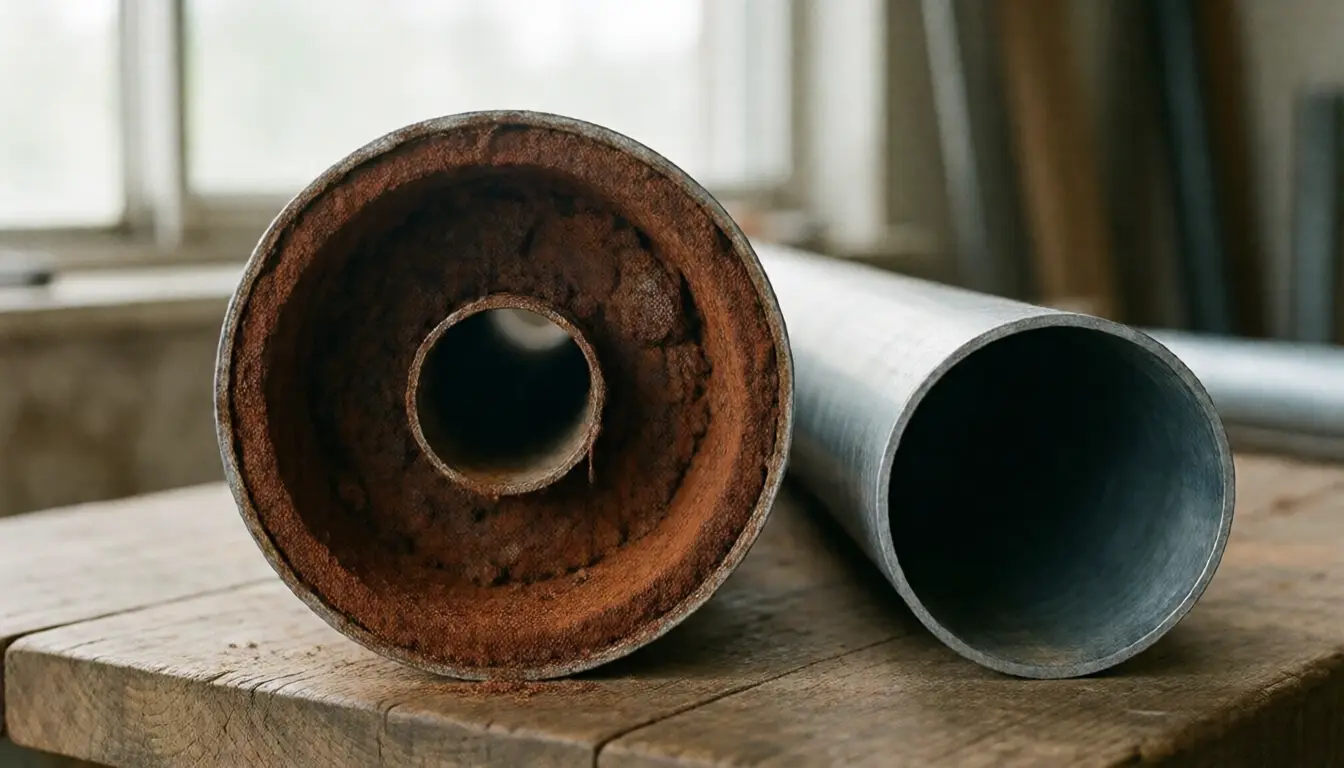
Four, pipes closed up by scale. This one applies only to houses still using galvanised steel pipe, which was the standard in earlier decades.
Steel pipe grows rust and scale on the inside wall until the opening water can pass through shrinks year after year, which explains water that has gradually weakened with nothing whatever having happened.
What to look at is the age of the house, whether the pipe visible at the meter or under the basin is steel or PVC, and whether the flow dropped gradually or suddenly.
Gradually over years is scale. Suddenly is something that failed or something that blocked.
Why the water heater cuts out when the flow is weak
This one convinces people their water heater has failed when it is perfectly fine.
An instantaneous water heater has a flow switch inside it, and only starts heating once water passes through at a minimum rate.
When the pressure is too low to reach that rate, the heater does not run. That is a safety design rather than a fault.
If the hot water cuts in and out while showering, particularly when somebody opens another tap in the house, that is a pressure problem rather than a heater problem.
And replacing it with a higher wattage model changes nothing, because the constraint is the water rather than the electricity.
Work through it from cheapest to most expensive
- Clean the aerators and inlet screens at the outlets. Ten minutes, no money, and it genuinely fixes a lot of houses.
- Check every valve is fully open, both the angle valves and the main valve into the house.
- Check the tank level and float valve, because a tank that never fills means a pump that cannot draw properly. Tanks are covered in above-ground or underground water tanks.
- Check the pump's pressure vessel by tapping it and pressing the air valve.
- Confirm it really is pressure by running the upstairs tap when nobody in the house is using water at all.
- Only if none of that helps should you discuss changing the pump, enlarging the riser, or replacing old steel pipe with PVC.
That last step is the biggest and most expensive job, so it belongs at the end rather than at the beginning where many contractors propose it.
And if you do replace the pump, tell the seller the height from the pump to the highest shower rather than how many bathrooms the house has, because the height is what determines the head required.
Frequently asked questions
Why is the water weak upstairs but normal downstairs?
Usually not enough pressure to lift it, since about ten metres of height uses roughly one bar. The reason may be no pump, an undersized pump, a pressure vessel with no air, or an undersized riser.
Only one shower is weak. Do I need a new pump?
No. If everything else runs strongly the problem is at that fitting. Clean the shower head and the mixer inlet screens, and check whether the flexible hose is kinked.
Why has the water weakened gradually year after year?
If the house has galvanised steel pipe, scale and rust build on the inside wall and shrink the bore progressively, which is why nothing happened and yet the flow keeps dropping.
The water heater cuts in and out. Is it broken?
Usually not. An instantaneous heater needs a minimum flow rate before it will run, so it stops when pressure falls. A higher wattage model will not help, because the constraint is the water.
Should I just fit a bigger pump?
Work through the order first: screens, valves, tank, pressure vessel. Then consider the pump, and if you replace it, give the seller the height from the pump to the highest outlet.
In short
- Ask first whether it is the whole floor or one fitting, because they are different problems.
- One weak fitting means an aerator, an inlet screen, an angle valve, or a kinked hose.
- About ten metres of height consumes roughly one bar before any water leaves the tap.
- Old galvanised steel pipe closes up from the inside, which explains a gradual decline over years.
- A water heater cutting in and out is usually a pressure problem, not a heater problem.
- Always go cheapest first. Changing the pump and repiping belong at the end.