
Three sections of the Civil and Commercial Code explain everything about land beside a public ditch
Section 1304 classifies property for common public use as public domain property of the state, which includes watercourses.
Section 1305 provides that public domain property cannot be transferred, except under a specific law or a royal decree.
Section 1306 forbids raising prescription against the state in respect of public domain property.
Read them together and the picture is immediate.
A public ditch belongs to nobody, cannot be bought, cannot be filled in, and the fact that a house has covered part of it for thirty years does not make it yours.
The remaining question is whether land beside a ditch is an advantage or a disadvantage, and the answer is both, depending on what the land is for.
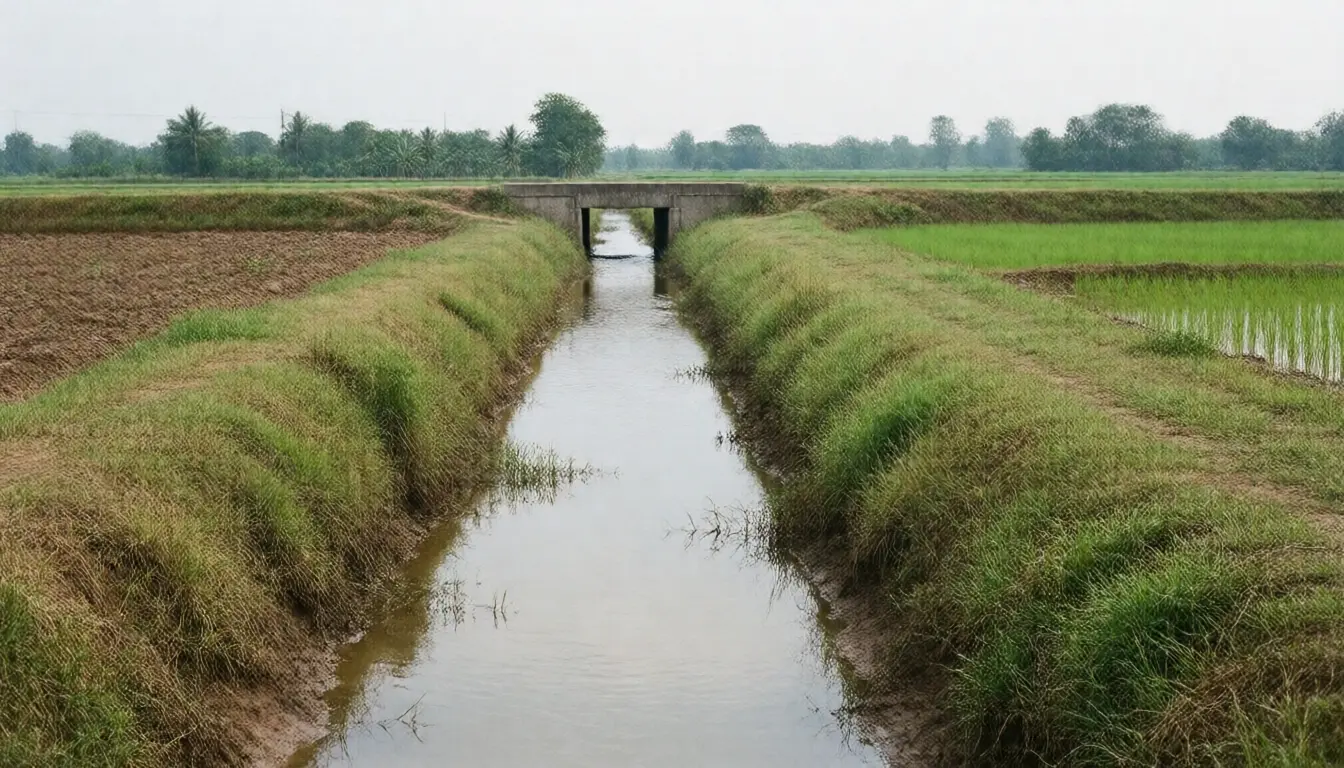
Advantages people overlook
Nothing will ever be built on that side, a certainty that land adjoining private property can never offer, because a neighbour who sells may bring a building with them.
There is already somewhere for water to go, which matters a great deal for a plot that has to handle rainfall.
Air and light come in permanently, so a house facing that way runs cooler and damper less.
On farmland it is a water source, which is the original reason these ditches exist.
Disadvantages to know before buying
Your area ends at the boundary, not at the water's edge. Many plots look larger than they are, because the previous owner used the strip beside the ditch until it looked like part of the plot.
Anything built over it has to come down, however long ago it went up, because section 1306 removes the time element entirely.
If the ditch separates the land from the road, you need a crossing, and laying a culvert or building a bridge over a public ditch requires permission from the responsible authority rather than being something you simply do.
Flooding and mosquitoes are real and have to be accepted, particularly with a ditch that has not been dredged in years.
A bank may value it more cautiously if the genuinely usable area is smaller than it appears.
What to check before buying
- Have the boundaries surveyed. Do not judge by the fence or the earth bank, because neither is the boundary.
- Ask the local authority how the ditch is registered, and whether any improvement or widening is planned.
- Look for structures from that plot encroaching on it, because the obligation to remove them falls on you as the new owner.
- Check the access: whether a proper culvert or bridge already exists and who maintains it.
- Visit on a day of heavy rain, because a ditch that looks placid in the dry season can be a different place in September.
Boundary and area mismatches are covered in when the survey area does not match the title deed, and drainage around a house is in standing water around the house: the pipes or the levels.
Frequently asked questions
Can a public ditch be bought?
No. Section 1305 provides that public domain property cannot be transferred except under a specific law or a royal decree.
Can I fill it in to enlarge my land?
No, and doing so encroaches on public domain property, which can lead to a removal order and legal liability.
Does decades of occupation create ownership?
No. Section 1306 bars raising prescription against the state over public domain property, so length of occupation confers nothing.
What is the advantage of land beside a ditch?
Nothing can be built on that side, there is already somewhere for water to go, air and light come in permanently, and on farmland it is a water source.
Does the visible area match the deed?
Often it does not, because the previous owner used the strip beside the ditch until it looked like part of the plot. Always have it surveyed before buying.
Can I bridge or culvert the ditch?
Only with permission from the responsible authority. It is not something to do yourself, and it must be settled before buying if the ditch separates the land from the road.
Who is responsible if the previous owner built over it?
The owner at the time, which becomes you once the transfer is done, so check carefully before buying.
When should I view the land?
At least once on a day of heavy rain, because a ditch that looks placid in the dry season can be entirely different in the wet.
In short
- A public ditch is public domain property and cannot be transferred, under section 1305.
- Prescription cannot be raised against the state under section 1306, so time confers nothing.
- The advantages are a permanently open side, drainage, air and light.
- The disadvantage is that the usable area is usually smaller than it looks.
- Encroaching structures have to be removed, and the obligation falls on the current owner.
- Crossing the ditch needs permission from the responsible authority.
- Survey the boundaries before buying, and visit once in heavy rain.