
You can. The law does not forbid it. The problem is not the building stage
One title deed can carry two houses, provided each satisfies building control law, and each can have its own house number.
What makes siblings fall out ten years later is not the building. It is the day one of them wants to sell their house.
Because two houses on one deed are not two things. They are one piece of property with two structures standing on it.
Whoever sells has to sell the whole plot, or sell only their undivided share, which almost nobody buys.
So the question to settle before the piles go in is when it gets divided, not how it gets built.
What the building stage requires
Each house is a building in its own right in the eyes of the law, not an extension of the other.
The open space still has to be there. Clause 33 of Ministerial Regulation No. 55 requires a residential building to keep open space of not less than thirty parts in 100 of its largest floor area, calculated across the whole plot rather than house by house.
That is why a small plot cannot take a second house even when the land area looks sufficient.
Setbacks and boundary distances still bind, both from the road and from neighbouring land, as set out in the road setback and what happens if you leave a metre too little.
Each house needs its own building permit. The second house is new construction, not an alteration of the first.
House numbers can be separate. Once the second house is completed as approved, it can be given its own house number and its own house registration book.
That last point leads plenty of people to believe the two are now fully separate, which they are not.
A house number is a civil registration matter. Ownership is an entirely different question.
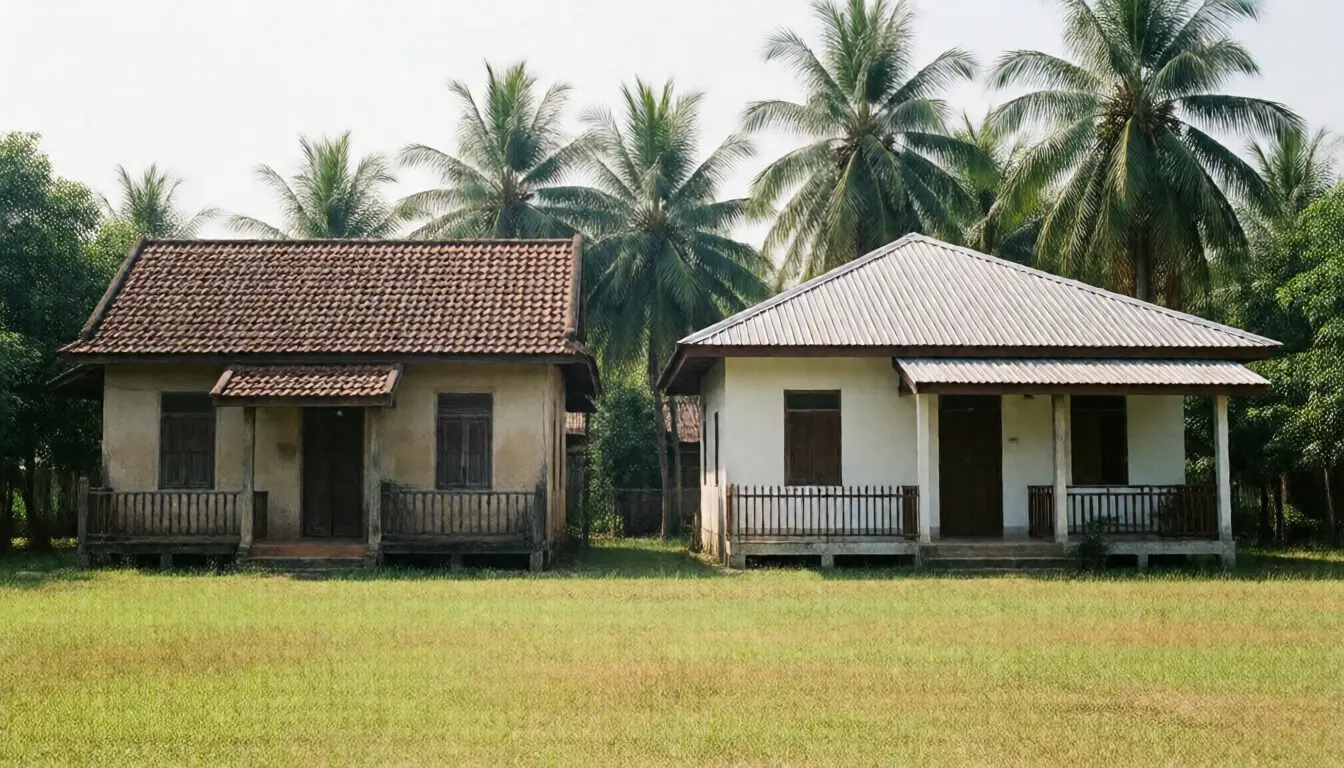
A house built on somebody else's land belongs to the landowner
This is the heart of the whole subject, and the part the person paying for the construction usually does not know.
Section 144 of the Civil and Commercial Code provides that the owner of a thing owns its component parts, and a building erected on land is a component part of that land.
Which means that if a son pays to build a house on land still in his father's name, that house belongs to the father in law, not to the son.
Material receipts, the contractor's agreement and photographs taken during construction are evidence of who paid. They are not evidence of who owns.
The way out that the law provides is section 146, which excepts structures erected by somebody exercising a right they hold over another person's land.
That right is the thing to register before building, a superficies or a lease, as explained in right of habitation against superficies.
Registering afterwards is still possible, but by then the house has already become a component part, so it has to be unwound another way, which is messier and brings tax into it.
Two ways to divide it
The first, split the title into two plots. Applied for at the land office, with a survey and boundary confirmation with the adjoining owners.
The condition that most often blocks it is that each resulting plot must have access to a public way.
A rear plot enclosed by the front plot can only be split off once a servitude has been registered to give it a way through.
Servitudes are covered in how a servitude arises over your land.
One more thing worth knowing: dividing land into ten or more sub plots for sale falls within the definition of land allocation under section 4 of the Land Allocation Act B.E. 2543, which carries its own approval process.
Two houses is nowhere near that threshold, but anyone thinking of splitting and selling several plots later should know where the line sits.
The second, leave the title whole and hold it in co-ownership, with two names on one deed.
Easier to do, harder to undo.
Because each co-owner holds a numerical share rather than a defined piece of ground.
One lives in the front house and the other in the back, but in law both own the whole plot together in proportion.
The right to demand partition, which cannot be signed away for good
Section 1363 of the Civil and Commercial Code gives each co-owner the right to demand partition of the property, unless a juristic act stands in the way, or the purpose of the co-ownership is permanent in nature.
The same section goes on to say that the right to demand partition may not be excluded by juristic act for more than ten years at a time.
That sentence matters more than it looks, because a family agreement never to divide, ever, binds for no more than ten years at a stretch.
Section 1364 says partition is to be made by dividing the property itself among the co-owners, or by selling it and dividing the proceeds.
Where they cannot agree, it ends in court, which may order the property divided, or, where division is impossible or would cause serious loss, order it sold and the money split.
Sold here can mean sold at auction, which usually fetches less than a normal sale on the open market.
That is the destination nobody wants, and the reason to settle the division question while everybody is still on speaking terms.
Three things to do on day one
One, decide before building whether you intend to divide. If you do, position the houses and the access so that division is actually possible, at the design stage.
A house placed neatly in the middle of the plot is a house that cannot be divided around without demolishing something.
Two, where the builder and the deed holder are different people, register the right before building, not after.
The fee now is a great deal cheaper than the lawyer later.
Three, put the arrangement in writing, even between siblings. Who paid for what, who lives where, how shared costs are split, and what happens if one of them wants out.
An agreement written while everybody is content is the most valuable document in the house on the day nobody is.
Frequently asked questions
Is building two houses on one deed unlawful?
No, provided each has its own building permit and complies with building control law on open space, setbacks and boundary distances.
Can the second house have its own house number?
Yes, once built as approved, with its own house registration book. But a house number is a civil registration matter and does not divide ownership of the land.
My child paid for the house, so is it theirs?
Not automatically. A building erected on land is a component part of that land, and the landowner owns the component parts, unless it was built under a registered right such as a superficies or a lease.
Is splitting the title difficult?
The procedure itself is not, but it frequently stalls on the requirement that each resulting plot have access to a public way, so an inner plot usually needs a servitude registered over the front plot first.
Can two names go on one deed instead?
Yes, that is co-ownership. But each holds a numerical share rather than a defined area, even where in practice they live in separate houses.
Can we agree never to divide?
Not permanently. Section 1363 provides that the right to demand partition cannot be excluded by juristic act for more than ten years at a time.
What if one of us wants to sell and the other does not?
They may demand partition, and failing agreement, sue. The court may order the property divided, or where that is impossible or would cause serious loss, order a sale and division of the proceeds, which usually raises less than selling privately.
When does dividing land for sale become land allocation?
When ten or more sub plots in total are divided out for sale, under the definition in section 4 of the Land Allocation Act B.E. 2543, which carries its own separate approval process.
In short
- Two houses on one deed is lawful where open space, setbacks and separate permits are all satisfied.
- Separate house numbers do not separate ownership of the land.
- A house built on land is a component part of it, so paying for it does not make you its owner.
- Where the builder and the deed holder differ, register the right before building.
- Splitting a title most often stalls on every plot needing access to a public way.
- Co-ownership is easy to enter and hard to leave, because shares are proportions, not places.
- The right to demand partition cannot be excluded for more than ten years at a time.
- The worst ending is a court ordered sale, which raises less than selling it yourselves.