
A pump that cycles constantly is not a dying pump. It is a tank with no air in it, or a leak
The complaint plumbers hear most is that opening a tap for a moment sets the pump hammering on and off, on and off, when it never used to.
Almost every time this is not the pump, and fitting a new one usually fixes nothing, because the new one does exactly the same thing within a few weeks.
There are only a handful of real causes, and the first two you can check yourself in ten minutes with no tools at all.
This comes in two halves: why a pump short cycles and how to work through it, then what to look at besides the wattage if you genuinely do need a new one.
How a domestic pump actually works
An automatic household pump is not just a motor. Three parts work together.
The motor and impeller draw water from the storage tank and push it into the house pipework.
The pressure switch is the small box on top that watches the pressure in the pipes. When pressure falls to one value it starts the pump, and when it rises to another it stops it. Those two figures are the cut-in and cut-out pressures, printed on the pump's rating plate.
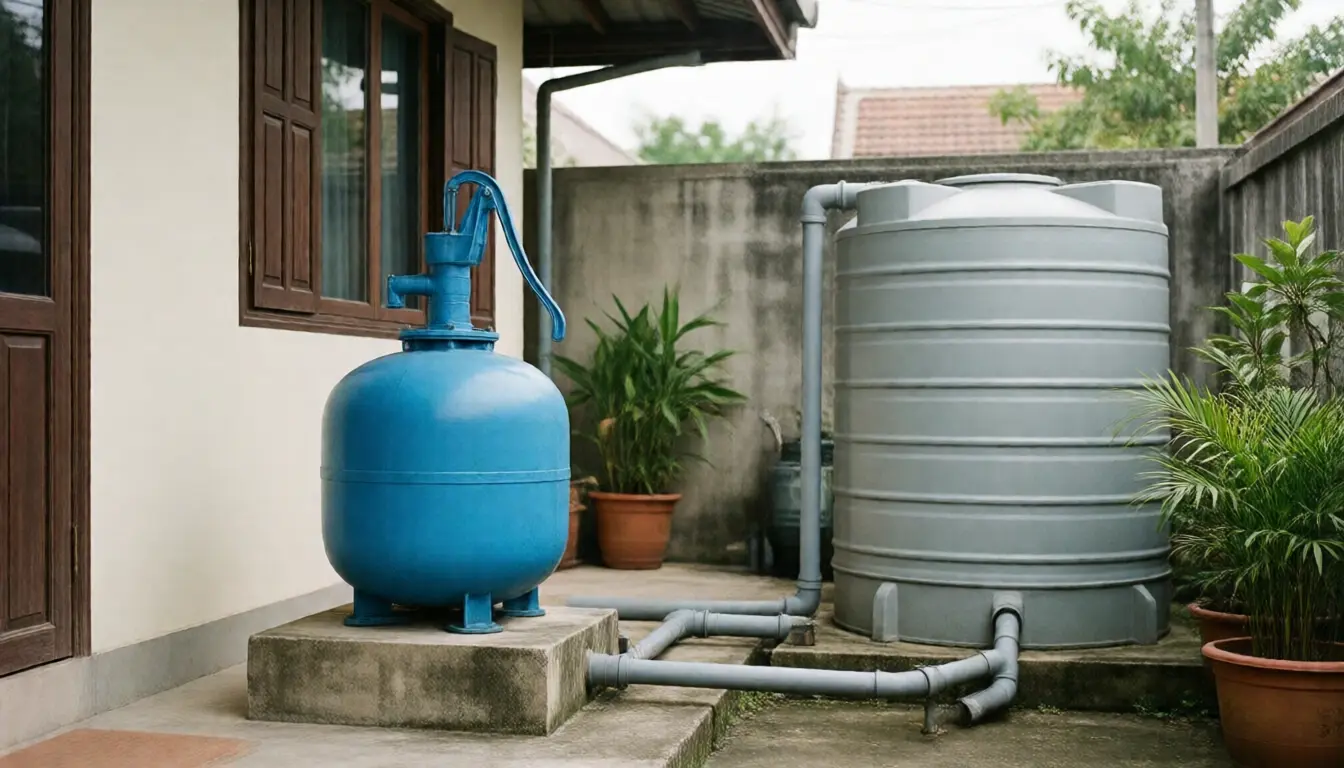
The pressure vessel is the round tank under or beside the motor. Inside it a rubber diaphragm separates water from air, and the compressed air behind that diaphragm behaves like a spring.
That third part is the whole story.
While the pump runs it forces water into the vessel and squeezes the air behind the diaphragm. When the pump stops, that compressed air pushes the water back out for you to use.
So when you open a tap briefly to wash your hands, the water arriving is not coming from the pump. It is coming from air in the vessel pushing water out, which is why the pump does not need to start.
The vessel exists to reduce how often the pump has to start. It is not there to store water. And when it can no longer do that job, the pump has to start for every drop that moves.
Work through the causes in this order
One, the vessel has lost its air. This is the leading cause in any house whose pump has been in service for years.
The rubber diaphragm has a service life. Once it splits, air and water mix, and the air gradually dissolves away with the water you use. A vessel that used to have a spring inside it becomes a plain tank of water.
The easiest check is to tap the vessel. A healthy one sounds hollow near the top and solid lower down. One that has lost its air sounds solid all over.
A clearer test is the air valve, which looks like the valve on a car tyre. Switch off the pump, open a tap until the pressure in the pipes is gone, then press the valve. Water coming out means the diaphragm has split, and the vessel or the diaphragm needs replacing.
If only air comes out, it may simply have bled down over the years. Recharge it to slightly below the pump's cut-in pressure, and only with the water drained out of the vessel, never with water still inside.
Two, something in the house is leaking. If the pump starts on its own when nobody is using water, the pressure in the pipes is falling, and there is only one way that happens: water is leaving the system.
The usual culprit is a toilet whose flush valve or float no longer seals, quietly running into the pan where nobody sees it.
To test, close the supply valve to every toilet in the house and see whether the pump still starts by itself. If it stops, you have found it.
If it does not stop, look at outside taps, bidet sprays, and buried pipework. Tracing leaks and the sensors that warn you first are covered in water leak sensors for a Thai home.
Three, a leaking check valve. The check valve stops water flowing backwards, and sits on the suction side of the pump.
If it no longer seals, water in the pipes drains back down into the storage tank, pressure falls, and the pump starts on its own, over and over all night.
The tell is a pump starting on a regular rhythm, say every ten minutes, with every toilet valve already closed.
Four, a pump too large for its vessel. This turns up in houses that recently fitted a bigger pump while keeping the old vessel.
A big pump fills a small vessel very quickly, so it cuts out quickly, and then restarts at the smallest draw. Frequent starting is what shortens a motor's life, not running continuously.
The order matters, because most people start at cause four by buying a new pump, which is the most expensive step and usually not the problem.
Sizing a pump is not about the wattage
Sellers usually ask how many bathrooms the house has and answer in watts, which is a reasonable starting point and not the answer.
Two figures decide whether a pump is enough.
Flow rate, the litres per minute, which has to cover the outlets genuinely used at the same time, not the total number of taps in the house, because nobody opens them all at once.
Head, the height the pump can push water to, measured in metres, which has to cover three things added together: the height from the pump to the highest outlet, the friction in the pipes and elbows, and the pressure a shower head needs to feel decent.
The most widely misunderstood point is that the maximum flow and the maximum head printed on the box do not happen at the same time.
A pump reaches its maximum flow when it has nothing to lift against, and its maximum head when almost nothing is flowing. Real use sits in between.
For a precise answer, ask the seller for the pump curve, the line showing how much this pump delivers at any given height.
One more thing: a pump does not create water, it only pushes what is there. If the storage tank refills slowly because its float valve is clogged or the mains supply is weak, a bigger pump changes nothing.
Check how fast the tank fills first by timing how long it takes to go from empty to full. If that is unusually slow, the problem is upstream, not at the pump.
Fixed speed against inverter pumps
A conventional pump runs at one speed, full on or off, which produces the cycling and the pressure that rises and falls throughout a shower.
An inverter pump varies motor speed with the flow being drawn, holding the pressure steady.
Three benefits are genuinely noticeable: the shower holds its pressure when somebody opens another tap, it is quieter because the motor is not slamming to full speed every time, and the number of motor starts drops sharply, which is good for its life.
The drawbacks are the price and one more circuit board that can fail, which matters in a house with an unstable supply.
If you fit one, ask the seller plainly where the board is sourced from and how long a replacement takes, because a pump waiting two weeks for a part is a house with no water for two weeks.
To find out what a pump really costs to run, the metering method in which appliance uses the most electricity works on pumps too, and usually shows less than people fear, because it runs in short bursts.
What not to do: pumping straight from the mains
Where the supply is weak, plenty of houses fix it by connecting a pump directly to the incoming water pipe, which is the quickest solution and the one to avoid.
The first reason is that drawing directly from the main lowers the pressure in that stretch of pipe, so neighbours further along get even less.
The second reason matters more. When pressure in a pipe goes negative, water from outside can be drawn back into it, which is a safety issue for the water everybody in the lane drinks.
The third is that the water authority has regulations on what users may and may not do, and states that where a user breaches them it reserves the right to cut off supply for as long as it sees fit.
The correct arrangement is to let the mains fill a storage tank and have the pump draw from that tank. Besides being correct, it gives you a reserve for the days the supply stops.
If you are not sure how your house is plumbed, look at whether the pipe from the meter runs into the tank first or straight into the pump, and ask the local water office before changing anything.
Noise, and installing one you can live beside
A pump that is unusually loud is usually not loud by itself. It is loud because of what it is touching.
Bolt a pump firmly to the house wall and the vibration travels into the wall, turning the whole panel into a loudspeaker. Set it on a concrete plinth separate from the house and sit it on anti-vibration pads.
Rigid pipe running straight from the pump into the house pipework transmits vibration the same way. Fit flexible connectors on both the suction and delivery sides.
Position matters too. A pump under a bedroom window is a problem every night, particularly a fixed-speed one that cycles frequently.
Electrically, a pump sits outdoors, gets wet, and gets handled during servicing, so it is a circuit that should always be protected by a residual current device, covered in RCDs in a Thai home.
And give it a rain cover that still ventilates, rather than wrapping it in plastic sheet so the heat cannot escape.
Frequently asked questions
Why does the pump keep cycling on and off?
Usually because the pressure vessel has lost its air charge or its diaphragm has split, so nothing is pushing water out in place of the pump. After that, a leak in the system, most often a toilet that no longer seals.
How do I check the pressure vessel myself?
Tap it. A solid sound all over means no air. Or switch off the pump, release all the pressure, and press the air valve. Water coming out means the diaphragm has split.
The pump starts at night with nobody using water.
Pressure is falling somewhere. Close the supply valve to every toilet first. If it stops, that was it. If not, suspect the check valve or a leaking pipe.
Is wattage enough to choose a pump?
No. Look at flow rate and head together, and understand that the two maximum figures do not occur at the same time. Ask for the pump curve if you can.
Will a bigger pump give stronger water?
Not necessarily. If the tank refills slowly or the house pipework is undersized, a bigger pump changes nothing. Time how long the tank takes to fill before deciding.
Can I pump straight from the mains?
You should not. It weakens the supply to neighbours, risks drawing contamination back into the pipe, and the water authority's rules on user conduct allow it to cut off supply for a breach. Pump from a storage tank instead.
In short
- The pressure vessel exists to reduce pump starts, not to store water.
- Constant cycling is usually a vessel with no air, then a leak, then the check valve.
- Tapping the vessel and pressing the air valve is a ten-minute check needing no tools.
- Choose on flow rate and head together, not wattage, and remember the two maxima do not coincide.
- A pump does not create water. If the tank fills slowly, a bigger pump will not help.
- Never pump directly from the mains. Fill a tank and draw from that.
- Mount it on its own plinth, use flexible connectors, and protect the circuit with an RCD.