
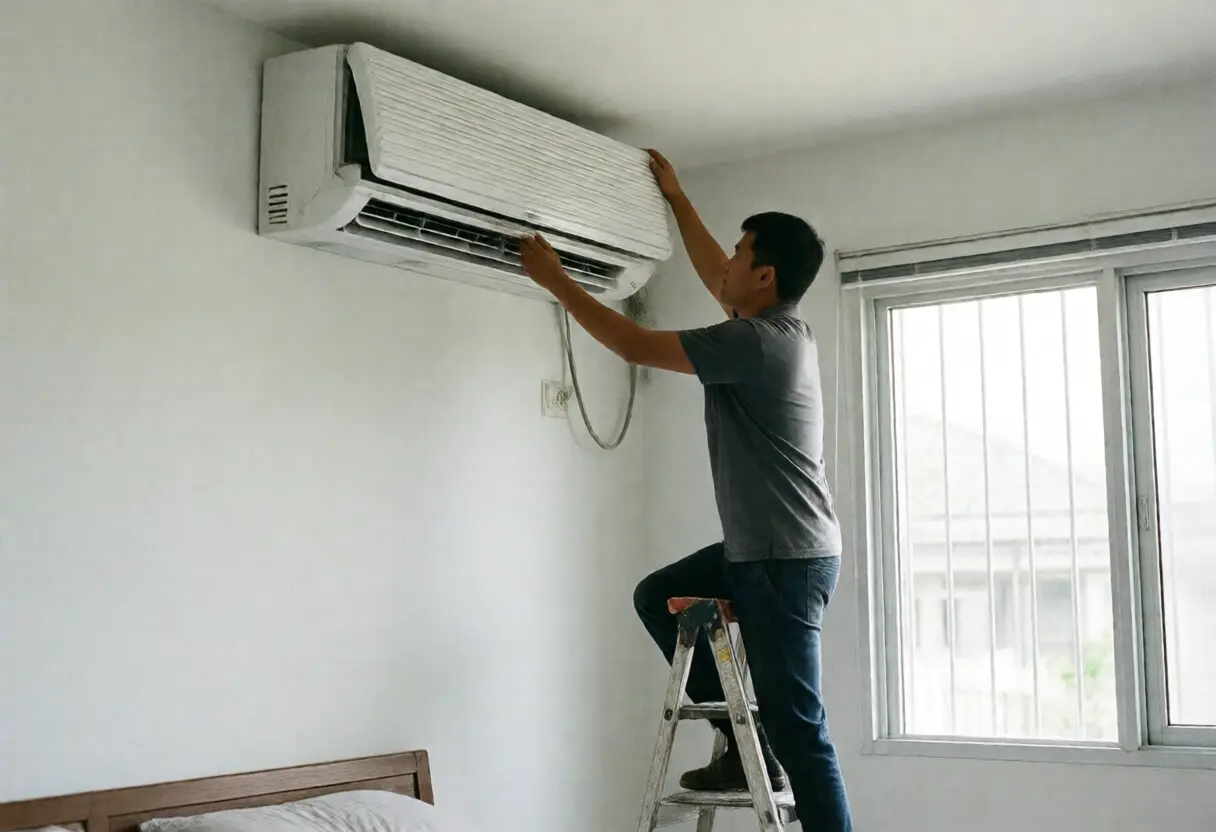
How to get even cooling and a sane electricity bill from an air conditioner
It is decided by the size you choose and the way it is installed, far more than by the brand. A unit that is too large for the room cools quickly and cuts out before it has removed the humidity, leaving a room that is cold and clammy and using more power than it should. An outdoor unit squeezed into a dead corner spends all day breathing back its own hot air, which is the electricity cost nobody sees on the bill.
Brand and model do matter. They just matter after those two things.
Choosing the BTU without going too big
Most installers start at roughly 700 to 900 BTU per square metre and adjust from there. That figure is a starting point, not an answer.
| The room | How to adjust |
|---|---|
| Ground floor bedroom with no direct sun | Use the lower end of the range |
| A wall or window taking the afternoon sun | Move towards the higher end |
| Top floor or a room under the roof | Increase, because it takes heat from the roof as well |
| Living room with several people and a television | Increase. People and equipment are heat sources |
| A kitchen open to the living room | Count the combined area, not just the room with the unit in it |
| Higher than normal ceiling | Increase, because the air volume is larger than the floor area suggests |
The trap is buying a size up to be safe. The result is a unit that runs in short bursts and stops. The room reaches temperature quickly with the humidity still in it, which feels cold and sticky at the same time, and a compressor that keeps starting and stopping uses more power than one running steadily at low speed.
Undersizing is a real problem too, because the unit runs flat out and never reaches the set point. But in most Thai homes the common fault is oversizing, not undersizing.
Where the indoor unit goes, and why one corner stays warm
- Let the air run along the long axis of the room rather than into a wall two metres away. Air that hits a wall too soon circles back into the unit instead of sweeping the room.
- Do not blow straight down onto the head of the bed, because it ends with the temperature set higher to escape the draught, and then the rest of the room is not cool.
- Do not mount it over a door that opens often. The cold air leaves through the door before it does any work.
- Keep the clearance from the ceiling the manual specifies. The unit needs room to draw air back in from above.
- Keep tall furniture out of the airflow. A wardrobe moved in later is the single most common cause of "the air conditioning is not as cold as it used to be".
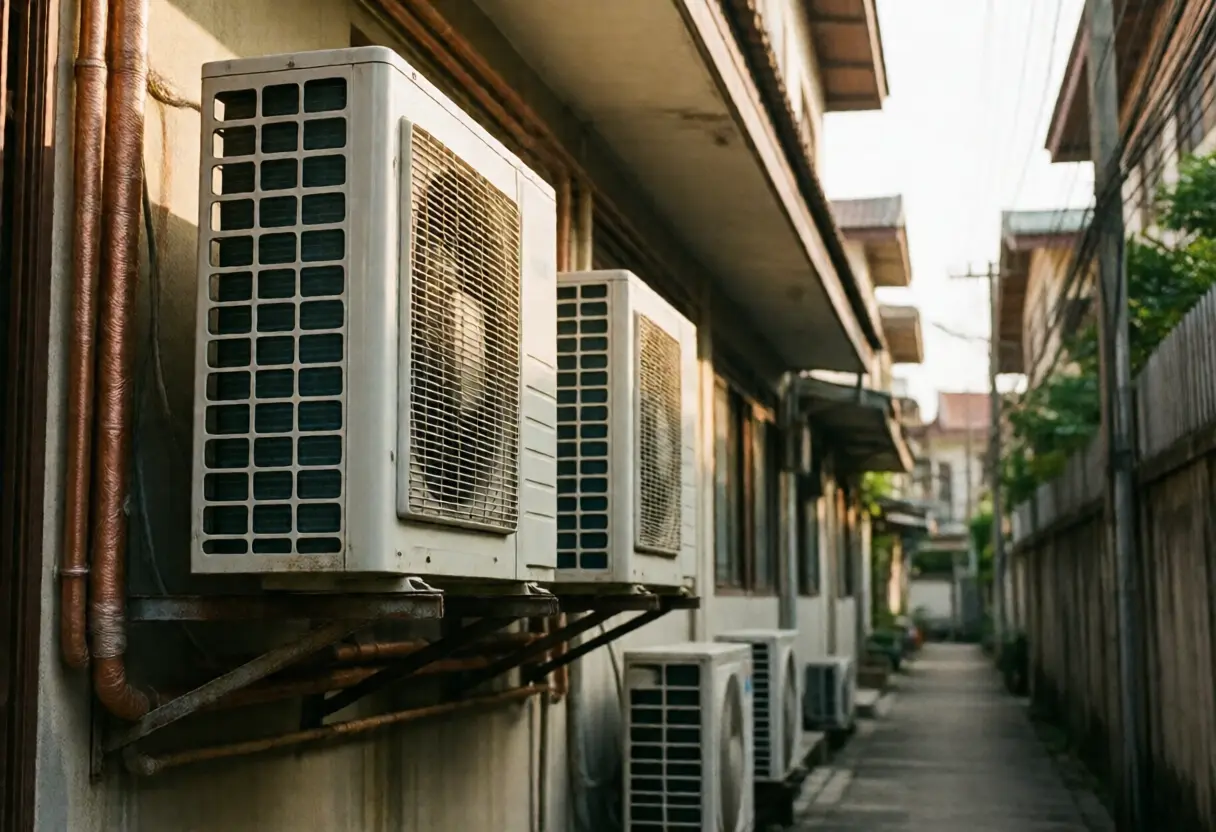
The outdoor unit, the part most people ignore
A condenser works by dumping heat into the air around it. If the air around it is already hot, it dumps less, and has to work harder for the same result.
- Leave the clearances the manual specifies, especially on the side the fan discharges. Pushed up against a solid wall, the hot air comes straight back round to the intake.
- Do not put it in a narrow slot closed on three sides. The tight side alley between houses is the classic case, and hot air simply accumulates there all day.
- Shade helps, provided the shade does not block airflow. An open canopy beats a solid enclosure.
- With several units in a row, do not let one unit's discharge blow into the next one's intake.
- Mount it level and firmly. A vibrating bracket is where the noise comes from, and where pipework eventually fatigues and leaks.
Heat and airflow around the house connect to indoor air quality more broadly, which is covered in indoor air and PM2.5.
Pipe runs and the installation questions nobody asks
Every model has a standard refrigerant line length in its manual. Run it longer than that and cooling capacity falls, and in some cases refrigerant has to be added according to the manufacturer's formula rather than by feel.
- Ask before installation how long the pipe run will be, and whether it exceeds the standard length for that model.
- Refrigerant lines must be insulated along their whole length, including outdoors. A gap in the insulation is a drip and lost cooling on the way.
- The drain line needs a continuous fall with no sagging section. Almost every case of water dripping from an indoor unit starts here.
- An air conditioner should have its own circuit and breaker rather than sharing the room's general sockets.
- Ask the installer to vacuum the system before charging, rather than purging air with refrigerant.
Who an inverter is actually worth it for
| Inverter | Fixed speed | |
|---|---|---|
| How it works | Varies compressor speed with the actual load | Runs at full output then stops, alternately |
| Suits | Rooms run for many hours, such as bedrooms | Rooms used in short bursts, occasionally |
| Temperature steadiness | Steadier | Swings around the set point |
| Purchase price | Higher | Lower |
| Repair cost when the board fails | Higher | Lower |
The practical conclusion is that the longer it runs, the more an inverter wins. A bedroom running eight hours a night is a clear case. A reception room used a few times a month may never recover the price difference over the unit's life.

Reading the label, and working out the running cost yourself
EGAT's Label No. 5 moved to a star system on 1 January 2019, using SEER as the basis for the star bands. More stars means a higher SEER.
SEER is expressed in BTU per hour per watt, which means you can estimate the power draw at full output yourself.
- Divide the BTU rating by the SEER figure to get approximate watts.
- A 12,000 BTU unit at SEER 20 comes out around 600 watts at full output.
- Divide watts by 1,000 and multiply by hours to get units of electricity.
- Multiply by the rate per unit on your own bill rather than a figure from an advertisement, because tariffs change by period and by consumption.
That is a full-output approximation. An inverter running at low speed draws less. It is still enough to compare two models you are hesitating between.
What you can still do after installation
- Clean the filters every two to four weeks, more often with dust or pets. A blocked filter reduces airflow and the unit runs longer for the same result.
- Have the coils cleaned on a schedule. A coil coated in dust exchanges heat poorly, the outdoor one especially.
- Set a comfortable temperature and leave it. Setting it very low at start-up does not cool the room faster, because a domestic unit does not work harder according to the number on the display.
- Use a fan to move the air. Moving air feels cooler without lowering the set point.
- Close the air leaks. Under doors, around pipe penetrations, and curtains against the afternoon sun do more than people expect.
If you are viewing houses, look at where the existing condensers sit. A house that put them in a dead corner from the start comes with that cost attached. See the listings for sale.
Frequently asked questions
How many BTU do I need?
Most installers start at roughly 700 to 900 BTU per square metre, then adjust upward for direct sun, ceiling height, the number of people and heat-producing equipment in the room.
Should I buy a size up to be safe?
No. An oversized unit reaches temperature and cuts out before removing humidity, leaving the room cold and damp, and frequent cycling uses more power than running steadily at low speed.
Why is one part of the room never cool?
Usually because the airflow does not run along the long axis of the room, furniture is blocking it, or the unit is mounted over a frequently used door.
Can the condenser go in the narrow alley beside the house?
It can, but it should not. The hot air it discharges accumulates there and is drawn back in, so the unit works harder for the same result.
Does a long pipe run matter?
Yes. Each model has a standard length in its manual. Beyond that, cooling capacity falls and refrigerant may need to be added according to the manufacturer's formula.
Is an inverter really worth it?
When the unit runs for many hours a day, such as in a bedroom. For a room used briefly and occasionally, the price difference may never be recovered.
How do I estimate the running cost?
Divide the BTU rating by the SEER on the label for approximate watts, divide by 1,000, multiply by hours used, and multiply by the rate per unit on your own bill.
Does setting the lowest temperature cool the room faster?
No. A domestic unit does not cool harder because of the number set. It simply runs longer than necessary and overcools the room.
Key takeaways
- Even cooling and the running cost are decided by sizing and installation more than by brand.
- Start at roughly 700 to 900 BTU per square metre and adjust for sun, ceiling height, occupancy and equipment.
- Oversizing leaves a room cold and humid, because the unit stops before it has dehumidified.
- Run the airflow along the long axis of the room and keep furniture out of it.
- A condenser in a dead corner breathes back its own hot air, and that is an invisible electricity cost.
- Ask about the refrigerant line length before installation, and give the unit its own circuit and breaker.
- The starred Label No. 5 is based on SEER, and BTU divided by SEER gives you approximate watts.