
What motorised blinds actually buy you is closing while nobody is home
Motorised blinds get sold as a luxury, and people buy them because they do not want to get up and pull a cord, which is a real reason but not the one that makes a house cooler.
What makes a house cooler is that west-facing walls and large windows take the heaviest sun between two and five in the afternoon, which is when most people are not home.
An ordinary blind, which somebody has to walk over and close, gets closed when they get in at six, by which time all the heat has already arrived.
A motorised blind scheduled to close at two every afternoon keeps the heat out in the first place, and that is the whole of its value. Not the remote control.
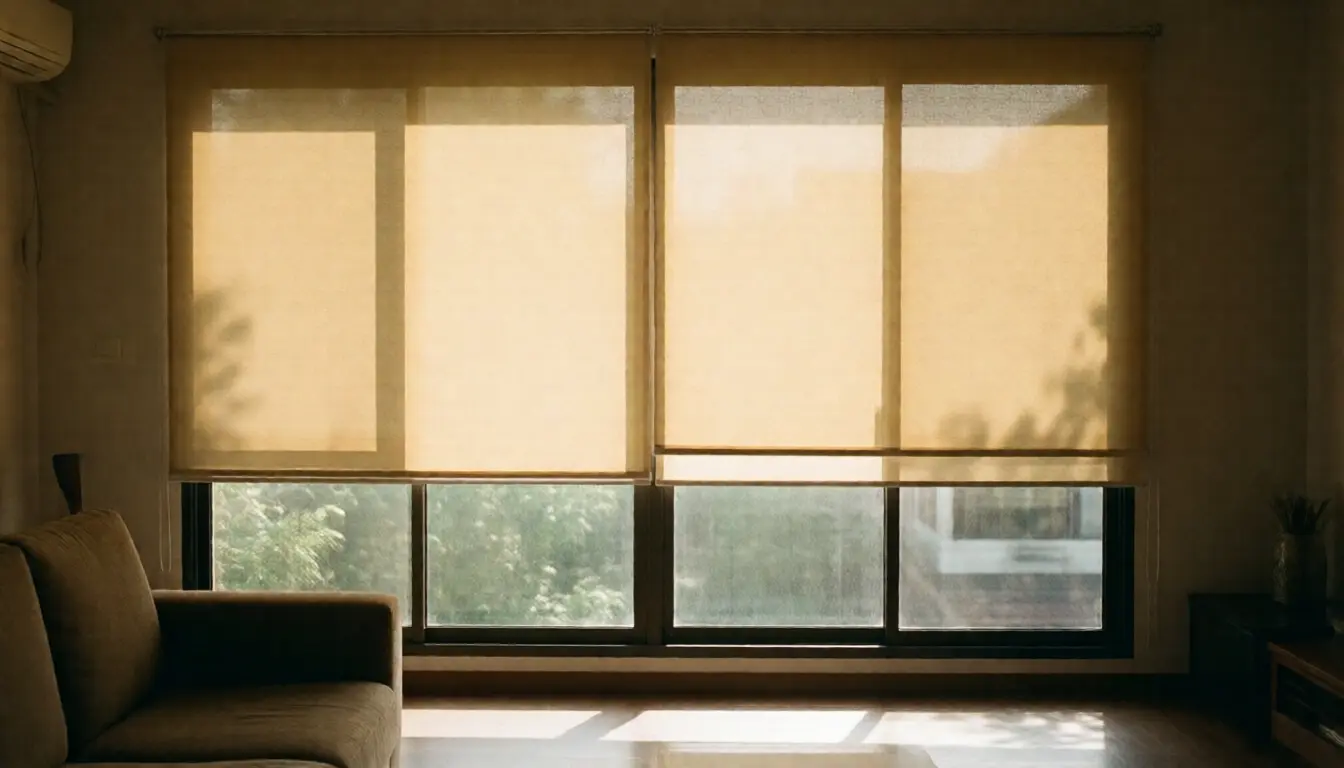
A blind is inside, so the heat is already in
This has to be said plainly before anybody sells you anything. Every blind hanging on the inside of the glass works after the sunlight has already come through it.
Some of that heat energy is therefore already in the room. The blind can only absorb it and stop it radiating further inwards, which is better than nothing but not comparable to stopping the sun outside the glass.
The correct order is external shading first, then the glass or film, then the blind.
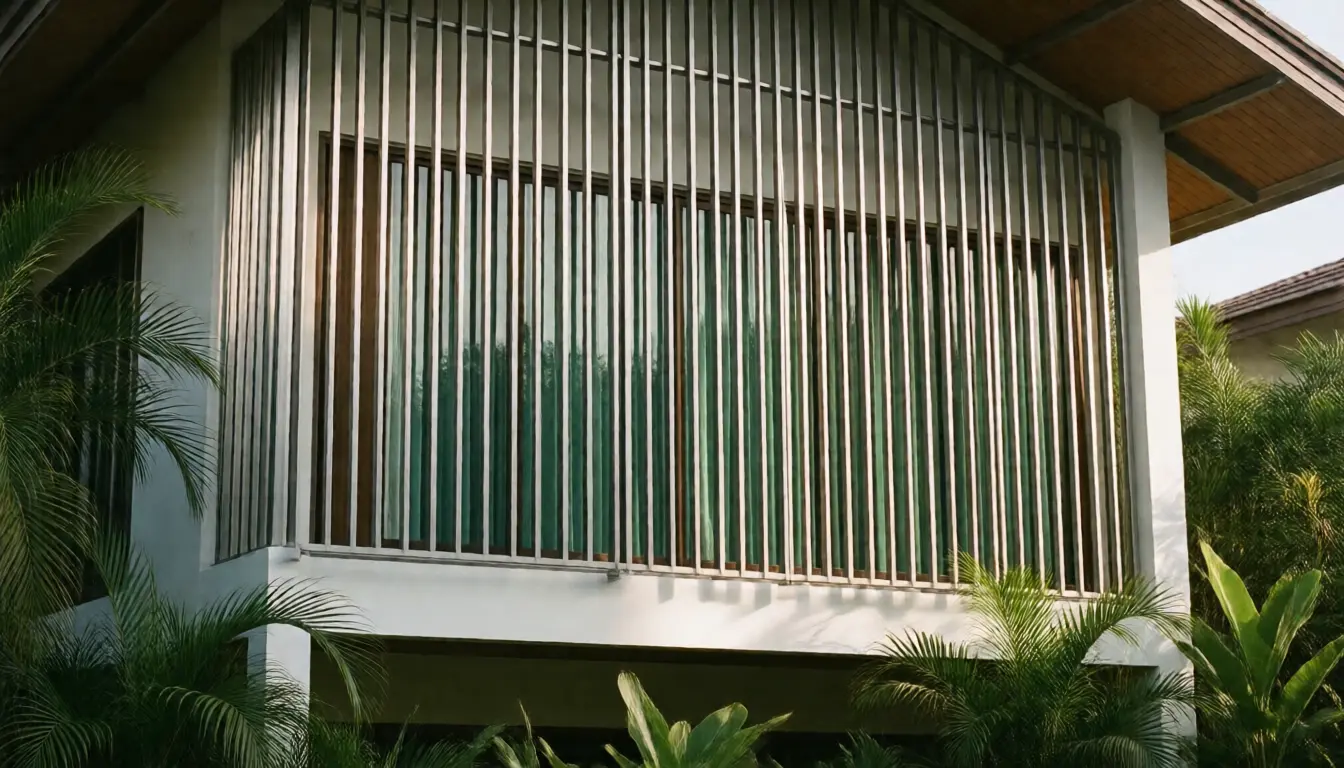
Where a house allows it, fitting vertical louvres outside the west-facing windows or extending the eaves far enough does more than every blind combined, because it stops the light before it becomes heat inside the room.
For a condominium where the outside cannot be touched, a blind is the best tool available. Glass and film are covered in window film against Low-E glass, and the overall order of what to fix first is in why Thai houses get hot and what to fix first.
Choosing the fabric matters more than choosing the motor
People spend their time on motor brands and apps and let the salesperson choose the fabric, when the fabric is what decides how much heat is kept out.
The openness factor is the proportion of the weave that is gaps. A very open fabric keeps the view and the daylight but lets more heat through. A dense fabric blocks better but means putting the lights on in the daytime.
The colour of the outward-facing side matters more than people think. Fabric that is pale on the outside, or has a reflective backing, sends some energy back before absorbing any. Fabric dark on both sides absorbs the heat and then radiates it into the room itself.
The usual answer is fabric pale outside and dark inside, giving both the reflection and the colour you want to see from within.
Closing the edges is what people rarely consider and what costs the most performance. A blind narrower than the opening and hanging away from the glass lets hot air circulate freely round the edges and into the room.
Mount the track wider than the frame on both sides and keep the fabric as close to the glass as possible, which turns the blind from a light screen into a genuine layer of still air.
Power at the head of the window, to think about before buying
This is what makes people regret buying motorised blinds, because the motor needs power, and it needs it at the top of the window, where most houses have no socket.
Mains-powered models run forever with no charging, but a cable must reach the head of the window, which is trivial while building or renovating and a nuisance in a finished house, meaning surface trunking or chasing the wall.
Battery models install immediately with no wiring, which suits condominiums and rented places. The trade is taking them down to charge periodically, a chore annoying enough that people abandon the automation and leave the blind in one position.
The middle route that works well is a battery model with a small solar panel stuck to the glass, charging itself from the light it is blocking, which removes the taking-down entirely.
If you are building or renovating, run power to the head of every window that might one day take a motorised blind, even if you are not buying now, because the cost while the walls are open is very small. What else to prepare is in wiring a new build before the walls close.
Schedule it properly, not at sunset
People set motorised blinds to open in the morning and close at sunset, which is a tidy schedule that does nothing for heat, because by sunset all of it has arrived.
A schedule that works has to differ by which way the window faces, because each direction takes the sun at a different time.
East-facing windows close from early morning until about ten, then can stay open all day since the sun has moved past.
West-facing windows close from about two until sunset, which is the most important window in the whole house.
South-facing windows take the sun mainly in the middle of the day, so close them from noon through the afternoon.
North-facing windows take the least direct sun, so leave them open for daylight and keep the lights off.
Set up like that, the result is a house that is not hot when you get in, and an air conditioner working less because it is not clearing heat accumulated all afternoon.
To go one step further, tie the closing to a light sensor rather than a fixed time, so the blinds do not close unnecessarily on overcast days. That makes the house brighter through the rainy season without giving up anything in the hot one.
What to ask before buying
- How loud is it? A bedroom blind that opens at seven with a loud motor is a system you will disable within the first week. Listen to one in the shop rather than trusting a number on a specification.
- Does it still work when the internet is down? A model that routes through the manufacturer's servers becomes a blind that will not move when the router reboots. Choose one with a radio remote or a button on the headrail as well.
- Where does it stop in a power cut, and can it be moved by hand? An important question for a blind across a sliding door to a balcony.
- Open or closed system? Whether it works only with one brand's app or will connect to a wider home system, which matters if you intend to bring everything together later.
- How long is the motor warranty and can the motor alone be replaced? Fabric always outlives motors, and having to strip out a whole assembly because of one motor is an expense that should not happen.
Frequently asked questions
Do motorised blinds really reduce the air conditioning bill?
They do, but not because they are motorised. They help because they can close in the afternoon when nobody is home, which is when the heat arrives. An ordinary blind closed at six in the evening does nothing for that.
Blinds or window film, which is better?
They work at different points. Film is on the glass and acts before a blind can. A blind is inside and works after the light is already through. If the budget allows only one, start with external shading before either.
When should they be scheduled to close?
By orientation. West at about two, which matters most; east in the morning; south from noon through the afternoon; north can stay open, since it takes the least direct sun.
Can I fit them in a condominium?
Yes, and a blind is the best tool a condominium has, since the outside cannot be touched. Choose a battery model needing no wiring, and check the building's rules about anything visible from outside first.
Should I choose open-weave or dense fabric?
It depends how much view and daylight that room needs. Open weave keeps the light but blocks less heat. Whichever you choose, take fabric that is pale on the outside so some energy is reflected back.
In short
- The real value of a motorised blind is closing in the afternoon while nobody is home, not the remote.
- A blind is inside, so it acts after the heat is through the glass. External shading is always better.
- Fabric matters more than the motor. Choose pale on the outside and mount the track wider than the frame.
- Work out the power at the head of the window before buying, and run cable in advance if you are building.
- Schedule by orientation, not at sunset.
- Ask about noise, operation with the internet down, and whether the motor alone can be replaced.