
Every hole is a risk, and roof types do not carry equal risk
Rooftop solar that makes a house leak does not leak because of the panels. It leaks because of how the panels were fixed to the roof.
One system has dozens of fixing points, and if each fixing has to go through the roof sheet, that is dozens of holes newly drilled in a roof that never had any.
The good news is that some roofs can be fixed to without a single penetration. The thing to know is that others definitely need drilling. So the first question is not how many panels, but what kind of roof you have.
The other thing to understand from the outset is that if it does leak, the drip will not be under the hole, because water runs along the underside of the roof before it falls, which makes finding it harder than expected. That is explained in finding a roof leak.
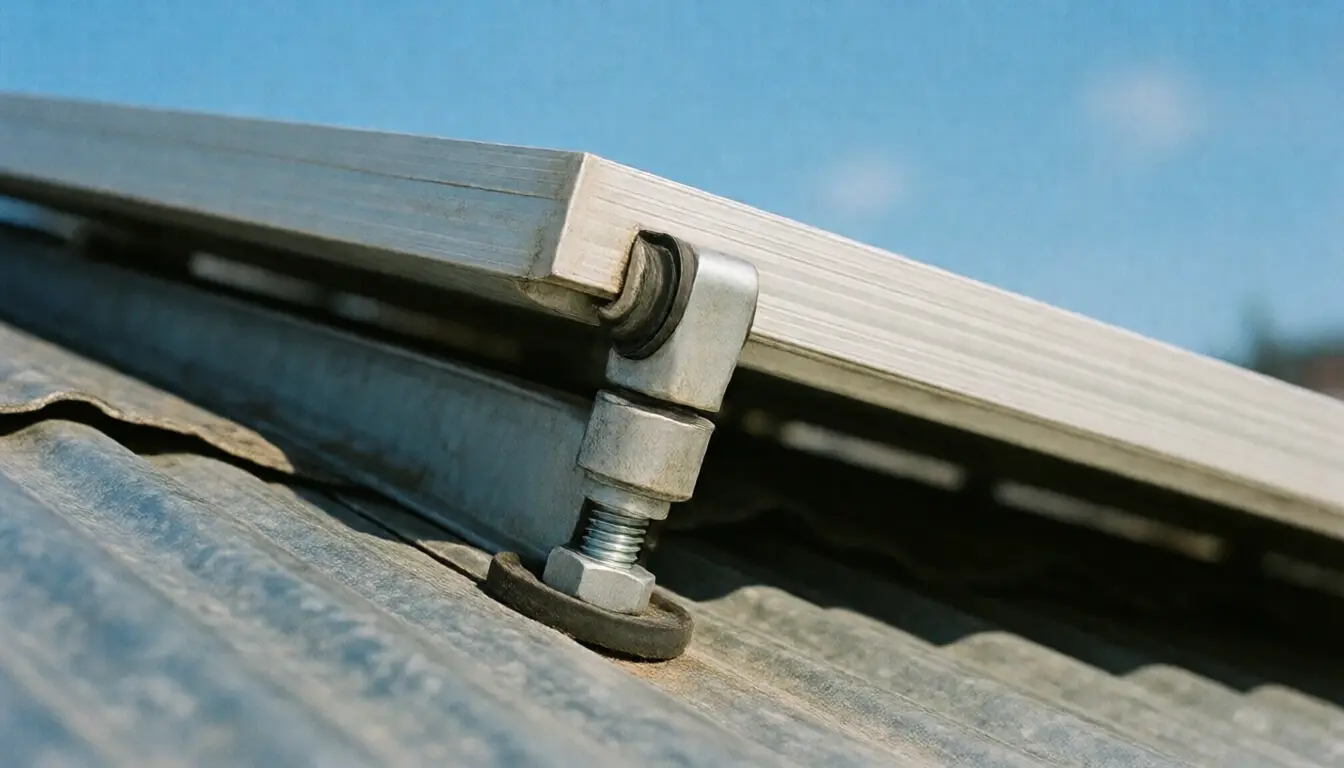
Metal and corrugated roofs: fix at the crest, never in the valley
A corrugated roof has crests standing up and valleys running down, and all the rainwater runs in the valleys.
The rule not to break is: fix at the crest, never in the valley, because a hole in the valley sits in running water for the whole of every storm, and no seal survives that indefinitely.
What is needed is a roofing screw with a bonded rubber washer under a metal one, which compresses to close the hole when tightened to the right point.
The common error is overtightening until the rubber squashes out sideways, which deforms it and makes it fail far sooner. Correct tightening is until the rubber just begins to compress, and then stop.
The screw must also land in a purlin, not merely in the roof sheet, because wind uplift will tear a fixing that only grips thin sheet in the first strong storm.
And silicone must never replace the washer. Silicone is a supplement applied over a correct seal, not the waterproofing itself, because silicone under Thai sun goes hard and cracks within a few years.
Tiled roofs: the best route is not drilling at all
Concrete tiled roofs, the most common type on Thai housing estates, can be fixed to with no penetration whatsoever.
The method is a tile hook: a shaped steel piece that slides under the tile above, hooks over the batten carrying the tiles, and emerges between the overlap.
All the load transfers straight into the roof structure, and there is not one new hole in the roof, which is what to ask for first if your house has a tiled roof.
What to check is that the hook does not lift the tile above it, because a lifted tile opens a gap for driven rain to get underneath. A competent installer cuts a small notch in the tile so the hook passes while the tile still lies flat.
Older clay or flat tiles need more care still, because they are brittle and crack when stood on. Ask the installer whether they have spare tiles to replace any broken during installation, because matching tiles for older roofs are often no longer available.
A concrete flat roof is the safest of all
If the house has a concrete roof terrace, you have the best option available: a ballasted frame that is not fixed to the surface at all.
It sits on the roof and uses weight to resist wind, so the waterproofing layer, which is the hardest thing to repair if damaged, is never penetrated.
Two things to check: whether the roof can carry the additional load, which needs an engineer particularly on an older building, and that the frame does not sit across the path water takes to the drains.
The second matters more than people think, because a frame blocking the flow creates standing water, and standing water is the leading cause of leaks in a concrete roof.
Pour water and watch the flow after installation, checking that it still reaches the drains as it did before.

The point people forget, and where it actually leaks
The cables from the panels have to get into the house somehow, and the point where they pass through the roof is done last and often done carelessly.
What should be used is a purpose-made roof cable entry, with a flashing that tucks under the sheet or tile above.
What should not be accepted is a hole with silicone packed round the cable, which is the most common approach and the one that will leak within two or three years.
The other point is any fixing near the ridge capping, where more water passes than anywhere else. If the layout runs a row of panels up to the ridge, ask how it will be fixed and what will keep the water out.
And before the panels go on top, photograph every fixing from above, because once they are down nobody will ever see those fixings again, and if it leaks in future that set of photographs is the only record of how the work was done.
Questions to ask the installer before signing
- What fixing method suits this roof, and how many penetrations? Ask for a real number, not an answer about standard mounting.
- Does it fix into the purlin or into the roof sheet? Because wind uplift is what tests a fixing, not the weight of the panels.
- Can the existing roof structure take it? Particularly a timber structure or a house over twenty years old. Ask whether the structure was inspected and who certified it.
- Where do the cables enter and what keeps water out there? Put it in the contract, since it is the most common leak point.
- How many years is the roof leak warranty? It is separate from the panel and inverter warranties, so write it out separately with its own period.
- Who pays if tiles break during installation, and are matching replacements available?
Install in the dry season, hose-test every penetration before accepting the work, and go up into the roof space again after the first heavy storm of the rains. Choosing an installer who will come back is in the rooftop solar installer registry.
Frequently asked questions
Does fitting solar mean the roof will leak?
Not necessarily. Tiled roofs can be fixed with tile hooks and no penetration at all, and a concrete roof can take a ballasted frame. Corrugated roofs do need drilling, but drilled at the crest with the correct washer they do not leak.
Why the crest and not the valley?
Because all the water runs in the valley, so a hole there sits in running water throughout every storm, and no seal survives that indefinitely.
Can silicone waterproof the fixings?
As a supplement yes, but never as the main seal, because silicone in daily sun hardens and cracks within a few years. The main seal is the bonded washer and the correct fixing method.
Can an old timber-framed roof take panels?
Only after inspection, because wind uplift tests the fixings more than the weight does, and timber weakened by termites or rot will not hold. Ask who inspects and who certifies it.
Where does it leak most often?
Where the cables pass through the roof, because that is done last, usually as a hole packed with silicone. Use a purpose-made cable entry with flashing tucked under the sheet above.
In short
- The first question is what kind of roof you have, because the risk differs enormously.
- Corrugated roofs are fixed at the crest only, never in the valley, and into a purlin.
- Tiled roofs can use tile hooks with no penetration at all. Ask for that method first.
- Concrete roofs take a ballasted frame, provided it does not block the water's path to the drains.
- The most common leak is where the cables pass through the roof, not at the brackets.
- Photograph every fixing before the panels cover them, and keep the leak warranty separate.