
Six checks, and five of them take under twenty minutes together
A call out charge starts when the technician leaves the shop, not when he starts working.
So running these six checks before phoning has two outcomes, and both are good.
The first is that you fix it yourself and pay nothing.
The second is that you cannot fix it, but you phone with information that tells the technician what it probably is before he arrives.
Which means he brings the right part on the first visit rather than coming twice.
First, work out which kind of problem it is
One question splits the causes into two groups that barely overlap.
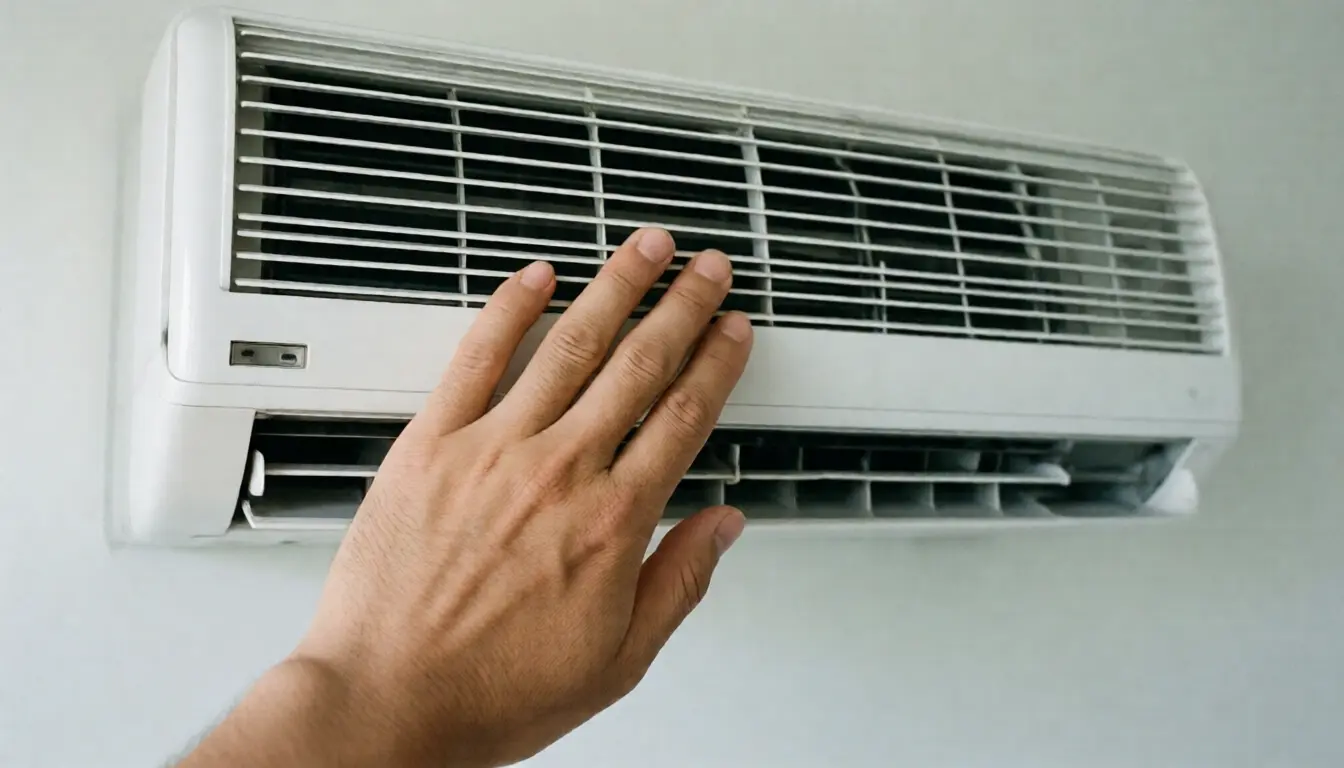
Hold your hand at the outlet grille for half a minute.
If the air is clearly cold but the room is not, the problem is the volume of air, or the room itself, rather than the cooling system.
Almost all of that group is fixable by the owner.
If the air is not cold at all, or barely cool, the problem is the cooling system.
Some of that group is fixable, and the rest needs instruments.
Remember your answer, then read on.
Check one: the remote, the reason people are embarrassed to admit
Look at three things on the remote before touching anything else.
The mode. In fan mode it blows air without cooling at all.
And in dry mode it runs far more gently than usual, which feels like not cooling.
The set temperature. Set above the current room temperature, the compressor will not run at all, exactly as designed.
Whether a timer is set, because a unit set to switch off stops in the middle of the night with nobody the wiser.
This sounds too basic to mention, and technicians find it often enough to justify the thirty seconds it costs.
Check two: is the airflow strong enough
Switch it off, open the front cover, take the filter out and look at it.
If it is a solid grey sheet you cannot see through, that is your answer.
Wash it in plain water with a soft brush, dry it completely, and refit it.
Switch on again and compare the airflow.
Noticeably stronger air and a room starting to cool means you are done.
Still weak after washing means the coil behind it is blocked or the blower is dirty, which is a technician's job, as set out in cleaning it yourself against calling a technician.
Check three: the outdoor unit, the one people forget
Walk outside and look at the outdoor unit while the system is running.
What you should find is the fan turning and the air coming off it hot.
If that air is not hot, heat is not being rejected, which is a symptom worth telling the technician.
Then look at four things around it.
- Leaves, dust or pet hair packed into the fins, which you can rinse gently yourself after isolating at the breaker.
- Objects blocking the front or the back: plant pots, boxes, or a cover somebody put on and forgot.
- Too little clearance from a wall or fence, which lets the hot air it expels circle straight back into it.
- A position in full sun all day, which makes rejecting heat harder through the afternoon.
The third is common in houses extended later, where the outdoor unit ends up in a narrow slot between the building and the boundary wall.
Check four: is the room leaking
This applies to the group where the air is cold but the room is not.
Go through this on the hottest part of the afternoon.
- Does the door close fully, and how large is the gap underneath?
- Are the windows locked or merely closed, because a sliding window closed but unlocked still passes air.
- Are the curtains heavy enough on the sunlit side, because sunlit glass is a heater inside the room.
- Is there an open hole in the ceiling, such as a service hatch with no cover, leading straight into the roof void?
- Is the bathroom extractor left running, because it pulls cooled air out continuously.
A house that cools at night but not in the afternoon is usually dealing with solar heat gain rather than a faulty machine.
Check five: power and breakers
If the indoor unit runs but the outdoor unit is silent, look at the breakers first.
In many houses the outdoor unit has its own local breaker nearby, which can trip while the one in the house looks normal.
If you reset it and it trips again before long, stop and call a technician.
Do not keep resetting it, because a breaker that trips repeatedly is telling you something is genuinely wrong, which is traced as in finding out why the breaker keeps tripping.
Check six: has the room changed
An air conditioner that used to cool and now does not has sometimes not changed at all. The room has.
- More people in it, because a person is a walking heat source.
- More equipment in it: a desktop computer, a small refrigerator, screens left on all day.
- A wall removed to join two rooms, leaving the same unit covering more space.
- A new roof or a removed ceiling, letting more heat down from above.
- A shade tree cut down, which changes the heat load of that whole wall.
If any of those apply, the unit may not be faulty at all. It is simply too small for the room it now serves.
What to tell the technician when you call
These five pieces of information let him arrive prepared.
- Whether the air coming out is cold or not.
- Whether the airflow is normal or weaker than it was.
- Whether the outdoor unit runs, and whether the air off it is hot.
- Whether there is dripping, ice, or an unusual noise.
- When it was last serviced.
Notice that all five are things you have just established in the six checks above.
Frequently asked questions
The air is cold but the room is not. Why?
Usually airflow or the room rather than the cooling system. Check the filter, the room's air leaks, curtains on the sunlit side, and any new heat load from people or equipment.
I washed the filter and nothing improved. What next?
If the airflow is still weak, the coil behind it is blocked or the blower is dirty, both of which need a technician because they are beyond reach.
The outdoor unit is not turning. What do I do?
Check its local breaker first, since it can trip while the house breaker looks normal. If it trips again shortly after resetting, stop and call a technician.
Why does it cool at night but not in the afternoon?
Usually solar heat gain rather than the machine. Look at the sunlit windows, curtains that are too thin, and whether the outdoor unit sits in full sun all day.
Does a narrow slot around the outdoor unit matter?
Yes, because the hot air it expels circles straight back into it, so it rejects heat poorly. It needs clearance all round and nothing blocking it.
Does it need refrigerant?
Not without measuring. The circuit is sealed, so a low charge means a leak, and topping it up without finding the leak means paying again every year.
At what age should it be replaced?
There is no fixed number. Weigh the repair cost against a new unit, how often it fails, and whether it still suits the size of the room today, which is the part most often forgotten.
In short
- First establish whether the air itself is cold, because the two groups have different causes.
- Check the mode, the set temperature and any timer on the remote before anything else.
- Wash the filter and compare the airflow, which answers immediately whether that was it.
- Go outside and confirm the fan turns and the air off it is hot.
- Obstructions and narrow slots let expelled heat circle back into the unit.
- A leaky room and sunlit glass explain cooling at night but not by day.
- The outdoor unit's local breaker can trip while the house breaker looks fine.
- A changed room can make a working unit too small without anything failing.
- Phone with the five pieces of information so the right part arrives first time.