
An unusually low price always has a reason, and it falls into five groups
A house twenty or thirty percent below the market is not cheap by accident. There is always a reason, and your job is to find out which group it belongs to.
Because four of the five groups can be fixed for a sum that can be established, and the fifth cannot be fixed at all.
People who buy a cheap house and regret it do not regret it because the house had a problem. They regret it because they did not know what the problem was before paying the deposit.
People who buy a cheap house and profit are the ones who found every problem, priced the repairs correctly, and bought at a price with those problems already deducted.
Group one: condition, which can be priced
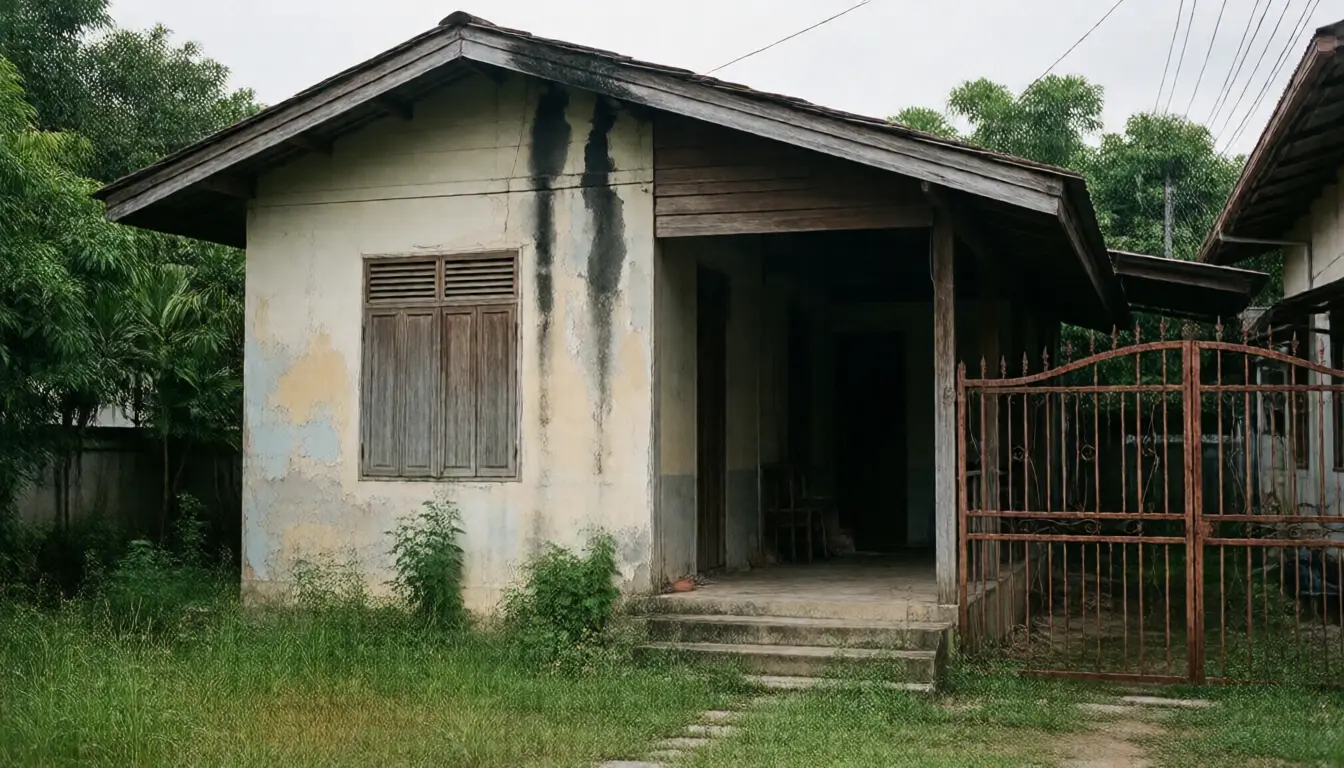
A house needing a new roof, a rewire, new plumbing, or with termite damage in the structure, is cheap for a straightforward reason.
The advantage of this group is that everything can be priced, if you take a builder to see it and get quotations before making an offer.
The order to inspect is structure first, then the roof, then the electrical and plumbing. Paint and tiling come last, because they cost little and are not what decides anything.
Cracks need separating into surface cracks and cracks that say something about the structure, explained in which cracks are dangerous, and ceiling staining with a leaking roof is in how to find a roof leak.
The rule to hold to is: get the quotations before making the offer, not after the deposit is paid and the builder is called in. A number arrived at after the deposit is a number you can no longer change your mind about.
Group two: title problems, readable on the back of the deed
This is simultaneously the cheapest and the most dangerous group, because the problem is not in the house but in the paperwork.
What to do is ask for a copy of both the front and the back of the title deed, and read every line of the registration schedule on the back, because everything ever registered against this land is there.
What turns up and makes a property cheap: a mortgage, a sale with right of redemption, a usufruct, a right of habitation, a servitude letting somebody else cross, and land with no access to a public road.
Land with no access is very cheap for an entirely real reason, since banks generally will not take it as security, meaning you must buy with cash and can only resell to somebody else with cash. That is in landlocked land and the necessary way.
Another common case is an inherited house where the estate is not settled, cheap because the heirs want it finished, but where you must confirm the authority to sell is genuinely complete rather than missing a signature. That is in inherited land and the estate administrator.
Group three: location and surroundings, which takes legwork
This group appears in no document and is invisible on a single Sunday afternoon viewing.
Check the flood history, which sellers rarely raise and neighbours mention immediately if you ask. How to check is in checking flood history before buying.
Then the transport map in the city plan, which shows whether a new road is aligned through the area, and which changes both the price and how pleasant it is to live there.
Then the neighbours, particularly a factory, a garage, a late-opening business, and the empty plot next door where somebody will build something one day. Look at the zoning colour of the neighbouring plots, not only the one you are buying.
The most effective and least time-consuming method is to visit twice at different hours, a weekday afternoon and a Friday night, because noise and traffic differ enormously between the two.

Group four: the seller's circumstances, the group you want
A house cheap because the owners are divorcing, moving abroad, need cash quickly, or because heirs want an estate finished, is a house that is cheap with nothing wrong with it.
This is the only group where cheap means genuine gain with no repairs, and it is why you should ask directly why they are selling.
The signs pointing this way are a house still lived in and looked after, complete paperwork, and a seller who answers clearly about transfer timing.
The signs pointing the other way are a house empty for a long time with no explanation, listed for two years with several price cuts, and a seller avoiding the question of why it has not sold.
Ask the same question of the agent and of the seller, then see whether the answers match, because answers that do not match are what tells you to keep asking.
Group five: the reason that cannot be fixed
Some houses are cheap because everyone locally knows something you do not, and once they know it, nobody locally wants to buy it.
What comes up in the Thai market is a house where something serious happened. Whatever you personally feel about that, it is a market fact affecting liquidity and resale price.
In practice that means that even if it does not trouble you at all, whoever buys from you in ten years may be troubled by it, and you will meet exactly the problem the current seller is meeting now.
There is no specific provision requiring a seller to disclose this, so the effective approach is to ask, and to ask the neighbours rather than the agent.
The question that works is knocking on two doors either side and asking how long the house has been empty and why it has not sold, which is easier for people to answer and produces a straighter answer than asking directly.
Do the full arithmetic before deciding it is cheap
The real price of a cheap house is not the asking price but the price plus everything needed to make it usable.
Add four items: the repairs at real quoted prices, the cost of living somewhere during the works which may be months of rent, the cost of resolving any title problem, and a contingency for what appears once things are opened up, which is always something in an older house.
Then compare the total against a normal house nearby. If the figure is not meaningfully lower, you are about to work hard for a year to save an amount that was not enough.
The other thing people do not consider is that the bank values it low too, and the facility is based on the appraised value. A cheap house with problems may therefore need more cash than a normal one, not less, which is explained in why banks value the same house differently.
Frequently asked questions
A house thirty percent below market. Worth looking at?
Worth looking at, but find the reason before paying a deposit, because four of the five groups can be fixed for a price that can be established while the fifth cannot and follows you to your own resale.
How do I check for title problems?
Ask for a copy of the front and the back of the deed and read every line of the registration schedule on the back, because mortgages, redemption sales, usufructs and servitudes are all there.
The house has been empty for years. Is that a bad sign?
It is a sign to ask further. Knock on two neighbouring doors and ask how long it has been empty and why it has not sold, which gives a straighter answer than the agent will.
Must a seller disclose that something serious happened there?
There is no specific provision requiring it, so ask, and ask the neighbours, because whatever you feel about it, it affects liquidity and price when you come to sell.
Is a cheap house easier to finance?
Not necessarily, because the bank also values a problem property low, and the facility follows the appraised value, so it often needs more cash than a normal house.
Who should I take to view it?
A builder who can assess the structure and the roof, before making an offer, with written quotations, because a number arrived at after the deposit is one you can no longer act on.
In short
- An unusually low price always has a reason, in one of five groups, four of which can be priced.
- Read every line of the registration schedule on the back of the deed, where title problems all live.
- Visit twice at different hours, and check the zoning of the neighbouring plots too.
- The group you want is cheap because of the seller's circumstances, not because of the house.
- Knock on two neighbours' doors and ask how long it has been empty. Straighter than asking the agent.
- Add repairs, living costs during works and a contingency before deciding it is actually cheap.