
How do you know termites are in the house?
Look for three things. Winding earth tunnels running up a wall, a column or the skirting. Timber that sounds hollow when you knock it although the surface still looks sound. And thin transparent wings collecting on a window ledge or under a light fitting after heavy rain. Any one of them is enough to call someone in.
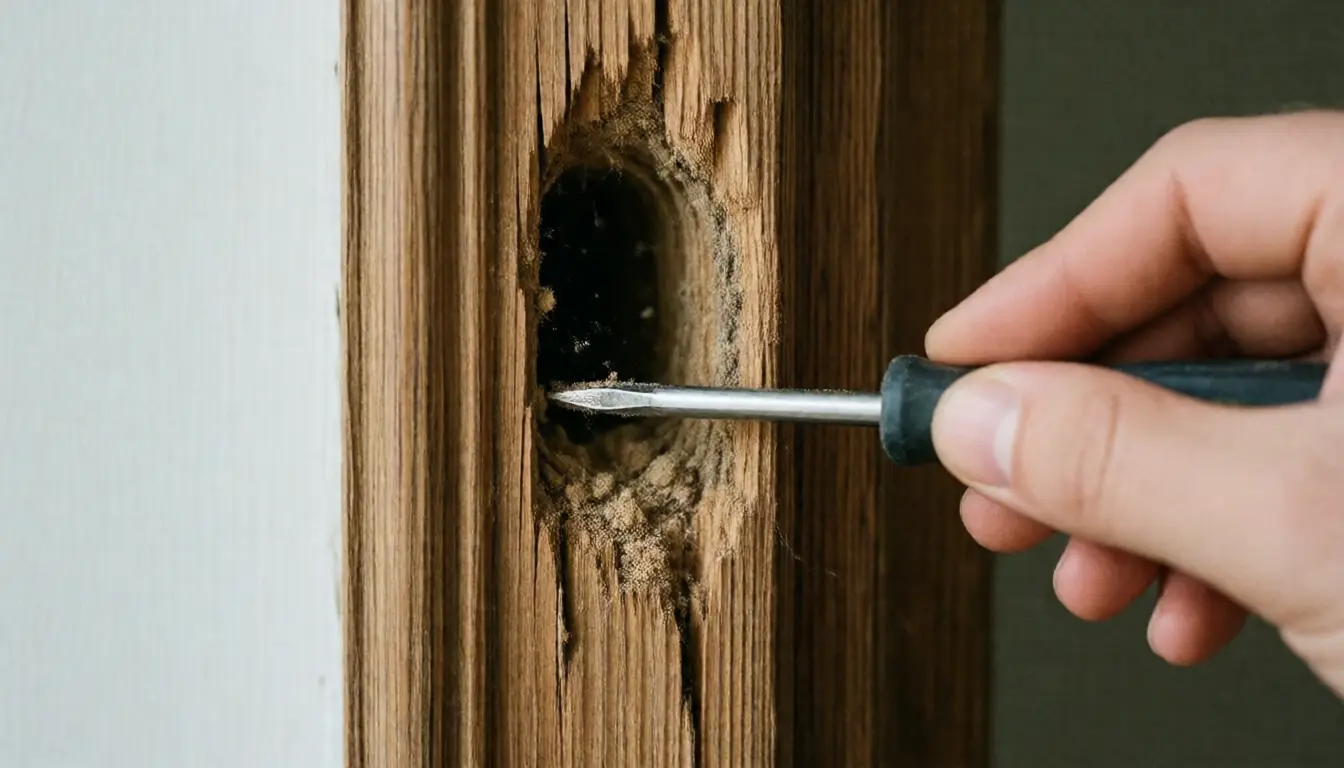
What makes termites worse than people expect is that they do not eat the surface of the wood. They eat the inside and leave a thin skin. A door frame that looks perfectly solid can already be half hollow, and by the time you can see it with your eyes the surface has collapsed, which is the stage where the timber has to be replaced rather than merely treated.

The termites in most Thai homes live underground
Thailand has close to two hundred termite species, but only a handful actually damage buildings, and the ones found in houses most often are subterranean. They nest in the soil and travel up into the building to feed.
That matters enormously for how you deal with them. If the nest is in the ground, spraying only where you can see termites achieves almost nothing. It is like cutting a branch and expecting the tree to die. The ones walking on your wall are a tiny fraction of the colony; the several hundred thousand still underground will send a fresh crew within days.
Subterranean termites get in through cracks in the slab, through the joint between slab and wall, and through the sleeves where electrical conduit or plumbing passes through the floor. That is why a spotlessly kept house is still vulnerable. Their route in is somewhere you cannot see.
The signs, one at a time
- Mud tubes. Hard earth tunnels about the width of a little finger or narrower, running up a wall, a column or the underside of a floor. Termites build them to stay out of light and dry air. Break a short section out and look again in two or three days. If it has been repaired, it is still in use.
- A hollow sound. Knock along door frames, skirting and timber floors with a knuckle. A change from solid to hollow over a short distance is the spot to be suspicious of. It is a simple test and it works, but you have to knock in many places to hear the difference.
- Discarded wings. Early in the rainy season, after heavy rain, termites fly out to start new colonies and then shed their wings. Thin identical wings collecting near a window or under a light mean there is a nest nearby, not simply that something flew past.
- Paint lifting in a line. Termites travelling under the paint push the surface up into a raised line that gives when you press it. Unlike ordinary paint failure it runs in a long track, usually vertically.
- A door or window that has started to stick out of season. A frame eaten from inside distorts and the leaf begins to catch. Plenty of people put it down to damp swelling the timber and plane the door thinner instead of asking why the frame moved.
- Fine granular droppings. Some species that live inside the timber push out powder or small brown pellets that collect under a tiny hole. Sweep it away, and if it comes back, they are still there.
What not to do once you find it
This matters as much as knowing what to do, because most people's first reaction makes the problem harder to fix.
Do not reach for the insect spray. A household aerosol does kill what it hits, and it does two damaging things. It kills only what you can see, which the colony does not notice. And it makes the rest retreat and open a new route somewhere else in the house. A problem whose location you knew becomes a problem that is scattered and hard to find.
Do not scrape all the mud tubes away before someone comes. The tubes are the map that shows where they are getting in. Clean them all off and the technician starts from nothing. Break out a short section to test whether the tube is live, and leave the rest.
Do not repair the timber or paint over it yet. Fitting a new door frame before treating the colony is handing them fresh food. Treat first, repair second.
The two treatment approaches actually used
Thai contractors work in two main ways, and which suits your house depends on whether it is built or being built, and on how you feel about drilling the floor.
| Approach | What it does | Suits | Worth knowing |
|---|---|---|---|
| Soil injection | Drilling the floor at intervals along the walls and injecting chemical underneath to create a treated soil barrier termites cannot cross | A finished house with a live problem | Works quickly, but the floor gets drilled and the result depends on whether coverage is genuinely complete. Areas hidden behind built-in furniture are the usual gaps |
| Baiting | Bait stations around the house that worker termites carry back and share through the colony, collapsing it | Houses where you would rather not drill, or where the entry route cannot be found | No drilling, and it reaches the nest, but it takes weeks to months and needs someone to check the stations on a schedule |
| Treating at construction | Pipework laid under the slab during the build, or the soil treated before the slab is poured | A house being built or extended | The cheapest and most effective over the life of the house, but only possible at that moment. Miss it and you cannot go back |
In practice many houses use two together: injection to stop the immediate problem, baiting to deal with the colony and keep watch afterwards. If a contractor proposes one without explaining why, ask for the reasoning before you agree.

What to ask before hiring anyone
Two quotations that differ by a factor of two usually differ in scope and warranty rather than skill. Ask every contractor these five and lay the answers side by side.
- Which method, and why that one for this house? A good answer refers to what they saw in your house, not to a general description that would fit anywhere.
- How many years of warranty, and warranting what? There is a wide gap between "we will come back and re-treat free if termites are found" and "we cover structural damage". The latter is rarer and comes with conditions. Get it in writing.
- How many holes in the floor, and do you make good afterwards? Ask for an approximate count and how they are filled, because a badly patched tiled floor is something you look at every day.
- How many follow-up visits, how far apart, and are they in this price? A baiting system nobody comes to refill and inspect is a set of empty plastic boxes buried in the garden.
- Do we need to move anything out, and how long should people and pets stay away? Ask plainly so you can plan. A professional answers this immediately.
One more: ask for the chemical to be named on the quotation rather than described as "termite treatment". You are entitled to know, both for the safety of the people in the house and so you can compare quotations that are actually comparable.
Prevention costs a fraction of treatment
Termites need two things: moisture and cellulose. Take both away from around the house and the odds drop sharply, and every item below is a single weekend's work.
- Keep timber out of direct contact with soil. Timber trellis posts, wooden fence footings and planters set into the ground are bridges straight to the house. Where you cannot avoid it, lift the timber off the soil on a concrete or steel base.
- Move woodpiles, cardboard and building offcuts away from the walls. They are food and cover at once, and stacked against a wall they are an invitation to the exact point where entry is easiest.
- Fix anything that pools or leaks. A dripping outside tap, an air conditioner draining onto the same patch of soil every day, a gutter overflowing at the base of a wall: each keeps that ground permanently damp, which is the condition termites like best.
- Let the underfloor space breathe. If the house has a crawl space or raised floor, do not seal it or fill it with stored items. No airflow means damp.
- Walk the perimeter once a year. Before the rains is a good moment. Half an hour with a torch along the footings, around pipe penetrations, and inside the built-in cupboards nobody opens.
A house with a standing damp problem usually has more than termites to worry about. On ventilation and moisture in Thai houses see light and ventilation through the rainy season, and if you are also finding cracks, compare them against which cracks are dangerous first, because not every crack is termite related.
Termites when you are buying or letting
If you are buying a resale house, termites are something to check on the viewing, not after transfer. Knock every door frame, open every built-in cupboard, put a torch under the kitchen sink, and look along the skirting in the rooms nobody uses, because those are the places a seller has not prepared.
Finding evidence does not mean walking away. Termites are fixable and the bill is nothing like a structural problem. It is information to negotiate with, and the contract should say who deals with it before transfer. The thing to be warier of is a house where the skirting has been freshly painted while everything else is old, which is a common way of hiding the trail.
If you are letting a property, write into the lease that the tenant must report any sign of termites or unusual damp immediately. Finding out late is the single thing that turns a small repair into a large one. Who pays for repairs in a rented home is covered in who pays for repairs in a rented home.
If you are looking for a house that has been inspected, see houses for sale and townhouses for sale.
Frequently asked questions
I saw flying termites indoors. Does that mean I have them?
Winged termites are drawn to light and can come in from a nest outside. But wings collecting indoors with no insects in sight means they were shed to start a colony in that area, and it is worth a careful inspection.
Can I just spray them myself?
Better not to. It kills only what it touches, does nothing to the underground nest, and drives the rest to open a new route elsewhere in the house, which makes them harder to locate.
Injection or baiting, which should I choose?
Injection works quickly but the floor has to be drilled. Baiting needs no drilling and reaches the colony, but takes longer and needs ongoing inspection. Many houses use both.
Is one treatment the end of it?
No. Subterranean termites live in the soil around the house. Treatment cuts their route in and destroys the colony, but the soil still holds termites, so re-inspection and renewal on schedule are part of the job.
Does home fire insurance cover termite damage?
Generally not, because it is treated as gradual damage from lack of maintenance rather than a sudden peril. Read your own policy to be certain.
My house is all concrete with no timber. Am I safe?
Safer, not immune. Termites eat cellulose, which is in door frames, laminate flooring, plasterboard, paper and built-in furniture, and a concrete house has all of those.
Where can I check for termites myself?
Knock every door frame, run a torch along the skirting, open the built-in cupboards nobody uses, look under the kitchen sink, and walk the outside footings, especially where pipes pass through the slab.
What should I do if I am buying a resale house?
Check on the viewing rather than after transfer, and if you find evidence, use it on price and put in the contract who deals with it before transfer. Be wary of a house where only the skirting has been freshly painted.
Key takeaways
- The three signs are mud tubes on walls, timber that sounds hollow, and shed wings after rain.
- Termites eat the inside and leave the surface, so by the time it shows the timber needs replacing.
- Most house termites are subterranean and nest in the soil, which is why spraying what you can see fixes nothing.
- Do not spray, do not scrape all the tubes away, and do not repair the timber before treating.
- Ask which method and why, what the warranty actually covers, how many holes, and how many follow-up visits.
- Prevent by keeping timber off soil, clearing stored material from the walls, and fixing standing water.
- When buying, knock frames and check skirting on the viewing, and be wary of freshly painted skirting on an otherwise old house.