
A cesspool does half the treatment. The right kind of prefabricated tank does both halves
That is the shortest answer, and it explains why the two cost such different amounts.
A cesspool separates solids from water. Sludge settles to the bottom and slowly breaks down, while the clearer water in the middle overflows onward.
But the water leaving a cesspool is not clean water. It merely has no floating solids in it. The organic load is still high.
In the traditional Thai arrangement, that overflow runs into a soakaway and seeps into the ground, which means the soil under your garden is the second half of the treatment system.
A prefabricated treatment tank of the complete kind holds both the settling stage and a stage where organic matter is broken down, inside one tank, so the water leaving it is very much better.
That difference matters most where the plot is small, the water table is high, or the soil drains poorly, which describes most housing estates in and around Bangkok.
This article covers both systems from first principles, through what kills a system that was only just installed, to what to check before buying a resale house.
A house makes two kinds of wastewater, and everything starts there
Before talking about tanks, separate the two, because household wastewater is not all the same.
Toilet waste carries human waste, with pathogens and a concentrated organic load. It always has to be treated.
Everything else is the kitchen sink, the basin, the shower and the washing machine: no human waste, but grease, detergent and food scraps.
In older Thai houses these two are kept separate. Toilet waste goes to the cesspool, while kitchen and bathroom water runs straight into the public drain.
In modern systems using a combined treatment tank, both streams enter the same tank, which gives better quality in what finally leaves the property.
What matters is that a tank designed for toilet waste alone and a tank designed for combined flow have different sizes and different internal arrangements.
Running kitchen water into a tank designed for toilet waste alone overloads it and shortens its life considerably, grease especially.
So the first question for the contractor is whether this tank is for toilet waste alone or is a combined treatment tank, and where the kitchen water is going.
How a cesspool and soakaway actually work
The traditional Thai system is two chambers connected in series.
The cesspool is closed. Toilet waste flows in, solids settle to the bottom as sludge, grease and floating matter form a layer on top, and the relatively clear water in the middle overflows onward.
Bacteria that live without oxygen digest the sludge in there, which is why it does not simply accumulate in proportion to what goes in, although it does not disappear entirely either.
The soakaway has open walls or an open base so water can seep into the soil. Overflow from the cesspool collects there and gradually disperses.
The soil around the soakaway is what really performs the final treatment, because micro-organisms in the ground break down the remaining organic matter as water travels through.
This system works very well in the conditions it was designed for: a large plot, free-draining soil, and a deep water table.
Problems begin when the real conditions are not those, which is the situation of most urban houses today.
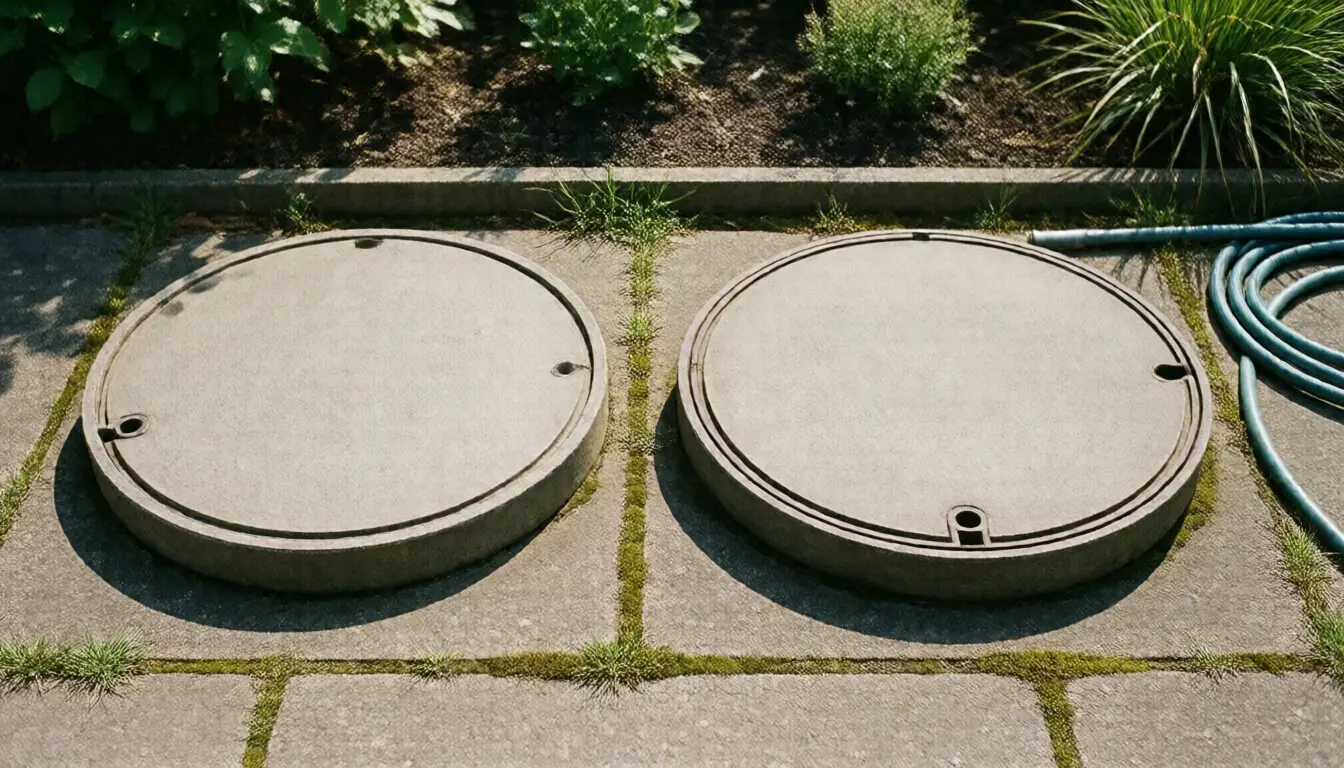
Why a soakaway eventually stops working
A soakaway does not fail because it is dirty. It fails because the soil around it saturates.
As water seeps through the soil over years, the walls of the soil cavity around the chamber gradually acquire a thin biological layer formed by micro-organisms and organic matter arriving with the water.
That layer steadily reduces how fast the soil can absorb, and at some point water cannot leave as fast as it arrives.
The signs that day is coming, in the order they usually appear:
- The toilet flushes more slowly with nothing blocking the pan.
- A smell around the covers, particularly after heavy rain.
- Permanently damp ground over the soakaway, or grass noticeably greener there than anywhere else.
- Water rising to the cover, which is the final sign and means the system is full.
What people do at that point is call a tanker to pump it out, which genuinely helps and helps only temporarily, because removing sludge from the cesspool does nothing about saturated soil around the soakaway.
If the symptoms return within a few months of pumping, the problem is the soakaway rather than the cesspool.
The real remedies are three: build an additional soakaway in a fresh position, change to a treatment tank whose effluent is good enough to discharge to the public drain, or connect to a local sewer where one exists.
The second is what most urban houses choose, and why prefabricated tanks became standard on new builds.
Prefabricated tanks come in three kinds, and the prices differ for a reason
The phrase prefabricated treatment tank covers very different products, and buyers frequently do not know which one they are getting.
First, a prefabricated septic tank. This is a cesspool made as a plastic or fibreglass tank rather than built from concrete rings on site.
The advantages are that it does not leak and installs quickly, but its function is still only settling, exactly as before.
Which means a soakaway or another discharge route is still needed. If somebody says a prefabricated tank means no soakaway, ask which of the three kinds it is.
Second, an anaerobic treatment tank. This holds both a settling section and a section packed with media for micro-organisms that live without oxygen to grow on.
Water leaving the settling section flows through that media, where the organisms break down the remaining organic matter, so the effluent is considerably better.
This is what most houses use today, because it needs no electricity, is easy to maintain, and produces effluent good enough for a single house.
Third, an aerated treatment tank. A blower forces air into the tank to sustain organisms that need oxygen, which break organic matter down faster and produce noticeably clearer effluent.
The trade is a permanent electricity supply, equipment that needs servicing and parts, and the fact that a long power cut or an unnoticed blower failure kills the organisms and the system then takes time to recover.
This suits buildings with many occupants or situations demanding particularly high effluent quality, more than an ordinary detached house.
What to ask the supplier plainly is which of the three this tank is, whether a soakaway is still required after it, and where the effluent will discharge.
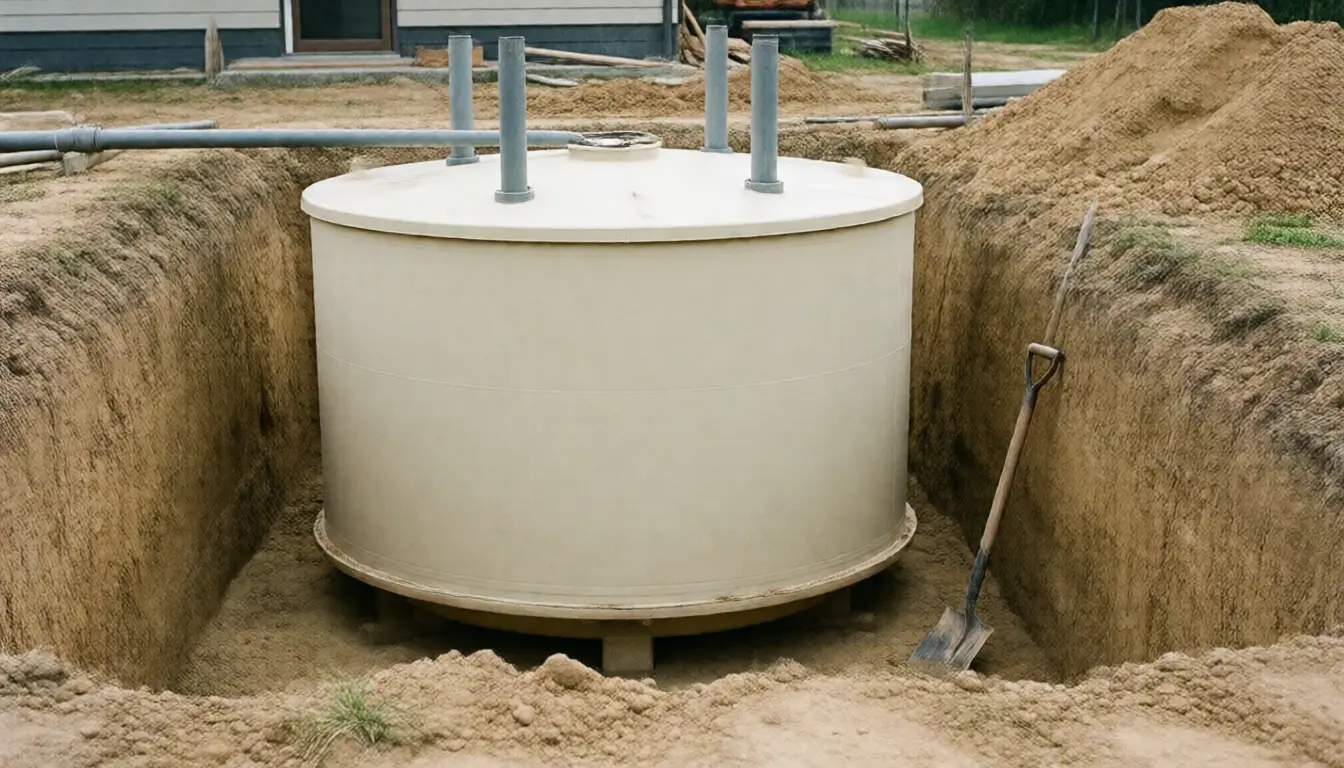
Sizing the tank
Tank size follows the volume of wastewater the house produces per day, which relates to how many people actually live there rather than to the number of bedrooms.
The most direct method is your own water bill, because nearly all the water used becomes wastewater.
Multiply the units on the bill by 1,000, divide by the days in the month for litres per day, and compare that with what the manufacturer states the model handles.
The caution that matters more than the number is that an undersized tank does not merely overflow. It leaves water in the tank for too short a time for the process to work.
Treatment takes time, and water passing through too quickly leaves undigested, which is invisible from outside. The tank looks entirely normal.
Allow for the future too. If more people will live there, or another bathroom is planned, replacing the tank later means digging everything out again.
One more thing people forget is periods when guests stay for several days, which spikes the load. A tank sized exactly to today struggles in exactly those weeks.
The vent pipe, which makes a house smell while the tank is perfectly fine
A treatment system produces gas continuously, because breaking down organic matter releases gas.
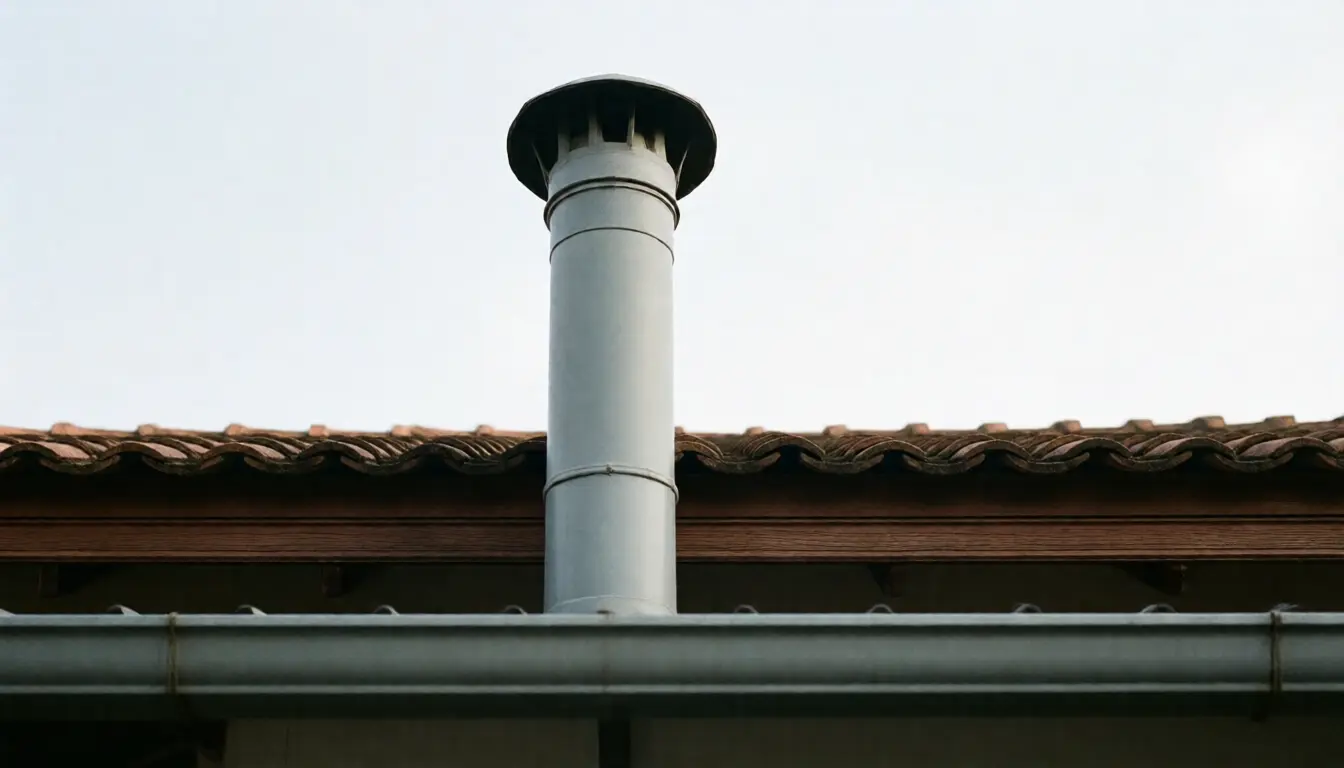
That gas needs a way out, and the correct way out is a vent pipe rising above the roof.
With no vent, or a blocked one, the gas finds another route, and that other route is the floor drains in your bathroom.
This is why some houses smell every time it rains or whenever a lot of water is used, while the tank is working exactly as it should.
The vent does a second job people rarely know about: it lets air in to replace water leaving the pipes.
Drainage with no air supply creates a slight vacuum when water runs fast, which pulls the water out of the traps under other fittings, and the smell then arrives through those.
Check three things: that a vent exists, that its outlet is above the roof and away from windows, and that nothing is blocking the top, such as a nest or leaves.
Drain smells in a bathroom in detail, including dried traps and extractor fans that pull the smell up themselves, are in bathroom ventilation and the drain smell that comes back.
What must never go down there, and why systems die while still new
A treatment system is alive. The micro-organisms are what does the work, not the tank.
So whatever kills the organisms stops the system, however new the tank is.
- Disinfectants and strong toilet cleaners poured in quantity, chlorine-heavy ones especially.
- Kitchen grease, which sets into a hard layer and obstructs both flow and digestion.
- Wet wipes and sanitary products, which do not break down and accumulate until they must be pumped out.
- Engine oil and chemicals of any kind.
- Large volumes of food waste from a sink grinder.
The first is what people do most often without realising. Cleaning the bathroom with concentrated product every day, in a house on a treatment tank, is pouring disinfectant into a tank that depends on bacteria.
That does not mean never using cleaning products. It means not emptying the bottle in, and not using large amounts on consecutive days.
For kitchen grease, the correct answer is trapping it before it reaches the tank, which is a grease trap's job rather than the treatment tank's.
On the sachets of bacterial starter sold for these systems, they genuinely help a system recover after something has damaged it, but they are not something a healthy system needs regularly.
A balanced system already receives plenty of organisms in what arrives every day. Needing to add starter often is a sign that something is killing them, and that cause is what to find instead.
Pumping out and routine care
Whatever the system, sludge accumulates and one day has to come out.
The interval depends on tank size and the number of users. Follow the manufacturer's manual, and write down the date every time it is pumped.
Worth doing is opening the cover once a year even when pumping is not yet due, because seeing how thick the sludge layer is beats guessing.
The caution during pumping is not to empty the tank completely.
Two reasons. First, leaving some water and sludge lets the organisms re-establish quickly. Second and more important, an empty tank in ground with a high water table can float up out of its hole.
This is the same problem as an underground water tank, explained in above-ground or underground water tanks, and why correct installation includes anti-flotation restraint.
Tell the tanker crew plainly to leave the level the manual specifies. Do not let them pump it dry on the theory that emptier is better.
And refill with clean water immediately afterwards to the working level, rather than leaving it empty for household flow to fill slowly.
Installation, where mistakes are hardest to fix
A treatment tank lives underground, so installation mistakes cost far more than mistakes elsewhere in a house.
Levels. The tank must sit where household flow reaches it by gravity, and where its outflow continues to the discharge point by gravity too.
A tank buried too deep for the outflow to run is a tank that needs a pump, which is another machine that fails and an electricity bill you should not be paying.
The bed. The tank must sit on compacted sand or concrete, not on rough ground with stones in it, because the weight of a full tank presses down on those few contact points and distorts the shell.
Backfilling. Fill the tank with water as the soil is backfilled around it, so the pressure inside and outside stay balanced. Backfilling around an empty tank can collapse it inwards.
Anti-flotation restraint. Where the water table is high, an anti-flotation slab and straps are needed, which is something to ask the contractor about directly.
Position. Do not put it under a driveway unless the tank is rated for traffic, and keep the covers at a level you can genuinely reach, rather than paved over or hidden under plant pots.
Keep it as far from any well or drinking water tank as the plot allows, particularly where there is a borehole.
Photograph the tank position, the inlet and outlet runs, and the distances from the house wall before backfilling, because in ten years when somebody needs to find the cover, that set of photographs is the only thing that helps.
The law, and what to check before buying a resale house
Legally, buildings must have a wastewater treatment system as required under building control law, which is checked at the permit stage.
For effluent quality there is the ministerial notification on standards controlling wastewater discharge from certain types and sizes of building, the latest edition being of 2024.
Read the words certain types and sizes carefully, because an ordinary single detached house usually falls outside the controlled categories in that notification.
That does not mean no treatment system is required. It means no measured effluent standard is imposed. The duty to have a system remains.
Local authorities may add their own requirements, so ask the district or municipal office before designing the system.
For anybody buying a resale house, four things to check:
- Which system it is: cesspool and soakaway, or a prefabricated tank, and if a tank, which of the three kinds.
- Where the covers are and whether they open. A house where nobody can find the cover is a house whose system has not been maintained for years.
- When it was last pumped. If the owner cannot say at all, budget for pumping and inspection from the outset.
- Where the effluent goes: a soakaway, the public drain, or nobody knows.
The last is the hardest to check and the most important, because a house discharging untreated wastewater into a drain is a house with a problem waiting.
Go and look on a dry day while somebody is running water inside, and see what emerges where.
Frequently asked questions
How does a cesspool differ from a treatment tank?
A cesspool only settles solids out. The overflow still needs a soakaway and the soil as final treatment. A prefabricated tank with treatment media holds both stages in one unit, so its effluent is far better.
With a prefabricated tank, do I still need a soakaway?
It depends which kind. A prefabricated septic tank, which only settles, still needs a discharge route. A tank with treatment media usually produces effluent good enough for the public drain. Ask the supplier plainly.
Why does a soakaway block up?
Not from dirt, but because the surrounding soil acquires a biological layer that slowly reduces how fast it absorbs. Pumping the cesspool therefore helps only temporarily. If symptoms return within months, the soakaway is the problem.
How do I size the tank?
From actual water use: multiply the units on the bill by 1,000, divide by the days, and compare with the manufacturer's rating. An undersized tank leaves water inside for too short a time for treatment to work.
Why does the house smell when the tank is brand new?
Usually the vent. The system produces gas continuously and needs a pipe discharging above the roof. Without one, or with a blocked one, the gas comes out through the bathroom floor drains instead.
Do I need to add bacterial starter regularly?
Not in a healthy system, because organisms arrive with the daily flow. Needing it often suggests something is killing them, such as strong bathroom cleaner or kitchen grease.
Should the tank be pumped completely empty?
No. Leave the level the manual specifies, both so the organisms re-establish quickly and because an empty tank in high groundwater can float out of its hole.
In short
- A cesspool only settles solids. In the traditional system the soil around the soakaway does the real treatment.
- Prefabricated tanks come in three kinds, and only the one with treatment media does both stages.
- Soakaways fail because the soil saturates, so pumping the cesspool is a temporary fix.
- Size from your actual water bill and allow for more occupants later.
- A vent above the roof is what stops the gas coming out through your bathroom drains.
- The bacteria do the work. Strong disinfectant and kitchen grease are what kill them.
- Never pump the tank dry, because an empty tank in high groundwater can float.
- Fill with water while backfilling, and photograph the position and pipe runs first.
- Before buying a resale house, ask which system, when it was last pumped, and where the effluent goes.