
One contractor says class 8.5 is enough, the other insists on 13.5. Who is right?
This comes up constantly when comparing quotations, and the answer is not that one of them is trying it on.
The number printed on blue PVC pipe is its pressure class, given in bar. Class 5 takes 5 bar, class 8.5 takes 8.5 bar, and class 13.5 takes 13.5 bar.
Pipes of the same outside diameter in all three classes look identical. What differs is the wall thickness, which means a higher class has a slightly smaller bore.
So the answer depends on the pressure your pump produces and on where in the system that particular run sits.
The main run taking full pump pressure and a short branch at the far end do not have to be the same class.
But across one house, the price difference between class 8.5 and class 13.5 is small, while the difference in service life and peace of mind is not.
This article does not stop at choosing a material, because in reality what makes a house's plumbing fail is rarely the wrong material. It is pipe size, pipe support, and fittings, three subjects almost nobody discusses before the work starts.
Reading the printing on the pipe
The Thai standard governing rigid PVC pipe is TIS 17, of which the long-serving edition is TIS 17-2532 and the revised edition is TIS 17-2561.
Under that standard, every length of drinking water pipe must carry markings printed clearly on it: the words for drinking water, the maker's name, the size, the pressure class, the length, the year of manufacture, and the registered trade mark.
Those markings are something you can check yourself in ten seconds, knowing nothing about pipe.
If the pipe stacked outside your house carries no markings at all, or only a brand name with no class and no year, that is a question to ask before anybody starts cutting.
The year is worth looking at too. Plastic pipe stored outdoors in a yard for several years is not the same as new pipe, particularly where it sat in the sun the whole time.
And photograph the markings before the contractor cuts into the lengths, because once the pipe is buried in a wall nobody can ever tell what class it was.
PVC, the pipe in almost every Thai house
PVC is rigid, cheap, easy to cut, and joined with solvent cement that needs no special tools, which is why it has dominated Thai houses for decades.
In practice the colours divide the work clearly. Blue is pressurised supply pipe, grey is waste pipe, and yellow is electrical conduit.
A very common mistake in cheap extension work is running grey pipe as a supply line, because it costs less and looks similar enough that most people cannot tell.
Waste pipe is not designed to hold pump pressure. It lasts a while and then splits at a fitting on a day when nobody is home.
PVC's biggest limitation is heat. It was not designed for hot water, and as temperature rises the material softens and its pressure capability falls.
Which means the hot line from a water heater or a heat pump to the outlets should not be blue PVC, however often you see it done.
The second limitation is sunlight. PVC left in direct sun for years turns brittle and cracks from a light knock, so any run outside the house should be painted or sleeved, a small job that adds a decade to the pipe.
On jointing, solvent cement is not glue. It dissolves the surface of both parts so they fuse into one piece, so it must be applied all round the pipe end and inside the fitting, pushed fully home, and turned slightly so it spreads.
Quantity matters too. Too little means a joint that never truly fused, and too much means cement running inside the pipe and setting there as a lump that obstructs flow permanently.
And it must cure for the time the manufacturer states before water is let in. Rushing that is the leading cause of leaking joints in freshly completed work.
PPR, the hot water pipe joined with heat rather than cement
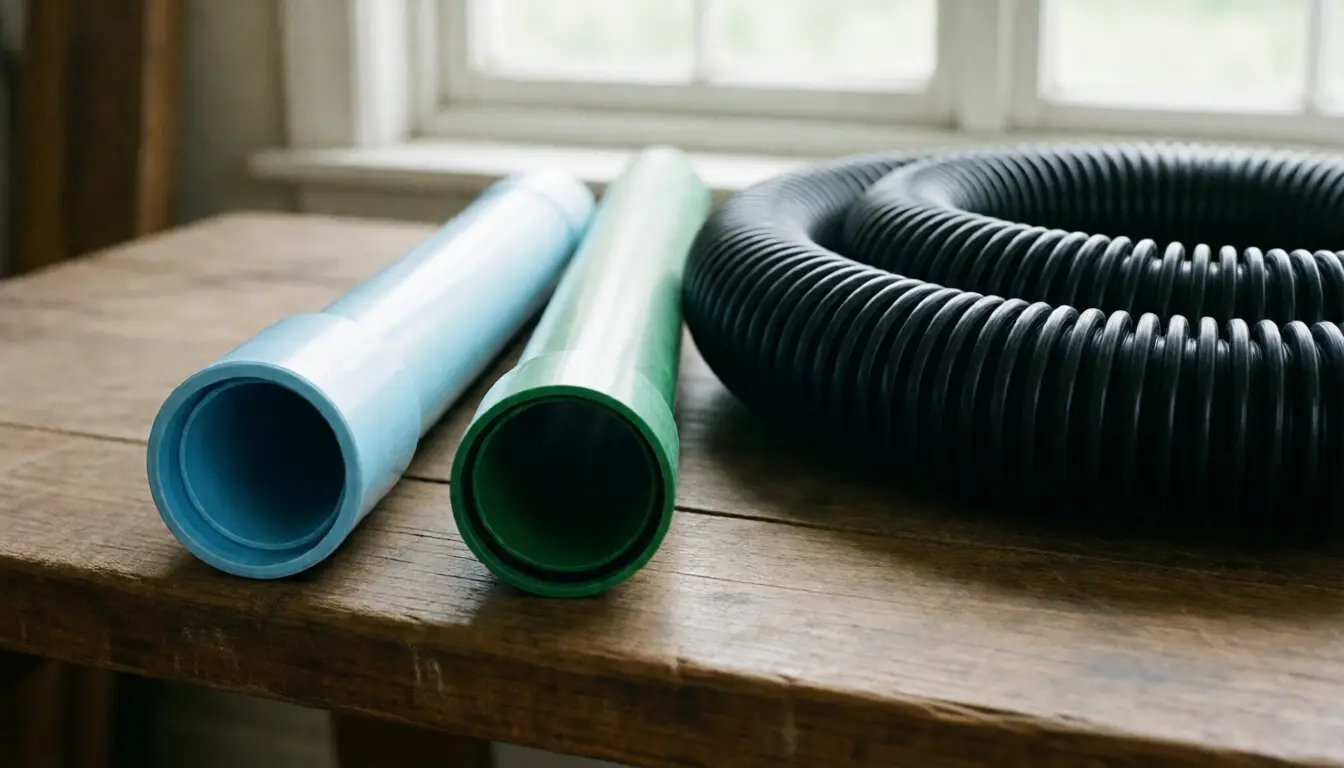
PPR is the green pipe seen in hot water work and in newer buildings.
The important difference is not the pipe itself but how it is joined.
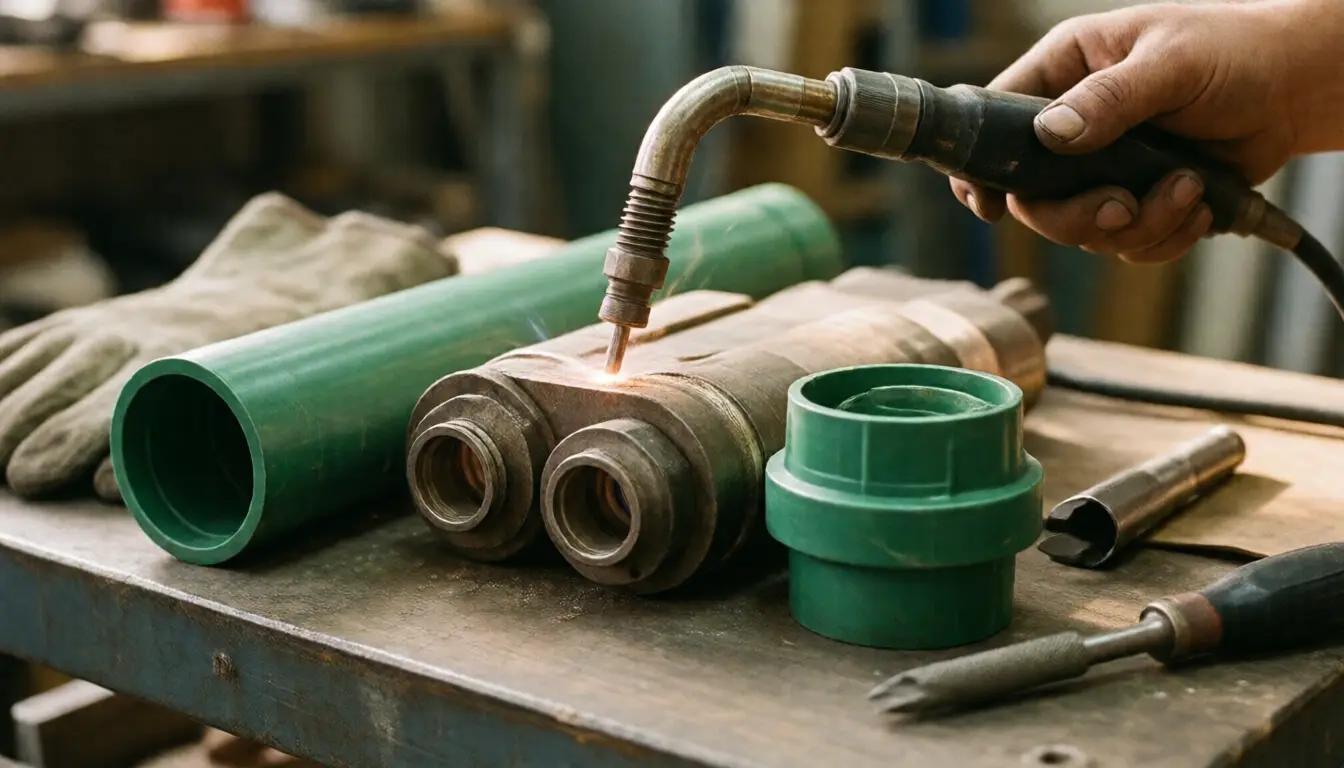
PPR is heat fused: the pipe end and the fitting are held against a heated tool until both surfaces melt slightly, then pushed together and held still until they cool.
The joint becomes one piece with the pipe, with no layer of another material in between, which is the strongest joint of any plastic pipe used in a house.
The advantages are hot water capability to its stated class, good pressure performance, and no risk of the joint failures that solvent-cemented pipe can suffer.
The disadvantages are needing the welding tool, needing somebody who can use it, and having to cut out and redo a joint that goes wrong, unlike PVC which any general contractor can handle.
Two mistakes are common when fusing PPR. The first is heating too long, so the material flows inward and partly blocks the bore, which is completely invisible from the outside.
The second is twisting while pushing home, which tears the melting material apart. PPR is pushed straight in and held. It is not turned like PVC.
One more thing to know is that PPR expands with heat more than PVC does, so a long straight hot run needs room to move rather than being clamped rigidly every metre.
Clamp it solidly along its whole length and the expansion force goes into the fittings and the fixings, and over time the pipe bows or the joints fatigue.
PE, the pipe for buried runs and long distances
PE is the black plastic pipe that arrives in coils of a hundred metres, and that single property is what wins it certain jobs outright.
Because it coils, it runs a long way with almost no joints, and joints are always where leaks happen.
Its best uses are the main from the meter to the house where it must be buried over a distance, the run from a borehole, and garden irrigation that has to wind around things.
It is also flexible, so ground that settles or shifts slightly does not crack it the way it cracks rigid pipe, which matters a great deal on the soft ground of Bangkok and the provinces around it.
Its black colour comes from carbon added to the material, which makes it far more sun-resistant than PVC.
The thing to watch is jointing. PE joins either with compression fittings or by heat fusion, and the latter is stronger and belongs in buried work meant to last.
If a compression fitting goes into a buried position with paving poured over it, assume that one day the paving will have to come up to reach it.
The better approach is planning so every joint sits inside an accessible chamber with a lid, rather than being buried under the parking area.
Pipe size matters more than pipe type
This gets discussed least and causes weak water most.
People assume that halving the bore halves the flow, which is not true at all. The flow drops much further than that.
The reason is that friction between the water and the pipe wall rises faster than the cross-sectional area falls. The narrower the bore, the more pressure the water loses to friction in every metre it travels.
In practice, an undersized main leaves the whole house weak while the pump is working perfectly and nothing is blocked.
In an ordinary house, the main running from the pump along the building is larger than the branches feeding individual outlets, which is a principle worth asking the contractor to explain for your layout.
The symptom of an undersized main is that one outlet alone is acceptable, but the moment somebody opens another the first one loses half its flow.
The symptom of an undersized branch is that one outlet is weak all the time, whether or not anybody else is using water.
Another thing that quietly consumes pressure is the number of elbows. A pipe that winds around ten bends to avoid columns costs more pressure than a longer straight route with two.
So when looking at a drawing, look at how direct the route is, not only at what the pipe is made of.
Pipe support, something you can check with your own eyes
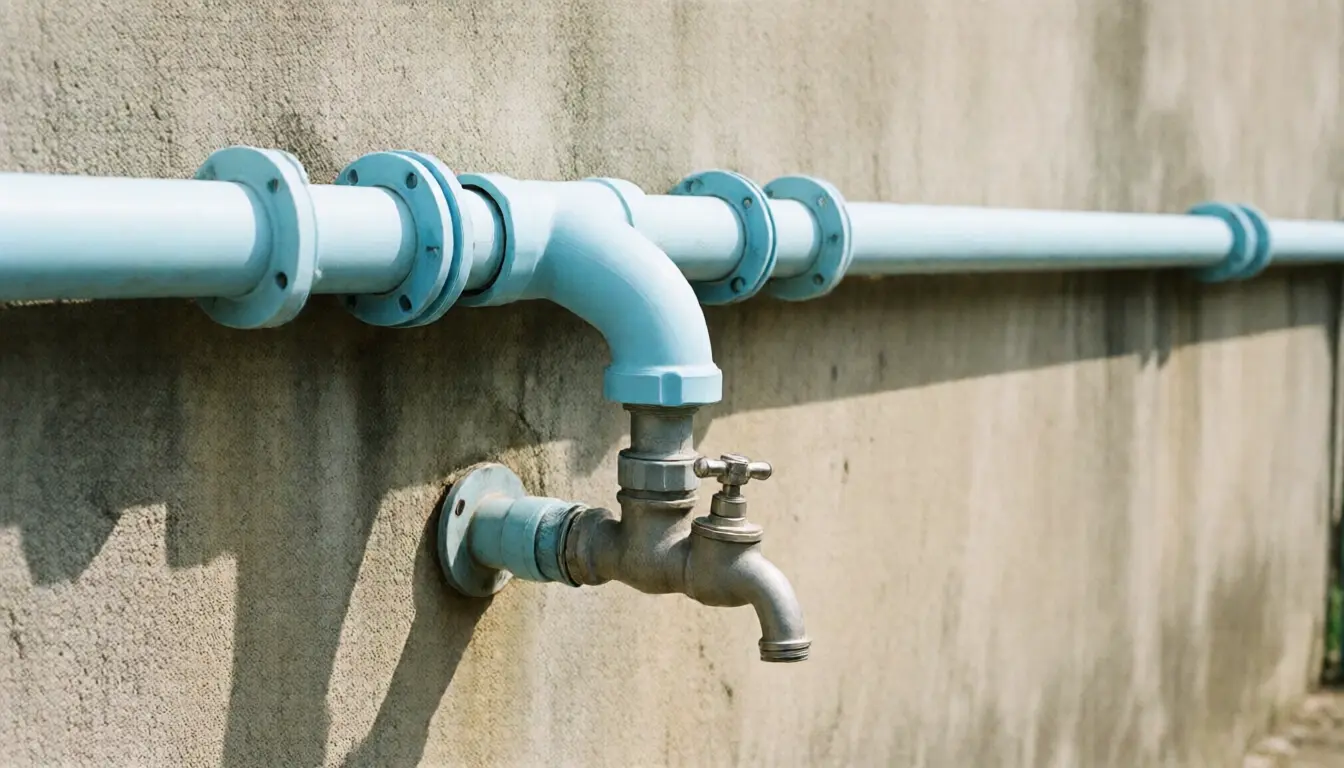
Plastic pipe is not rigid like steel. It sags under the weight of the water inside it and with the heat of the air around it.
A horizontal run clipped too far apart gradually bellies downwards, which besides looking untidy creates low points where sediment settles and high points where air collects.
Correct spacing depends on the pipe size and material. Smaller pipe needs closer support, and hot pipe needs closer support than cold because it softens.
Ask the contractor what spacing they use and where it comes from. The good answer cites the pipe manufacturer's manual rather than habit.
What you can check yourself is walking along any exposed run in the house or above the ceiling. Any section visibly sagging is a section clipped too far apart.
The type of fixing matters too. A run clamped rigidly along its whole length accumulates stress from thermal expansion, hot lines especially.
The right approach is a few solid anchors to fix the position and the rest as guides that let the pipe slide lengthways.
Fittings leak, pipes rarely do
A pipe splitting in the middle of a run is uncommon. Almost everything that actually leaks is a fitting.
The weakest point in any plastic system is where plastic meets metal: threaded connections into taps, valves or the meter.
An all-plastic thread tightened too hard cracks, and usually not immediately. It cracks months later after enough hot and cold cycles.
What to specify up front is fittings with a brass thread moulded into the plastic, rather than bare plastic threads wherever a metal connection is made.
The difference is a few tens of baht per joint, and it is exactly the joint whose failure inside a wall means demolition to repair.
On thread tape, wrap it in the same direction the fitting will turn, otherwise it unwinds as you tighten, and wrap enough rather than so much that the bulk itself splits the plastic thread.
Joining different pipe materials is possible but needs fittings designed for the transition, not improvisation to make two things fit together.
And where a house has both old steel pipe and copper, connecting the two directly causes corrosion at the joint, which is a property of two dissimilar metals rather than a failure of workmanship. That connection needs a fitting that separates them.
Old pipe still found in Thai houses
Houses built before PVC took over were usually run in galvanised steel, a good material on the day it was installed and a problem twenty years later.
Steel grows rust and scale on its inside wall until the opening water passes through keeps shrinking, which explains why water in an older house weakens gradually with nothing having happened.
Another sign is faintly brown water on the first draw of the morning, which is rust released while the water stood still overnight.
Some houses used copper, which lasts far better and is often still fine. Copper's problems are not the pipe but the soldered joints and the places it meets other metals.
If that is your house and a renovation is coming, this is the only moment when repiping the whole system costs a sensible amount, because the walls are open anyway.
Replacing one section each time something leaks costs more over the years and disrupts life more.
If a full replacement is not affordable, do it in stages by priority: the main and anything buried in walls first, leaving exposed and easily reached runs for later.
Pressure testing before the walls close, the step everybody skips
This is what separates work done properly from work done to be finished.
After the pipework is in and before anything is plastered over or concreted, the system should be pressurised above its working pressure and left while somebody watches whether the gauge drops.
A gauge that creeps down means there is a leak somewhere, and this is the only moment it can be found without breaking anything.
Ask the contractor to do it in front of you, and photograph the gauge at the start and at the end with the times.
A contractor doing good work is happy to, because it protects them too on the day somebody blames their work for a leak.
And before the walls close, photograph every pipe run with a tape measure laid across for scale, because on the day somebody drills to hang something, that set of photographs is the only thing keeping the bit away from a pipe.
What the quotation has to state
- Pipe material and pressure class for each part, not one line reading plumbing works.
- The size of the main and of the branches, as numbers.
- The type of fitting wherever plastic meets metal, brass-insert or bare plastic thread.
- The support spacing, and the manufacturer's manual it comes from.
- The pressure test: at what pressure, for how long, and before the walls close.
- What the hot lines are made of, and the answer should not be PVC.
Those six items add a few lines to a quotation, and they turn documents that cannot be compared into documents that can.
When two contractors then quote very different figures, you know why rather than guessing.
If the house has weak water while the pump is fine, work through the causes in weak water pressure upstairs before deciding to tear out pipework.
Choosing a pump to suit the pipework you already have is in why a household pump short cycles and how to size one, and the storage tank upstream of it is in above-ground or underground water tanks.
In short
- Classes 5, 8.5 and 13.5 on blue pipe are the pressure it takes, in bar.
- Under TIS 17 drinking water pipe must carry the maker, size, class and year printed on it. Photograph it before the contractor cuts.
- PVC is not for hot water and turns brittle after years in the sun.
- Never run grey waste pipe as a pressurised supply line.
- PPR is the hot water pipe, fused with heat, pushed straight without twisting, and allowed room to expand.
- PE is the pipe for buried and long runs. Always leave its joints inside an accessible chamber.
- Pipe size and the number of elbows govern pressure more than the material does.
- Leaks happen at fittings, especially where plastic meets metal. Specify brass inserts.
- Have the pressure test done in front of you before the walls close, and photograph every run.